Eulerian Motion Guidance: Robust Image Animation via Bidirectional Geometric Consistency
Pith reviewed 2026-06-30 23:23 UTC · model grok-4.3
The pith
Adjacent-frame Eulerian motion fields plus bidirectional cycle checks let diffusion models train in parallel while masking occlusions to cut animation artifacts.
A machine-rendered reading of the paper's core claim, the machinery that carries it, and where it could break.
Core claim
The paper claims that Eulerian motion fields computed between adjacent frames supply local supervision signals that support parallelized training and keep error bounds tight throughout generation, while the Bidirectional Geometric Consistency mechanism uses a forward-backward cycle check to identify and mask occluded regions, thereby preventing the model from optimizing incorrect warping objectives.
What carries the argument
Bidirectional Geometric Consistency mechanism, which performs a forward-backward cycle check on adjacent-frame Eulerian motion fields to mathematically detect and mask occluded regions.
If this is right
- Training becomes parallelizable across frames instead of sequential.
- Supervision error stays bounded at each short temporal hop.
- Occluded regions are explicitly masked so incorrect warping objectives are not learned.
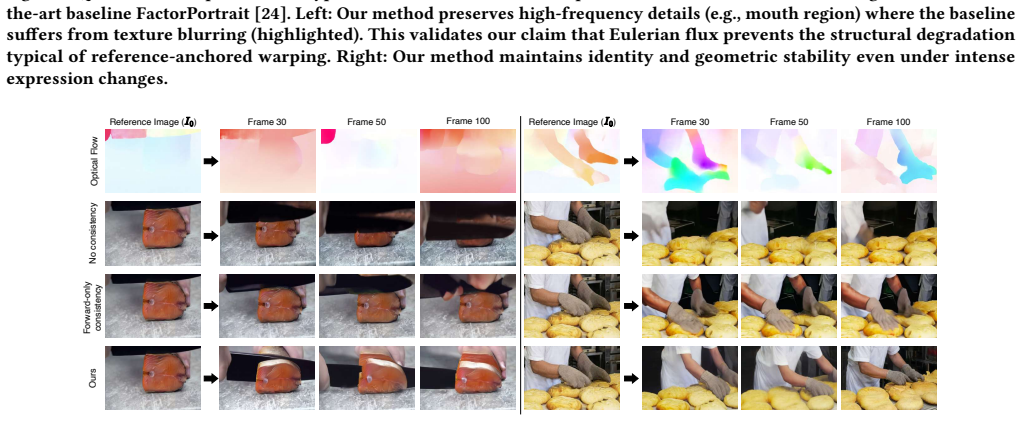
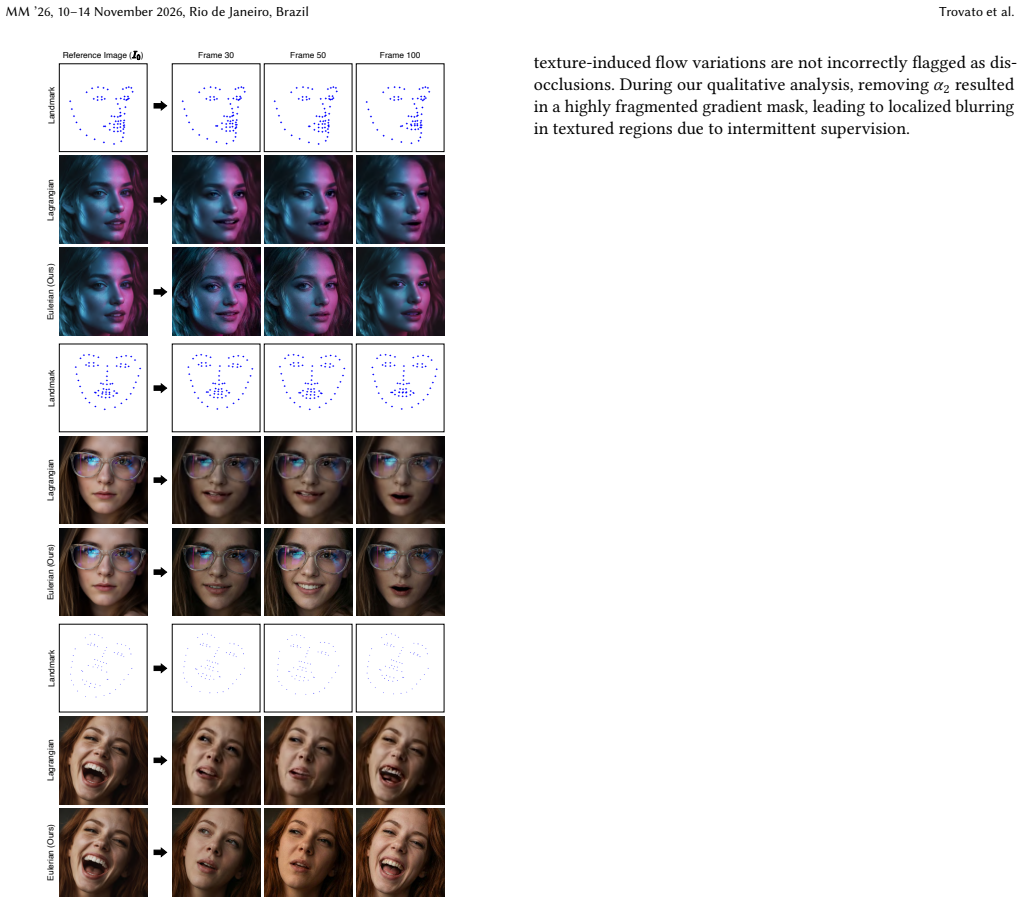
- Output animations exhibit preserved temporal coherence and fewer dynamic artifacts than reference-based baselines.
Where Pith is reading between the lines
- The same local supervision pattern could be chained across longer video lengths without the error accumulation typical of single-reference Lagrangian methods.
- The cycle-check masking step might transfer to other motion-conditioned generative tasks that currently suffer from occlusion-induced drift.
Load-bearing premise
The forward-backward cycle check reliably identifies occluded regions without introducing new errors or masking valid motion information.
What would settle it
Generate animations on test videos containing known large occlusions; if the cycle-masked regions do not align with actual occluded areas or if visible warping artifacts still appear inside the unmasked motion regions, the central claim is falsified.
Figures





read the original abstract
Recent advancements in image animation have utilized diffusion models to breathe life into static images. However, existing controllable frameworks typically rely on Lagrangian motion guidance, where optical flow is estimated relative to the initial frame. This paper revisits the same optical-flow primitive through a more local supervision design: we use adjacent-frame Eulerian motion fields to guide generation, where the motion signal always describes a short temporal hop. This shift enables parallelized training and provides bounded-error supervision throughout the generation process. To mitigate the drift artifacts common in adjacent frame generation, we introduce a Bidirectional Geometric Consistency mechanism, which computes a forward-backward cycle check to mathematically identify and mask occluded regions, preventing the model from learning incorrect warping objectives. Extensive experiments demonstrate that our approach accelerates training, preserves temporal coherence, and reduces dynamic artifacts compared to reference-based baselines.
Editorial analysis
A structured set of objections, weighed in public.
Referee Report
Summary. The manuscript proposes Eulerian Motion Guidance for image animation with diffusion models. It replaces Lagrangian motion guidance (optical flow from the initial frame) with adjacent-frame Eulerian motion fields for local, short-hop supervision. This design is claimed to enable parallelized training and bounded-error supervision. A Bidirectional Geometric Consistency mechanism is introduced that performs a forward-backward cycle check to mathematically identify and mask occluded regions, thereby preventing the model from learning incorrect warping objectives. The paper asserts that the approach accelerates training, preserves temporal coherence, and reduces dynamic artifacts relative to reference-based baselines.
Significance. If validated, the shift to adjacent-frame Eulerian fields could meaningfully improve training efficiency via parallelization while supplying more stable supervision signals than long-range Lagrangian guidance. The Bidirectional Geometric Consistency idea addresses a known source of drift in adjacent-frame generation and, if the cycle check reliably isolates occlusions, would constitute a useful technical contribution to motion-guided animation. The emphasis on bounded-error supervision is a clear conceptual strength.
major comments (2)
- [Bidirectional Geometric Consistency] Bidirectional Geometric Consistency section: The central claim that the forward-backward cycle check 'mathematically identifies and masks occluded regions' to prevent incorrect warping objectives rests on the assumption that any cycle inconsistency is caused exclusively by occlusion. The manuscript provides no analysis or experiments showing that estimation errors in the Eulerian motion fields (e.g., aperture problems, lighting variation) do not produce false-positive masks that remove valid adjacent-frame motion signals, which would undermine the bounded-error supervision guarantee.
- [Experiments] Experimental evaluation: The abstract states that 'extensive experiments demonstrate' accelerated training, preserved coherence, and reduced artifacts, yet the provided manuscript text supplies no quantitative metrics, ablation tables, or implementation details (e.g., datasets, baselines, or error measures). This absence makes it impossible to verify whether the proposed mechanisms actually deliver the claimed benefits.
Simulated Author's Rebuttal
We thank the referee for the thoughtful and constructive comments. We address each major point below and outline the revisions we will make.
read point-by-point responses
-
Referee: [Bidirectional Geometric Consistency] Bidirectional Geometric Consistency section: The central claim that the forward-backward cycle check 'mathematically identifies and masks occluded regions' to prevent incorrect warping objectives rests on the assumption that any cycle inconsistency is caused exclusively by occlusion. The manuscript provides no analysis or experiments showing that estimation errors in the Eulerian motion fields (e.g., aperture problems, lighting variation) do not produce false-positive masks that remove valid adjacent-frame motion signals, which would undermine the bounded-error supervision guarantee.
Authors: We appreciate the referee drawing attention to this subtlety. The forward-backward cycle is derived from the geometric identity that, for visible regions, the composition of adjacent-frame Eulerian fields should recover the original coordinates up to discretization error. The mask is therefore a conservative filter that discards any location exhibiting inconsistency, regardless of cause. While we agree that motion-estimation artifacts (aperture problems, illumination changes) can trigger false positives, such locations are precisely those where the supervision signal is unreliable; discarding them still supports the bounded-error claim for the retained regions. Nevertheless, we acknowledge that the manuscript lacks explicit robustness analysis and will add a dedicated paragraph plus a small diagnostic experiment quantifying the fraction of masks attributable to estimation error versus true occlusion. revision: yes
-
Referee: [Experiments] Experimental evaluation: The abstract states that 'extensive experiments demonstrate' accelerated training, preserved coherence, and reduced artifacts, yet the provided manuscript text supplies no quantitative metrics, ablation tables, or implementation details (e.g., datasets, baselines, or error measures). This absence makes it impossible to verify whether the proposed mechanisms actually deliver the claimed benefits.
Authors: We apologize for the incomplete presentation in the version the referee received. The complete manuscript contains quantitative results (FID, FVD, temporal coherence scores), ablation tables isolating the Eulerian supervision and bidirectional mask, implementation details (datasets, training schedule, baselines), and error measures. To eliminate any ambiguity, we will reorganize the experimental section so that all metrics, tables, and reproducibility information appear in the main body with clear references from the abstract and introduction. revision: yes
Circularity Check
No significant circularity in derivation chain
full rationale
The paper describes a methodological shift to adjacent-frame Eulerian motion fields for parallel training and bounded-error supervision, plus a Bidirectional Geometric Consistency mechanism based on forward-backward cycle checks for occlusion masking. No equations, fitted parameters, or self-citations are presented that reduce any claimed result (e.g., accelerated training or reduced artifacts) to quantities defined by the method's own inputs or prior author work. The central claims rest on the design choices and empirical validation rather than self-referential definitions or renamings, making the derivation self-contained against external benchmarks.
Axiom & Free-Parameter Ledger
Reference graph
Works this paper leans on
-
[1]
Omer Bar-Tal, Hila Chefer, Omer Tov, Charles Herrmann, Roni Paiss, Shiran Zada, Ariel Ephrat, Junhwa Hur, Guanghui Liu, Amit Raj, et al. 2024. Lumiere: A space-time diffusion model for video generation. InSIGGRAPH Asia 2024 Conference Papers. 1–11
2024
-
[2]
Andreas Blattmann, Tim Dockhorn, Sumith Kulal, Daniel Mendelevitch, Maciej Kilian, Dominik Lorenz, Yam Levi, Zion English, Vikram Voleti, Adam Letts, et al. 2023. Stable video diffusion: Scaling latent video diffusion models to large datasets.arXiv preprint arXiv:2311.15127(2023)
work page internal anchor Pith review Pith/arXiv arXiv 2023
-
[3]
Ryan Burgert, Yuancheng Xu, Wenqi Xian, Oliver Pilarski, Pascal Clausen, Ming- ming He, Li Ma, Yitong Deng, Lingxiao Li, Mohsen Mousavi, et al. 2025. Go-with- the-flow: Motion-controllable video diffusion models using real-time warped noise. InProceedings of the Computer Vision and Pattern Recognition Conference. 13–23
2025
-
[4]
Zhiyuan Chen, Jiajiong Cao, Zhiquan Chen, Yuming Li, and Chenguang Ma. 2025. Echomimic: Lifelike audio-driven portrait animations through editable landmark conditions. InProceedings of the AAAI Conference on Artificial Intelligence, Vol. 39. 2403–2410
2025
-
[5]
Jiahao Cui, Hui Li, Yun Zhan, Hanlin Shang, Kaihui Cheng, Yuqi Ma, Shan Mu, Hang Zhou, Jingdong Wang, and Siyu Zhu. 2025. Hallo3: Highly dynamic and realistic portrait image animation with video diffusion transformer. InProceedings of the Computer Vision and Pattern Recognition Conference. 21086–21095
2025
-
[6]
Jiankang Deng, Jia Guo, Niannan Xue, and Stefanos Zafeiriou. 2019. Arcface: Additive angular margin loss for deep face recognition. InProceedings of the IEEE/CVF conference on computer vision and pattern recognition. 4690–4699
2019
-
[7]
Wanquan Feng, Tianhao Qi, Jiawei Liu, Mingzhen Sun, Pengqi Tu, Tianxiang Ma, Fei Dai, Songtao Zhao, Siyu Zhou, and Qian He. 2025. I2vcontrol: Disentan- gled and unified video motion synthesis control. InProceedings of the IEEE/CVF International Conference on Computer Vision. 14051–14060
2025
-
[8]
Craig G Fraser. 2005. Leonhard Euler, book on the calculus of variations (1744). InLandmark Writings in Western Mathematics 1640-1940. Elsevier, 168–180
2005
- [9]
-
[10]
Sicheng Gao, Yutang Feng, Linlin Yang, Xuhui Liu, Zichen Zhu, David S Do- ermann, and Baochang Zhang. 2022. MagFormer: Hybrid Video Motion Mag- nification Transformer from Eulerian and Lagrangian Perspectives.. InBMVC. 444
2022
-
[11]
Martin Heusel, Hubert Ramsauer, Thomas Unterthiner, Bernhard Nessler, and Sepp Hochreiter. 2017. Gans trained by a two time-scale update rule converge to a local nash equilibrium.Advances in neural information processing systems30 (2017)
2017
-
[12]
Li Hu. 2024. Animate anyone: Consistent and controllable image-to-video syn- thesis for character animation. InProceedings of the IEEE/CVF Conference on Computer Vision and Pattern Recognition. 8153–8163
2024
-
[13]
Longbin Ji, Lei Zhong, Pengfei Wei, and Changjian Li. 2025. PoseTraj: Pose- Aware Trajectory Control in Video Diffusion. InProceedings of the Computer Vision and Pattern Recognition Conference. 22776–22785
2025
-
[14]
Hoiyeong Jin, Hyojin Jang, Jeongho Kim, Junha Hyung, Kinam Kim, Dongjin Kim, Huijin Choi, Hyeonji Kim, and Jaegul Choo. 2025. InsertAnywhere: Bridging 4D Scene Geometry and Diffusion Models for Realistic Video Object Insertion. arXiv preprint arXiv:2512.17504(2025)
work page internal anchor Pith review Pith/arXiv arXiv 2025
-
[15]
Wei-Sheng Lai, Jia-Bin Huang, Oliver Wang, Eli Shechtman, Ersin Yumer, and Ming-Hsuan Yang. 2018. Learning blind video temporal consistency. InProceed- ings of the European conference on computer vision (ECCV). 170–185
2018
-
[16]
Yaowei Li, Xintao Wang, Zhaoyang Zhang, Zhouxia Wang, Ziyang Yuan, Liang- bin Xie, Ying Shan, and Yuexian Zou. 2025. Image conductor: Precision control for interactive video synthesis. InProceedings of the AAAI Conference on Artificial Intelligence, Vol. 39. 5031–5038
2025
-
[17]
Jingyun Liang, Yuchen Fan, Kai Zhang, Radu Timofte, Luc Van Gool, and Rakesh Ranjan. 2024. Movideo: Motion-aware video generation with diffusion model. In European Conference on Computer Vision. Springer, 56–74
2024
-
[18]
Ilya Loshchilov and Frank Hutter. 2017. Decoupled weight decay regularization. arXiv preprint arXiv:1711.05101(2017)
work page internal anchor Pith review Pith/arXiv arXiv 2017
- [19]
- [20]
-
[21]
Niranjan D Narvekar and Lina J Karam. 2011. A no-reference image blur metric based on the cumulative probability of blur detection (CPBD).IEEE Transactions on Image Processing20, 9 (2011), 2678–2683
2011
-
[22]
Muyao Niu, Xiaodong Cun, Xintao Wang, Yong Zhang, Ying Shan, and Yinqiang Zheng. 2024. Mofa-video: Controllable image animation via generative motion field adaptions in frozen image-to-video diffusion model. InEuropean Conference on Computer Vision. Springer, 111–128
2024
-
[23]
Alec Radford, Jong Wook Kim, Chris Hallacy, Aditya Ramesh, Gabriel Goh, Sand- hini Agarwal, Girish Sastry, Amanda Askell, Pamela Mishkin, Jack Clark, et al
-
[24]
In International Conference on Machine Learning (ICML)
Learning transferable visual models from natural language supervision. In International Conference on Machine Learning (ICML). PMLR
-
[25]
Jiapeng Tang, Kai Li, Chengxiang Yin, Liuhao Ge, Fei Jiang, Jiu Xu, Matthias Nießner, Christian Häne, Timur Bagautdinov, Egor Zakharov, et al . 2025. Fac- torPortrait: Controllable Portrait Animation via Disentangled Expression, Pose, and Viewpoint.arXiv preprint arXiv:2512.11645(2025)
-
[26]
Zachary Teed and Jia Deng. 2020. Raft: Recurrent all-pairs field transforms for optical flow. InEuropean conference on computer vision. Springer, 402–419
2020
-
[27]
Carl Vondrick, Hamed Pirsiavash, and Antonio Torralba. 2016. Generating videos with scene dynamics.Advances in neural information processing systems 29 (2016)
2016
-
[28]
Team Wan, Ang Wang, Baole Ai, Bin Wen, Chaojie Mao, Chen-Wei Xie, Di Chen, Feiwu Yu, Haiming Zhao, Jianxiao Yang, et al. 2025. Wan: Open and advanced large-scale video generative models.arXiv preprint arXiv:2503.20314(2025)
work page internal anchor Pith review Pith/arXiv arXiv 2025
- [29]
-
[30]
Zhouxia Wang, Ziyang Yuan, Xintao Wang, Yaowei Li, Tianshui Chen, Menghan Xia, Ping Luo, and Ying Shan. 2024. Motionctrl: A unified and flexible motion controller for video generation. InACM SIGGRAPH 2024 Conference Papers. 1–11
2024
-
[31]
Thaddäus Wiedemer, Yuxuan Li, Paul Vicol, Shixiang Shane Gu, Nick Matarese, Kevin Swersky, Been Kim, Priyank Jaini, and Robert Geirhos. 2025. Video models are zero-shot learners and reasoners.arXiv preprint arXiv:2509.20328(2025)
work page internal anchor Pith review Pith/arXiv arXiv 2025
- [32]
-
[33]
Zhongcong Xu, Jianfeng Zhang, Jun Hao Liew, Hanshu Yan, Jia-Wei Liu, Chenxu Zhang, Jiashi Feng, and Mike Zheng Shou. 2024. Magicanimate: Temporally consistent human image animation using diffusion model. InProceedings of the IEEE/CVF Conference on Computer Vision and Pattern Recognition. 1481–1490
2024
- [34]
-
[35]
Fei Yin, Yong Zhang, Xiaodong Cun, Mingdeng Cao, Yanbo Fan, Xuan Wang, Qingyan Bai, Baoyuan Wu, Jue Wang, and Yujiu Yang. 2022. Styleheat: One- shot high-resolution editable talking face generation via pre-trained stylegan. In European conference on computer vision. Springer, 85–101
2022
-
[36]
Shengming Yin, Chenfei Wu, Jian Liang, Jie Shi, Houqiang Li, Gong Ming, and Nan Duan. 2023. Dragnuwa: Fine-grained control in video generation by inte- grating text, image, and trajectory.arXiv preprint arXiv:2308.08089(2023)
work page internal anchor Pith review Pith/arXiv arXiv 2023
- [37]
-
[38]
Zhongrui Yu, Martina Megaro-Boldini, Robert W Sumner, and Abdelaziz Djelouah. 2025. Unboxed: Geometrically and Temporally Consistent Video Outpainting. InProceedings of the Computer Vision and Pattern Recognition Con- ference. 7309–7319
2025
-
[39]
Richard Zhang, Phillip Isola, Alexei A Efros, Eli Shechtman, and Oliver Wang
-
[40]
The Unreasonable Effectiveness of Deep Features as a Perceptual Metric. InCVPR
-
[41]
Wenxuan Zhang, Xiaodong Cun, Xuan Wang, Yong Zhang, Xi Shen, Yu Guo, Ying Shan, and Fei Wang. 2023. Sadtalker: Learning realistic 3d motion coefficients for stylized audio-driven single image talking face animation. InProceedings of the IEEE/CVF conference on computer vision and pattern recognition. 8652–8661
2023
-
[42]
vanishing subject
Guangcong Zheng, Xianpan Zhou, Xuewei Li, Zhongang Qi, Ying Shan, and Xi Li. 2023. Layoutdiffusion: Controllable diffusion model for layout-to-image generation. InProceedings of the IEEE/CVF Conference on Computer Vision and Pattern Recognition. 22490–22499. Trovato et al. A Proof of Theorem 1 Theorem 1. (Expected Error Accumulation in Lagrangian Motion F...
2023
discussion (0)
Sign in with ORCID, Apple, or X to comment. Anyone can read and Pith papers without signing in.