REVIEW 2 major objections 1 cited by
Earth observation agents must be redesigned around geospatial state changes and physical validity rather than extending generic frameworks.
Reviewed by Pith at T0; open to challenge. T0 means a machine referee read the full paper against a public rubric. the ladder, T0–T4 →
T0 review · grok-4.3
2026-07-01 08:37 UTC pith:MYNBDWSH
load-bearing objection This position paper maps agentic AI ideas onto Earth Observation constraints but stays high-level without examples to show the issues are structural. the 2 major comments →
Agentic AI for Remote Sensing: Technical Challenges and Research Directions
The pith
A machine-rendered reading of the paper's core claim, the machinery that carries it, and where it could break.
Core claim
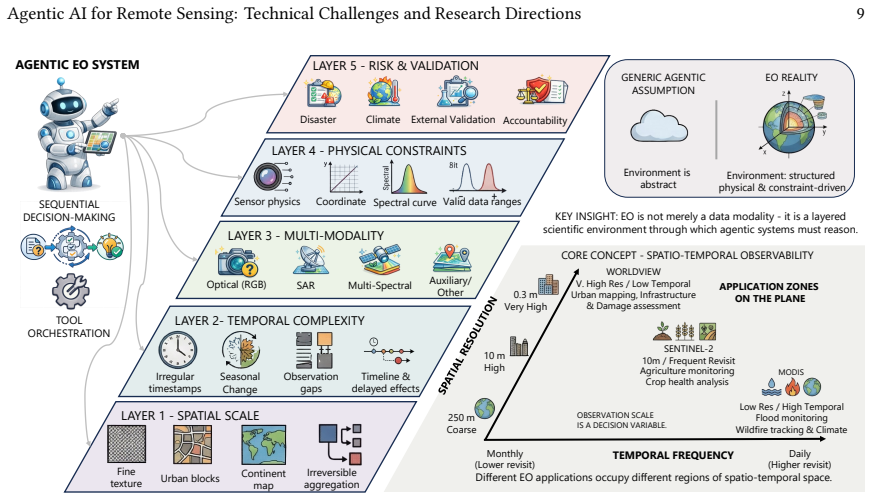
This position paper claims that the challenges of applying agentic AI to Earth Observation are structural rather than incidental. Because EO data is georeferenced, multi-modal, and temporally structured, and because common operations transform the underlying state, errors can accumulate silently while correctness depends on geospatial consistency and physical validity in addition to internal coherence. Generic agent assumptions therefore do not transfer directly, and reliable geospatial agents require new designs organized around structured geospatial state, tool-aware reasoning, verifier-guided execution, and validity-aware learning and evaluation.
What carries the argument
EO-native agent design principles that center on structured geospatial state and validity checks to prevent silent error propagation across workflow steps.
Load-bearing premise
The assumption that generic agent designs can maintain correctness in geospatial workflows without explicit checks for state transformations caused by operations like reprojection and resampling.
What would settle it
A side-by-side test of a generic agent versus an EO-aware agent on an identical multi-step remote sensing pipeline, with measurement of how often each produces outputs that violate geospatial or physical constraints.
If this is right
- Multi-step EO pipelines will produce undetected errors unless agents explicitly track and validate state changes from each tool operation.
- Verifier-guided execution must be added to catch violations of temporal or spatial consistency before they compound.
- Performance evaluation of agents in EO must include validity metrics beyond task completion or internal coherence.
- Tool selection and use in EO agents must incorporate awareness of how each tool alters the geospatial data state.
Where Pith is reading between the lines
- These constraints may require new training objectives that penalize physically invalid intermediate states during agent learning.
- The same structural issues could appear in other domains that rely on coordinate transformations and physical consistency, such as autonomous navigation or medical image analysis.
- Foundation models for remote sensing may need to expose explicit state representations to support the proposed verifier mechanisms.
Editorial analysis
A structured set of objections, weighed in public.
Referee Report
Summary. This position paper argues that Earth Observation (EO) workflows are not a straightforward extension of generic agentic AI. It claims that operations such as reprojection, resampling, compositing, and aggregation transform the underlying geospatial state, leading to silent error propagation where correctness requires not only internal coherence but also geospatial consistency, temporally valid comparisons, and physical validity. The paper asserts these challenges are structural, examines how generic agent assumptions break in EO contexts, characterizes failure modes in multi-step pipelines, and outlines design principles for EO-native agents based on structured geospatial state, tool-aware reasoning, verifier-guided execution, and validity-aware learning and evaluation.
Significance. If the position is substantiated with concrete examples, the paper could usefully identify limitations in applying current agentic AI to remote sensing and motivate EO-specific agent architectures. As a high-level position paper, it draws attention to workflow constraints that generic systems may overlook, potentially guiding future research on reliable geospatial agents.
major comments (2)
- [Abstract] Abstract: The central claim that challenges are 'structural rather than incidental' and that errors 'may propagate silently across steps' is asserted without any concrete failure-mode examples, workflow traces, or comparisons to generic agent assumptions, leaving the structural nature of the issues unverified.
- [Abstract] Abstract: The outlined design principles (structured geospatial state, tool-aware reasoning, verifier-guided execution, validity-aware learning) are stated at a high level with no elaboration on mechanisms, how they specifically mitigate the identified failure modes, or any discussion of validation approaches.
Simulated Author's Rebuttal
We thank the referee for the constructive feedback. We address each major comment below and agree that targeted revisions to the abstract will better signal the manuscript's structure and contributions.
read point-by-point responses
-
Referee: [Abstract] Abstract: The central claim that challenges are 'structural rather than incidental' and that errors 'may propagate silently across steps' is asserted without any concrete failure-mode examples, workflow traces, or comparisons to generic agent assumptions, leaving the structural nature of the issues unverified.
Authors: The abstract is a concise summary of the position paper's thesis. The body of the manuscript examines generic agent assumptions, shows how they break under geospatial constraints, and characterizes failure modes with workflow-level analysis. To make this linkage explicit from the abstract alone, we will add a sentence that references the relevant sections containing the concrete examples and comparisons. revision: yes
-
Referee: [Abstract] Abstract: The outlined design principles (structured geospatial state, tool-aware reasoning, verifier-guided execution, validity-aware learning) are stated at a high level with no elaboration on mechanisms, how they specifically mitigate the identified failure modes, or any discussion of validation approaches.
Authors: The abstract introduces the four design principles at the level appropriate for a summary. The manuscript elaborates the mechanisms, their targeted mitigation of the identified failure modes, and validation strategies in dedicated sections. We will revise the abstract to briefly note the mitigation role of each principle and point readers to those sections for the detailed discussion. revision: yes
Circularity Check
No significant circularity
full rationale
This is a position paper whose central claim—that EO workflows impose structural constraints on agentic AI not addressed by generic designs—rests entirely on domain analysis of operations such as reprojection and resampling. The provided abstract and full text contain no equations, fitted parameters, derivations, or self-citations. No load-bearing step reduces by construction to an input, self-citation chain, or renamed prior result; the argument is self-contained as an external critique of existing agent assumptions.
Axiom & Free-Parameter Ledger
axioms (2)
- domain assumption EO workflows operate on georeferenced, multi-modal, and temporally structured data where operations transform the underlying state
- domain assumption Correctness in EO depends on geospatial consistency, temporally valid comparisons, and physical validity
read the original abstract
Earth Observation (EO) is moving beyond static prediction toward multi-step analytical workflows that require coordinated reasoning over data, tools, and geospatial state. While foundation models and vision-language models have advanced representation learning and language-grounded interaction in remote sensing, and agentic AI has shown strong potential for long-horizon reasoning and tool use, EO is not a straightforward extension of generic agentic AI. EO workflows operate on georeferenced, multi-modal, and temporally structured data, where operations such as reprojection, resampling, compositing, and aggregation transform the underlying state and can constrain later analysis. As a result, errors may propagate silently across steps, and correctness depends not only on internal coherence but also on geospatial consistency, temporally valid comparisons, and physical validity. This position paper argues that these challenges are structural rather than incidental. We examine the assumptions commonly made in generic agentic systems, analyze how they break in geospatial workflows, and characterize failure modes in multi-step EO pipelines. We then outline design principles for EO-native agents centered on structured geospatial state, tool-aware reasoning, verifier-guided execution, and validity-aware learning and evaluation. Building reliable geospatial agents, therefore, requires rethinking agent design around the physical, geospatial, and workflow constraints that govern EO analysis.
Figures




Forward citations
Cited by 1 Pith paper
-
HydroAgent: Closing the Gap Between Frontier LLMs and Human Experts in Hydrologic Model Calibration via Simulator-Grounded RL
HydroAgent fine-tunes Qwen3-4B on 2,576 expert calibration trajectories and applies Group-Relative Policy Optimization with NSE reward from live CREST simulations to improve hydrologic model calibration over frontier LLMs.
discussion (0)
Sign in with ORCID, Apple, or X to comment. Anyone can read and Pith papers without signing in.