REVIEW 1 major objections 1 minor 77 references
PageGuide browser extension uses visual overlays to ground LLM answers on web page elements, raising accuracy and cutting time in user tests for find, guide, and hide tasks.
Reviewed by Pith at T0; open to challenge. T0 means a machine referee read the full paper against a public rubric. the ladder, T0–T4 →
T0 review · grok-4.3
2026-07-01 09:06 UTC pith:BYTMOF6F
load-bearing objection PageGuide gives a concrete browser extension for visually grounding LLM answers on the page via DOM overlays, but the N=94 study gains cannot be assessed without any methodology details. the 1 major comments →
PageGuide: Browser extension to assist users in navigating a webpage and locating information
The pith
A machine-rendered reading of the paper's core claim, the machinery that carries it, and where it could break.
Core claim
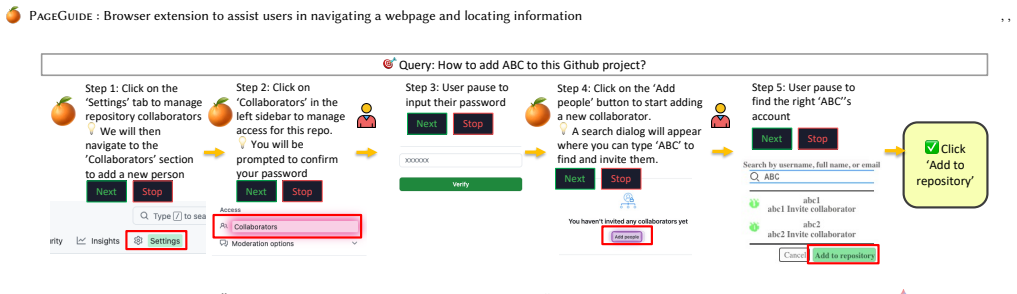
PageGuide is a browser extension that grounds LLM answers directly in the HTML DOM via visual overlays. It supports three modes: Find for locating and highlighting relevant evidence in-situ, Guide for presenting step-by-step instructions one at a time, and Hide for allowing users to decide whether to remove distracting elements. In a user study with 94 participants, PageGuide outperformed unaided browsing with Hide accuracy improving by 26 percentage points and task time dropping by 70 percent, Guide completion rate increasing by 30 percentage points, and Find reducing Ctrl+F usage by 80 percent along with 19 percent less task time.
What carries the argument
Visual overlays that map LLM outputs to specific HTML DOM elements for in-place highlighting, guidance, and hiding.
Load-bearing premise
The performance gains measured in the N=94 user study are caused by the PageGuide features rather than by task selection, participant assignment, or other aspects of the study design.
What would settle it
A follow-up study using different tasks, a larger or more diverse participant pool, and tighter controls that finds no significant difference in accuracy or time between PageGuide and unaided browsing would show the reported benefits do not hold.
If this is right
- Users can verify AI answers on the actual page without separate manual searches.
- Step-by-step guidance enables users to complete multi-step tasks themselves rather than relying on full automation.
- Selective hiding of content improves focus and accuracy when locating information on cluttered pages.
- Reduced use of shortcuts like Ctrl+F indicates lower manual search effort across tasks.
Where Pith is reading between the lines
- The grounding method could be adapted to non-browser interfaces such as document viewers or mobile apps to provide similar source-linked assistance.
- Repeated interactions might let the system learn and suggest personalized hiding rules based on past user choices.
- Pairing the overlay approach with more advanced browser agents could create systems that offer guidance alongside partial automation.
Editorial analysis
A structured set of objections, weighed in public.
Referee Report
Summary. The paper presents PageGuide, a browser extension that grounds LLM outputs via visual DOM overlays to support three modes: Find (locating and highlighting evidence in-situ), Guide (step-by-step instructions for multi-step tasks), and Hide (selectively hiding distracting content). It claims that in a user study (N=94), PageGuide outperforms unaided browsing with a 26 percentage point accuracy gain (86.7% relative) and 70% time reduction in Hide, a 30 percentage point completion rate increase in Guide, and an 80% drop in Ctrl+F usage plus 19% time reduction in Find.
Significance. If the empirical claims hold after methodological details are supplied, the work would be significant for HCI by showing how visual grounding can address verification and trust problems with ungrounded LLM assistants and browser agents. The public release of code and demo at pageguide.github.io is a clear strength for reproducibility and extension by others.
major comments (1)
- [Abstract] Abstract (user study paragraph): The headline quantitative claims (Hide +26pp accuracy, Guide +30pp completion, Find -80% Ctrl+F) rest entirely on the N=94 study, yet the manuscript supplies no information on design (between- vs. within-subjects, counterbalancing, task selection criteria), controls (prior familiarity, blinding), or analysis (statistical tests, effect sizes, confidence intervals). This is load-bearing for the central claim that gains are caused by the visual-grounding, step-by-step, and hiding mechanisms rather than confounds.
minor comments (1)
- [Abstract] Abstract: grammatical and agreement errors ('PageGuide outperform', 'Hide accuracy improve', 'Code and demo is at') should be corrected for clarity.
Simulated Author's Rebuttal
We thank the referee for highlighting the need for greater methodological transparency in the user study. We agree that the reported performance gains require detailed justification of the experimental design to rule out confounds, and we will revise the manuscript to supply this information.
read point-by-point responses
-
Referee: [Abstract] Abstract (user study paragraph): The headline quantitative claims (Hide +26pp accuracy, Guide +30pp completion, Find -80% Ctrl+F) rest entirely on the N=94 study, yet the manuscript supplies no information on design (between- vs. within-subjects, counterbalancing, task selection criteria), controls (prior familiarity, blinding), or analysis (statistical tests, effect sizes, confidence intervals). This is load-bearing for the central claim that gains are caused by the visual-grounding, step-by-step, and hiding mechanisms rather than confounds.
Authors: We acknowledge that the manuscript currently provides only high-level results without the requested methodological details on study design, controls, or analysis. This omission weakens the ability to attribute the gains specifically to PageGuide's mechanisms. In the revision we will expand the User Study section with a full description of the experimental protocol, including design type and counterbalancing, task selection criteria, controls for prior familiarity and blinding, and the statistical tests, effect sizes, and confidence intervals used. These additions will directly address the concern that the claims rest on unverified assumptions. revision: yes
Circularity Check
No circularity: empirical user study with no derivations or self-referential claims
full rationale
The paper describes a browser extension (PageGuide) and reports results from an N=94 user study comparing it to unaided browsing. No equations, fitted parameters, predictions derived from inputs, or self-citations appear in the abstract or described claims. The central performance deltas (e.g., +26pp accuracy, -70% time) are presented as direct empirical outcomes rather than reductions of any prior result by construction. This matches the default case of a self-contained empirical system paper with no load-bearing derivation chain.
Axiom & Free-Parameter Ledger
read the original abstract
Users browsing the web daily struggle to quickly locate relevant information in cluttered pages, complete unfamiliar multi-step tasks, and stay focused amid distracting content. State-of-the-art AI assistants (e.g., ChatGPT, Gemini, Claude) and browser agents (e.g., OpenAI Operator, Browser Use) can answer questions and automate actions, yet they return answers without showing where the information comes from on the page, forcing users to manually verify results and blindly trust every automated steps. We present PageGuide, a browser extension that grounds LLM answers directly in the HTML DOM via visual overlays, addressing three core user needs: (a) Find-locating and highlighting relevant evidence in-situ so users can instantly verify answers on the page; (b) Guide-showing step-by-step instructions (e.g. how to change password) one at a time so users can follow and perform actions by themselves; and (c) Hide-hiding distracting content-giving users a chance to decide to hide an element or not. In a user study (N=94), PageGuide outperform unaided browsing across all modes: Hide accuracy improve by 26 percentage points (86.7% relative gain) and task completion time drops by 70%; Guide completion rate increases by 30 percentage points; and Find reduces manual search effort, with Ctrl+F usage falling by 80% and task time decreasing by 19%. Code and demo is at: pageguide.github.io.
Figures





Reference graph
Works this paper leans on
- [1]
- [2]
-
[3]
Anthropic. 2024. 3.5 Sonnet, Computer Use, and the API updates. Anthropic announcement. https://www.anthropic.com/news/3-5-models-and-computer- use Accessed: 2026-03-03
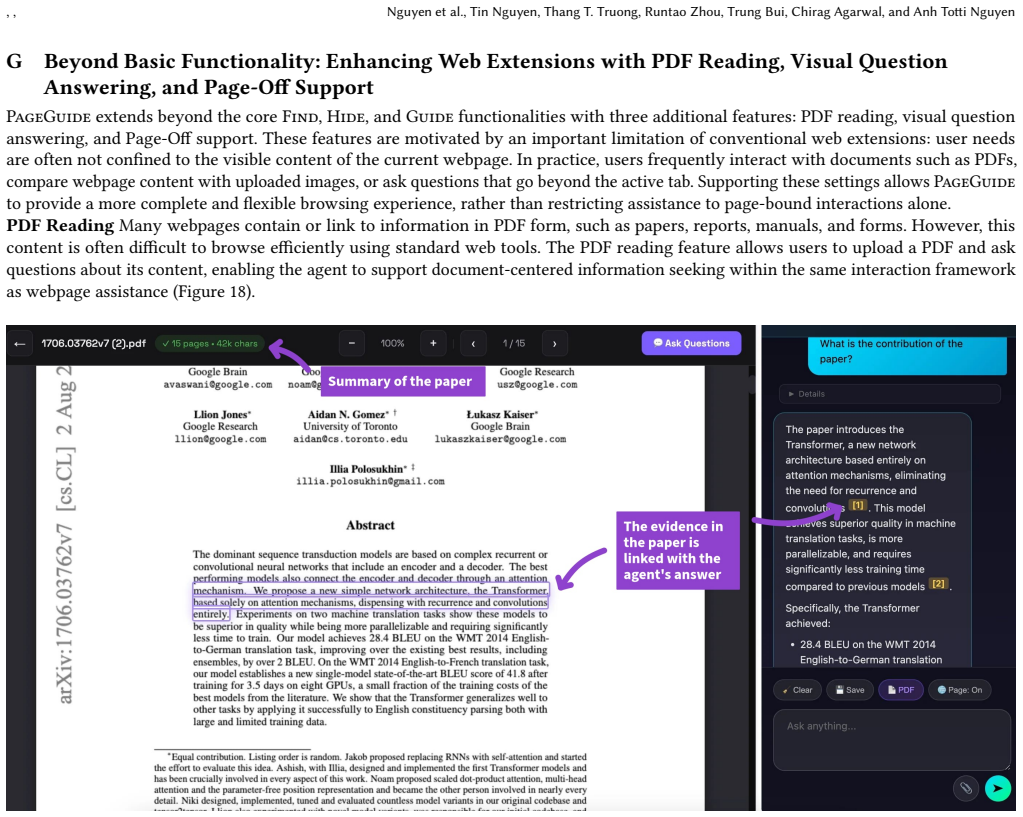
2024
- [4]
-
[5]
Gilles Baechler, Srinivas Sunkara, Maria Wang, Fedir Zubach, Hassan Mansoor, Vincent Etter, Victor Carbune, Jason Lin, Jindong Chen, and Abhanshu Sharma
-
[6]
ScreenAI: A vision-language model for UI and infographics understanding. arXiv preprint arXiv:2402.04615
-
[7]
Longformer: The Long-Document Transformer
Iz Beltagy, Matthew E. Peters, and Arman Cohan. 2020. Longformer: The Long- Document Transformer. arXiv preprint arXiv:2004.05150
work page internal anchor Pith review Pith/arXiv arXiv 2020
-
[8]
browser-use. 2025. browser-use: Make websites accessible for AI agents. GitHub repository. https://github.com/browser-use/browser-use Accessed: 2026-03-02
2025
- [9]
-
[10]
Pradeep Dasigi, Kyle Lo, Iz Beltagy, Arman Cohan, Noah A Smith, and Matt Gardner. 2021. A dataset of information-seeking questions and answers anchored in research papers. InProceedings of the 2021 Conference of the North Ameri- can Chapter of the Association for Computational Linguistics: Human Language Technologies. 4599–4610
2021
-
[11]
DataReportal, We Are Social, and Meltwater. 2025. Digital 2025: Global Overview Report. Annual global digital report. https://datareportal.com/reports/digital- 2025-global-overview-report
2025
-
[12]
Xiang Deng, Yu Gu, Boyuan Zheng, Shijie Chen, Sam Stevens, Boshi Wang, Huan Sun, and Yu Su. 2023. Mind2Web: Towards a Generalist Agent for the Web. InAdvances in Neural Information Processing Systems, A. Oh, T. Naumann, A. Globerson, K. Saenko, M. Hardt, and S. Levine (Eds.), Vol. 36. Curran Associates, Inc., 28091–28114. https://proceedings.neurips.cc/pa...
2023
-
[13]
Google. 2025. Bring Gemini to Chrome. Google Blog. https://blog.google/ products-and-platforms/products/chrome/gemini-3-auto-browse/ Accessed: 2026-03-02
2025
-
[14]
Ananya Gubbi Mohanbabu, Yotam Sechayk, and Amy Pavel. 2025. Task Mode: Dynamic Filtering for Task-Specific Web Navigation using LLMs. InProceedings of the 27th International ACM SIGACCESS Conference on Computers and Accessibility. ACM, New York, NY, USA, 1–18
2025
-
[15]
Tanmay Gupta, Piper Wolters, Zixian Ma, Peter Sushko, Rock Yuren Pang, Diego Llanes, Yue Yang, Taira Anderson, Boyuan Zheng, Zhongzheng Ren, Harsh Trivedi, Taylor Blanton, Caleb Ouellette, Winson Han, Ali Farhadi, and Ranjay Krishna. 2026. MolmoWeb: Open Visual Web Agent and Open Data for the Open Web. https://allenai.org/papers/molmoweb
2026
-
[16]
GWI. 2025. Ad blockers in 2025: Key trends and what they mean for advertisers. GWI insights article. https://www.gwi.com/blog/ad-blockers
2025
-
[17]
Hongliang He, Wenlin Yao, Kaixin Ma, Wenhao Yu, Yong Dai, Hongming Zhang, Zhenzhong Lan, and Dong Yu. 2024. WebVoyager: Building an End-to-End Web Agent with Large Multimodal Models. InProceedings of the 62nd Annual Meeting of the Association for Computational Linguistics (Volume 1: Long Papers), Lun-Wei Ku, Andre Martins, and Vivek Srikumar (Eds.). Assoc...
-
[18]
Eric Horvitz. 1999. Principles of mixed-initiative user interfaces. InProceedings of the SIGCHI Conference on Human Factors in Computing Systems(Pittsburgh, Pennsylvania, USA)(CHI ’99). Association for Computing Machinery, New York, NY, USA, 159–166. doi:10.1145/302979.303030
-
[19]
Shagun Jhaver, Alice Qian Zhang, Quan Ze Chen, Nikhila Natarajan, Ruotong Wang, and Amy X Zhang. 2023. Personalizing content moderation on social media: User perspectives on moderation choices, interface design, and labor. Proceedings of the ACM on Human-Computer Interaction7, CSCW2 (2023), 1–33
2023
-
[20]
Jaylen Jones, Zhehao Zhang, Yuting Ning, Eric Fosler-Lussier, Pierre-Luc St- Charles, Yoshua Bengio, Dawn Song, Yu Su, and Huan Sun. 2026. When Benign Inputs Lead to Severe Harms: Eliciting Unsafe Unintended Behaviors of Computer- Use Agents. arXiv preprint arXiv:2602.08235
work page internal anchor Pith review Pith/arXiv arXiv 2026
-
[21]
Jing Yu Koh, Robert Lo, Lawrence Jang, Vikram Duvvur, Ming Lim, Po-Yu Huang, Graham Neubig, Shuyan Zhou, Russ Salakhutdinov, and Daniel Fried. 2024. Vi- sualWebArena: Evaluating Multimodal Agents on Realistic Visual Web Tasks. In Proceedings of the 62nd Annual Meeting of the Association for Computational Lin- guistics (Volume 1: Long Papers), Lun-Wei Ku, ...
- [22]
-
[23]
Dai, Jakob Uszkoreit, Quoc Le, and Slav Petrov
Tom Kwiatkowski, Jennimaria Palomaki, Olivia Redfield, Michael Collins, Ankur Parikh, Chris Alberti, Danielle Epstein, Illia Polosukhin, Jacob Devlin, Kenton Lee, Kristina Toutanova, Llion Jones, Matthew Kelcey, Ming-Wei Chang, Andrew M. Dai, Jakob Uszkoreit, Quoc Le, and Slav Petrov. 2019. Natural Questions: A Benchmark for Question Answering Research. I...
-
[24]
Hao-Ping (Hank) Lee, Yi-Shyuan Chiang, Lan Gao, Stephanie Yang, Philipp Winter, and Sauvik Das. 2025. Purpose Mode: Reducing Distraction through Toggling Attention Capture Damaging Patterns on Social Media Web Sites.ACM Trans. Comput.-Hum. Interact.32, 1, Article 10 (April 2025), 41 pages. doi:10.1145/ 3711841
2025
-
[25]
Ido Levy, Ben Wiesel, Sami Marreed, Alon Oved, Avi Yaeli, and Segev Shlomov
-
[26]
ST-WebAgentBench: A Benchmark for Evaluating Safety and Trustworthiness in Web Agents
ST-WebAgentBench: A benchmark for evaluating safety and trustworthi- ness in web agents. arXiv preprint arXiv:2410.06703
work page internal anchor Pith review Pith/arXiv arXiv
-
[27]
Ping Liu, Karthik Shivaram, Aron Culotta, Matthew Shapiro, and Mustafa Bilgic
-
[28]
InProceedings of the International AAAI Conference on Web and Social Media, Vol
How Does Empowering Users with Greater System Control Affect News Filter Bubbles?. InProceedings of the International AAAI Conference on Web and Social Media, Vol. 18. 943–957
-
[29]
Elita Lobo, Chirag Agarwal, and Himabindu Lakkaraju. 2025. On the impact of fine-tuning on chain-of-thought reasoning. InProceedings of the 2025 Confer- ence of the Nations of the Americas Chapter of the Association for Computational Linguistics: Human Language Technologies (Volume 1: Long Papers). 11679–11698
2025
- [30]
-
[31]
Yohei Nakajima. 2023. BabyAGI. GitHub repository. https://github.com/ yoheinakajima/babyagi Accessed: 2026-03-03
2023
-
[32]
Tin Nguyen, Logan Bolton, Mohammad Reza Taesiri, and Anh Totti Nguyen
-
[33]
HoT: Highlighted Chain of Thought for Referencing Supporting Facts from Inputs
HoT: Highlighted Chain of Thought for Referencing Supporting Facts from Inputs. arXiv preprint arXiv:2503.02003. doi:10.48550/arXiv.2503.02003 Version 5
work page internal anchor Pith review Pith/arXiv arXiv doi:10.48550/arxiv.2503.02003
-
[34]
OpenAI. 2025. ChatGPT Agent: Browsing and completing tasks on the web (Atlas). OpenAI product page. https://chatgpt.com/features/agent Accessed: 2026-03-02
2025
-
[35]
OpenAI. 2025. Introducing Operator. OpenAI product announcement. https: //openai.com/index/introducing-operator/ Accessed: 2026-03-03
2025
-
[36]
Significant Gravitas. 2023. Auto-GPT. GitHub repository. https://github.com/ Significant-Gravitas/AutoGPT Accessed: 2026-03-03
2023
-
[37]
Stanford News. 2025. Social media research tool lowers the political temperature. (November 2025). https://news.stanford.edu/stories/2025/11/social-media-tool- polarization-user-control-research Accessed: 2026-03-26
2025
-
[38]
John Sweller. 1988. Cognitive Load During Problem Solving: Effects on Learning. Cognitive Science12, 2 (1988), 257–285. doi:10.1207/s15516709cog1202_4
-
[39]
Sree Harsha Tanneru, Dan Ley, Chirag Agarwal, and Himabindu Lakkaraju. 2024. On the Difficulty of Faithful Chain-of-Thought Reasoning in Large Language Models. InTrustworthy Multi-modal Foundation Models and AI Agents (TiFA). https://openreview.net/forum?id=3h0kZdPhAC
2024
-
[40]
The Browser Company. 2025. Dia Browser. Official product page. https: //www.diabrowser.com/ Accessed: 2026-03-02
2025
- [41]
- [42]
-
[43]
Jason Wei, Xuezhi Wang, Dale Schuurmans, Maarten Bosma, brian ichter, Fei Xia, Ed Chi, Quoc V Le, and Denny Zhou. 2022. Chain-of-Thought Prompting Elicits Reasoning in Large Language Models. InAdvances in , , Nguyen et al., Tin Nguyen, Thang T. Truong, Runtao Zhou, Trung Bui, Chirag Agarwal, and Anh Totti Nguyen Neural Information Processing Systems, S. K...
2022
-
[44]
Wikipedia contributors. 2026. List of most-visited websites — Wikipedia, The Free Encyclopedia. https://en.wikipedia.org/wiki/List_of_most-visited_websites. Accessed: 2026-04-01
2026
-
[45]
Chen Xiang, Yuchen Zeng, Xiaofei Wang, et al. 2025. CoW Pilot: A Framework for Human-in-the-Loop Web Agents. InProceedings of the 2025 Annual Conference of the North American Chapter of the Association for Computational Linguistics (Demonstrations). Association for Computational Linguistics, Albuquerque, New Mexico, 61–72. doi:10.18653/v1/2025.naacl-demo.6
- [46]
-
[47]
Suyu Ye, Haojun Shi, Darren Shih, Hyokun Yun, Tanya G. Roosta, and Tianmin Shu. 2026. RealWebAssist: A Benchmark for Long-Horizon Web Assistance with Real-World Users.Proceedings of the AAAI Conference on Artificial Intelligence40, 40 (Mar. 2026), 34441–34449. doi:10.1609/aaai.v40i40.40742
-
[48]
Zhexin Zhang, Shiyao Cui, Yida Lu, Jingzhuo Zhou, Junxiao Yang, Hongning Wang, and Minlie Huang. 2024. Agent-SafetyBench: Evaluating the safety of LLM agents. arXiv preprint arXiv:2412.14470
work page internal anchor Pith review Pith/arXiv arXiv 2024
-
[49]
Boyuan Zheng, Boyu Gou, Jihyung Kil, Huan Sun, and Yu Su. 2024. Gpt-4v (ision) is a generalist web agent, if grounded.arXiv preprint arXiv:2401.01614(2024)
work page internal anchor Pith review Pith/arXiv arXiv 2024
-
[50]
Runtao Zhou, Giang Nguyen, Nikita Kharya, Anh Nguyen, and Chirag Agarwal
-
[51]
InProceedings of the 31st International Conference on Intelligent User Interfaces (IUI ’26)
Improving Human Verification of LLM Reasoning through Interactive Explanation Interfaces. InProceedings of the 31st International Conference on Intelligent User Interfaces (IUI ’26). Association for Computing Machinery, New York, NY, USA, 456–473. doi:10.1145/3742413.3789134
-
[52]
WebArena: A Realistic Web Environment for Building Autonomous Agents
Shuyan Zhou, Frank F. Xu, Hao Zhu, Xuhui Zhou, Robert Lo, Abishek Sridhar, Xianyi Cheng, Tianyue Ou, Yonatan Bisk, Daniel Fried, Uri Alon, and Graham Neubig. 2024. WebArena: A Realistic Web Environment for Building Autonomous Agents. arXiv:2307.13854 [cs.AI] https://arxiv.org/abs/2307.13854 PageGuide: Browser extension to assist users in navigating a webp...
work page internal anchor Pith review Pith/arXiv arXiv 2024
-
[53]
guide" - For step-by-step
"guide" - For step-by-step "how to" questions that need interactive guidance
-
[54]
"hide" - For requests to hide, remove, or suppress distracting/annoying content (ads, banners, popups, cookie notices, sidebars, recommendations, etc.)
-
[55]
image_find
"image_find" - For questions about an UPLOADED IMAGE (finding similar items, comparing with page content)
-
[56]
pdf_find
"pdf_find" - For questions about PDF documents (summarize, find specific content, extract info from PDFs)
-
[57]
find" - For questions, information lookup, finding content, highlighting elements (DEFAULT) ROUTING RULES: -
"find" - For questions, information lookup, finding content, highlighting elements (DEFAULT) ROUTING RULES: - "guide": User wants to LEARN how to do something in steps (e.g.,"how do I report this video?", "where can I find settings?", "help me delete my account") - "hide": User wants to hide or remove something on the page (e.g.,"hide the ads", "remove th...
-
[58]
Answer the question based on the page content if possible
-
[59]
text"] citations inline to reference specific elements from the PAGE INDEX - N is the index number from PAGE INDEX -
If the page content has the answer, use [N:"text"] citations inline to reference specific elements from the PAGE INDEX - N is the index number from PAGE INDEX - "text" is the EXACT text snippet to highlight (copy from the page content)
-
[60]
Each citation should point to an element that supports that part of your answer
-
[61]
For lists of items, cite each one with the specific text to highlight
-
[62]
Use ONE citation per item (if same text has multiple indices, pick the link)
-
[63]
The "text" should be a short, specific phrase (not the entire element text)
-
[64]
Consider conversation history for context, but always answer based on CURRENT page content
-
[65]
Wikipedia’s [1], [2], [3]) — only use [N:"text"] format where N comes from the PAGE INDEX above
NEVER reproduce existing footnote markers from the webpage itself (e.g. Wikipedia’s [1], [2], [3]) — only use [N:"text"] format where N comes from the PAGE INDEX above
-
[66]
The information is not provided on this page
**CRITICAL**: If the information is NOT provided on this page: - State exactly: "The information is not provided on this page. " - Then, providing the answer using your own general knowledge base is HIGHLY ENCOURAGED. Do not simply stop after stating it is not on the page. - You MUST include citations to real, valid source URLs using STANDARD MARKDOWN LIN...
-
[67]
PAGE INDEX - Visible elements on the page
-
[68]
USER QUESTION - What the user wants to do
-
[69]
STEP NUMBER - Current step (1 = first step)
-
[70]
" or
PREVIOUS STEPS - What was done before (if any) Your job: Guide the user ONE STEP at a time. IMPORTANT CONCEPTS: - Some buttons/options are HIDDEN in menus (like "... " or " ..." three-dot menus) - If the target isn’t visible, guide user to open the menu FIRST - Common hidden locations: dropdown menus, "More" buttons, three-dot menus, right-click menus, se...
-
[71]
ONE step at a time - don’t overwhelm the user
-
[72]
If target is likely hidden in a menu, first step should open that menu
-
[73]
waitFor":
Use "waitFor": "click" when user needs to click something
-
[74]
isLastStep
Set "isLastStep": true only when the goal is achieved
-
[75]
Make instructions clear and specific
-
[76]
Highlight the element user needs to interact with EXAMPLES: PAGE INDEX:
-
[77]
(button) Save Q: "How do I report this video?" (Step 1) → { "step":1, "instruction":"Click the three-dot menu ( ...) to see more options", "highlight":"index":5, "text":" ...", "wait- For":"click", "isLastStep":false, "nextStepHint":"The menu will open with Report option" } Q: "How do I report this video?" (Step 2, after menu opened) PAGE INDEX now shows:...
discussion (0)
Sign in with ORCID, Apple, or X to comment. Anyone can read and Pith papers without signing in.