Accelerating scaling solutions from dark matter particle creation
Pith reviewed 2026-05-09 21:22 UTC · model grok-4.3
The pith
Accelerating scaling attractors emerge only when dark matter particle creation drives energy flow from dark matter to the second fluid.
A machine-rendered reading of the paper's core claim, the machinery that carries it, and where it could break.
Core claim
In a two-fluid cosmological model with pressureless dark matter experiencing adiabatic particle creation and interacting with a barotropic fluid, accelerating scaling attractors arise only when the interaction is controlled by the dark matter density and energy flows from dark matter to the second fluid. These attractors are found in global and local dark-matter-based interactions and in the global mixed case, but are absent when the interaction depends on the second fluid or on local mixed terms, which instead drive the universe toward a dark-matter-dominated accelerating phase.
What carries the argument
Autonomous systems in a compact phase space derived from six interaction prescriptions, which locate and determine the stability of fixed points representing scaling solutions.
Load-bearing premise
The six widely used interaction prescriptions capture the essential physics and the adiabatic particle creation rate remains valid at late times in a flat FLRW background under general relativity.
What would settle it
Future measurements showing whether the ratio of energy densities between dark matter and the barotropic fluid approaches a nonzero constant at late times, together with the direction of energy transfer, would confirm or refute the existence of these attractors.
Figures


read the original abstract
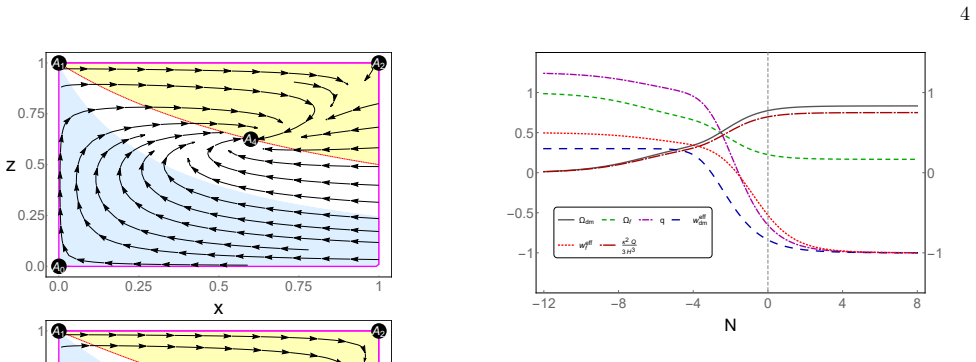
This article opens new window to obtain accelerating scaling attractors without any need of dark energy. We study cosmological dynamics in a two-fluid system where pressureless dark matter (DM) undergoes adiabatic particle creation and exchanges energy with a barotropic fluid. Considering six widely used interaction prescriptions, we formulate the corresponding autonomous systems in a compact phase space and perform a unified dynamical analysis. We find that accelerating scaling attractors, namely late-time states where both fluids coexist with fixed energy fractions, arise only when the interaction is controlled by the DM density and energy flows from DM to the second fluid. Such attractors appear in the global and local DM-based interactions, and in the global mixed case, but are entirely absent when the interaction depends on the second fluid or on local mixed terms, which instead drive the universe to a DM-dominated accelerating phase. These results clarify the unique conditions under which matter creation can mimic dark-energy-like behaviour without introducing a dark-energy component.
Editorial analysis
A structured set of objections, weighed in public.
Referee Report
Summary. The manuscript analyzes a two-fluid FLRW cosmology in which pressureless dark matter undergoes adiabatic particle creation while exchanging energy with a barotropic fluid via one of six phenomenological interaction terms Q. After reducing the system to autonomous equations in a compact phase space, the authors perform a unified stability analysis and conclude that accelerating scaling fixed points (constant positive density fractions for both fluids with w_eff < −1/3) exist only for the three interaction classes controlled by the DM density (global, local, and global mixed) with energy flowing from DM to the barotropic fluid; the remaining prescriptions drive the universe to a DM-dominated accelerating phase instead.
Significance. If the central claim survives scrutiny, the work is significant because it isolates the precise phenomenological conditions under which adiabatic DM particle creation can produce late-time acceleration and scaling solutions without a separate dark-energy component. The systematic comparison across six standard interaction forms supplies a useful classification that can guide future model building in interacting dark-sector cosmologies.
major comments (3)
- [Autonomous-system formulation (around the continuity equations)] The derivation of the creation pressure p_c = −ρ_DM Γ/(3H) and its insertion into the continuity equations assumes the adiabatic condition remains exact once the interaction Q is present. The modified equations are ρ̇_DM + 3H ρ_DM = −Q − 3H p_c and ρ̇_2 + 3H(1+w_2)ρ_2 = Q, yet the manuscript does not re-derive Γ from the coupled particle-number balance or Boltzmann equation; this assumption is load-bearing for the claim that acceleration at the scaling attractors is supplied by p_c.
- [Dynamical analysis of fixed points] For the DM-controlled interactions that are reported to possess accelerating scaling attractors, the eigenvalues of the Jacobian at those fixed points are not listed, nor are the corresponding phase portraits or basins of attraction shown. Without these explicit stability results it is difficult to verify that the points are indeed late-time attractors and that the other interaction classes truly lack them.
- [Interaction prescriptions and parameter choices] The six interaction prescriptions each contain at least one free coupling parameter whose value is chosen so that the desired scaling behavior appears. The manuscript should state the ranges of these parameters for which the attractors exist and remain accelerating, because the central “arise only when” claim is otherwise sensitive to parameter tuning.
minor comments (2)
- [Notation throughout] The barotropic fluid is consistently called the “second fluid”; introducing a compact symbol (e.g., ρ_b, w_b) would improve readability of the autonomous equations.
- [Section presenting the six prescriptions] A brief table summarizing the six interaction forms, their Q expressions, and the corresponding fixed-point coordinates would help the reader compare the cases at a glance.
Simulated Author's Rebuttal
We thank the referee for the careful and constructive review of our manuscript. The comments have prompted us to clarify several key aspects of our analysis. We address each major comment in turn below, indicating the revisions we will make to strengthen the paper.
read point-by-point responses
-
Referee: The derivation of the creation pressure p_c = −ρ_DM Γ/(3H) and its insertion into the continuity equations assumes the adiabatic condition remains exact once the interaction Q is present. The modified equations are ρ̇_DM + 3H ρ_DM = −Q − 3H p_c and ρ̇_2 + 3H(1+w_2)ρ_2 = Q, yet the manuscript does not re-derive Γ from the coupled particle-number balance or Boltzmann equation; this assumption is load-bearing for the claim that acceleration at the scaling attractors is supplied by p_c.
Authors: We appreciate this observation on the foundational assumptions. In the model, the particle creation rate Γ is introduced for the dark matter fluid following the standard phenomenological treatment of adiabatic creation in FLRW cosmologies, where the particle number balance is ṅ + 3 H n = n Γ (independent of the energy-exchange term Q). The interaction Q represents a separate phenomenological energy transfer between the fluids and does not alter this number balance or the thermodynamic derivation of the creation pressure p_c = −ρ_DM Γ/(3H). Thus the standard formula remains valid, and the negative p_c supplies the acceleration at the scaling points. To address the concern explicitly, we will add a clarifying paragraph in the revised manuscript explaining this separation of the creation process from the energy-exchange term Q, with reference to the standard literature. revision: yes
-
Referee: For the DM-controlled interactions that are reported to possess accelerating scaling attractors, the eigenvalues of the Jacobian at those fixed points are not listed, nor are the corresponding phase portraits or basins of attraction shown. Without these explicit stability results it is difficult to verify that the points are indeed late-time attractors and that the other interaction classes truly lack them.
Authors: We agree that tabulating the eigenvalues improves transparency. Although the unified stability analysis was performed by computing the Jacobian eigenvalues at each fixed point, they were not presented in tabular form for conciseness. In the revision we will add a table listing the eigenvalues (and their real parts) for the accelerating scaling fixed points in the DM-controlled cases, together with the parameter conditions under which all real parts are negative. For the phase-space structure, we will include a qualitative discussion of the basins of attraction and, space permitting, representative phase portraits to illustrate the flow toward the late-time attractors and the absence of scaling solutions in the other interaction classes. revision: yes
-
Referee: The six interaction prescriptions each contain at least one free coupling parameter whose value is chosen so that the desired scaling behavior appears. The manuscript should state the ranges of these parameters for which the attractors exist and remain accelerating, because the central “arise only when” claim is otherwise sensitive to parameter tuning.
Authors: This is a fair criticism. The existence and stability of the scaling attractors depend on the values of the coupling parameters. We will revise the manuscript to state explicitly the ranges of these parameters (e.g., intervals for the dimensionless coupling constants) for which the accelerating scaling fixed points exist, remain stable, and satisfy w_eff < −1/3. These ranges will be derived directly from the fixed-point coordinates and the eigenvalue conditions, thereby rendering the classification “arise only for DM-controlled interactions with energy flow from DM” precise and independent of arbitrary tuning. revision: yes
Circularity Check
Derivation is self-contained phase-space analysis with no reduction to inputs
full rationale
The paper constructs autonomous systems directly from the continuity equations that incorporate the adiabatic creation pressure p_c = −ρ_DM Γ/(3H) together with each of the six phenomenological Q forms. Fixed-point conditions and stability eigenvalues are then obtained by algebraic solution of those equations; the statement that accelerating scaling attractors exist only for DM-controlled interactions is therefore a direct output of the phase-space analysis rather than a redefinition or fit of the input quantities. No load-bearing self-citation, ansatz smuggling, or renaming of known results occurs in the central derivation chain, and the model assumptions (flat FLRW, adiabatic creation, chosen Q prescriptions) are stated explicitly without being derived from the target result.
Axiom & Free-Parameter Ledger
free parameters (1)
- interaction coupling parameters
axioms (2)
- standard math The background is a flat FLRW metric governed by general relativity.
- domain assumption Dark matter is pressureless and particle creation is adiabatic.
discussion (0)
Sign in with ORCID, Apple, or X to comment. Anyone can read and Pith papers without signing in.