Towards Realistic Open-Vocabulary Remote Sensing Segmentation: Benchmark and Baseline
Pith reviewed 2026-05-10 08:16 UTC · model grok-4.3
The pith
OVRSISBenchV2 provides a more realistic and challenging benchmark for open-vocabulary remote sensing segmentation, where the Pi-Seg baseline achieves strong performance through positive-incentive noise.
A machine-rendered reading of the paper's core claim, the machinery that carries it, and where it could break.
Core claim
OVRSISBenchV2 substantially expands scene diversity, semantic coverage, and evaluation difficulty beyond prior work, and Pi-Seg delivers strong and consistent results particularly on the more challenging OVRSISBenchV2 benchmark by using positive-incentive noise to broaden the visual-text feature space.
What carries the argument
The positive-incentive noise mechanism in Pi-Seg, consisting of learnable and semantically guided perturbations that broaden the visual-text feature space during training to improve transferability.
If this is right
- OVRSISBenchV2 enables more rigorous testing of open-vocabulary methods in remote sensing.
- Pi-Seg shows consistent improvements across OVRSISBenchV1, V2, and downstream tasks.
- Realistic benchmarks better reflect complex deployment scenarios like flood detection.
- Positive-incentive noise enhances cross-dataset generalization in segmentation models.
Where Pith is reading between the lines
- Similar benchmark expansion approaches could be applied to other specialized domains like medical imaging.
- The noise perturbation idea might transfer to general open-vocabulary segmentation outside remote sensing.
- Future work could test if the benchmark's diversity reduces selection bias in model development.
- Integration with other sensors or modalities could further test the method's robustness.
Load-bearing premise
The manually selected categories and datasets accurately capture the full range of realistic geospatial application demands without introducing selection bias or missing key scene and sensor variations.
What would settle it
A follow-up experiment where Pi-Seg fails to outperform standard baselines on OVRSISBenchV2 or where new datasets reveal that the 128 categories do not cover important real-world cases would challenge the central claims.
Figures




read the original abstract
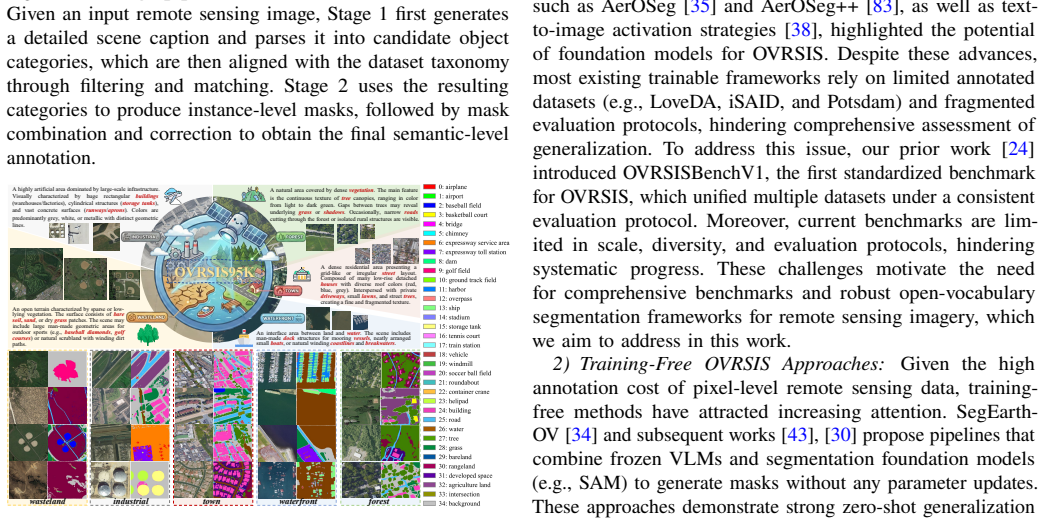
Open-vocabulary remote sensing image segmentation (OVRSIS) remains underexplored due to fragmented datasets, limited training diversity, and the lack of evaluation benchmarks that reflect realistic geospatial application demands. Our previous \textit{OVRSISBenchV1} established an initial cross-dataset evaluation protocol, but its limited scope is insufficient for assessing realistic open-world generalization. To address this issue, we propose \textit{OVRSISBenchV2}, a large-scale and application-oriented benchmark for OVRSIS. We first construct \textbf{OVRSIS95K}, a balanced dataset of about 95K image--mask pairs covering 35 common semantic categories across diverse remote sensing scenes. Built upon OVRSIS95K and 10 downstream datasets, OVRSISBenchV2 contains 170K images and 128 categories, substantially expanding scene diversity, semantic coverage, and evaluation difficulty. Beyond standard open-vocabulary segmentation, it further includes downstream protocols for building extraction, road extraction, and flood detection, thereby better reflecting realistic geospatial application demands and complex deployment scenarios. We also propose \textbf{Pi-Seg}, a baseline for OVRSIS. Pi-Seg improves transferability through a \textbf{positive-incentive noise} mechanism, where learnable and semantically guided perturbations broaden the visual-text feature space during training. Extensive experiments on OVRSISBenchV1, OVRSISBenchV2, and downstream tasks show that Pi-Seg delivers strong and consistent results, particularly on the more challenging OVRSISBenchV2 benchmark. Our results highlight both the importance of realistic benchmark design and the effectiveness of perturbation-based transfer for OVRSIS. The code and datasets are available at \href{https://github.com/LiBingyu01/Pi-Seg}{LiBingyu01/Pi-Seg}.
Editorial analysis
A structured set of objections, weighed in public.
Axiom & Free-Parameter Ledger
axioms (1)
- domain assumption Visual and text encoders can be aligned via contrastive or perturbation-based training to support open-vocabulary generalization.
invented entities (1)
-
positive-incentive noise mechanism
no independent evidence
discussion (0)
Sign in with ORCID, Apple, or X to comment. Anyone can read and Pith papers without signing in.