Geometry Reinforced Efficient Attention Tuning Equipped with Normals for Robust Stereo Matching
Pith reviewed 2026-05-10 17:48 UTC · model grok-4.3
The pith
Surface normals provide domain-invariant geometric cues that improve zero-shot generalization in stereo matching from synthetic to real data.
A machine-rendered reading of the paper's core claim, the machinery that carries it, and where it could break.
Core claim
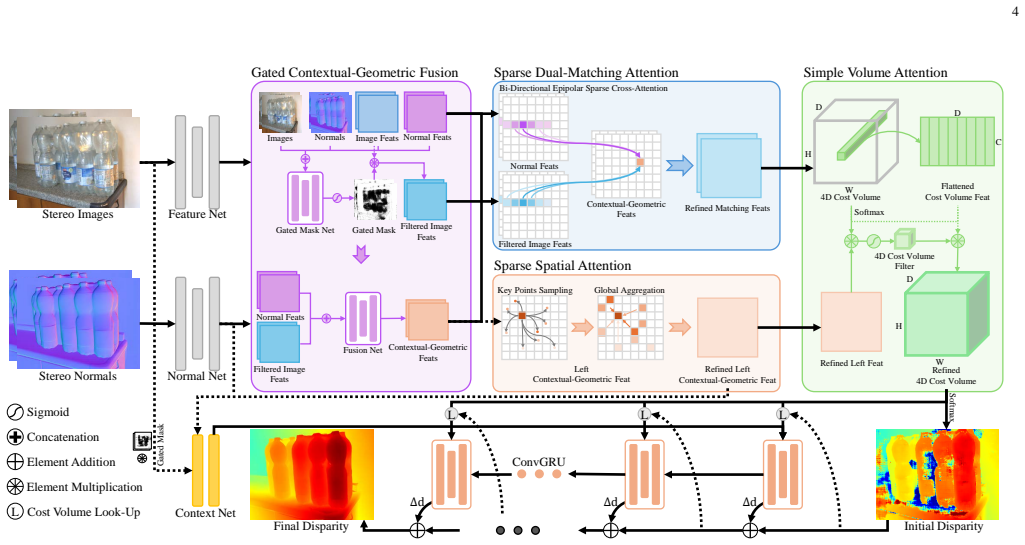
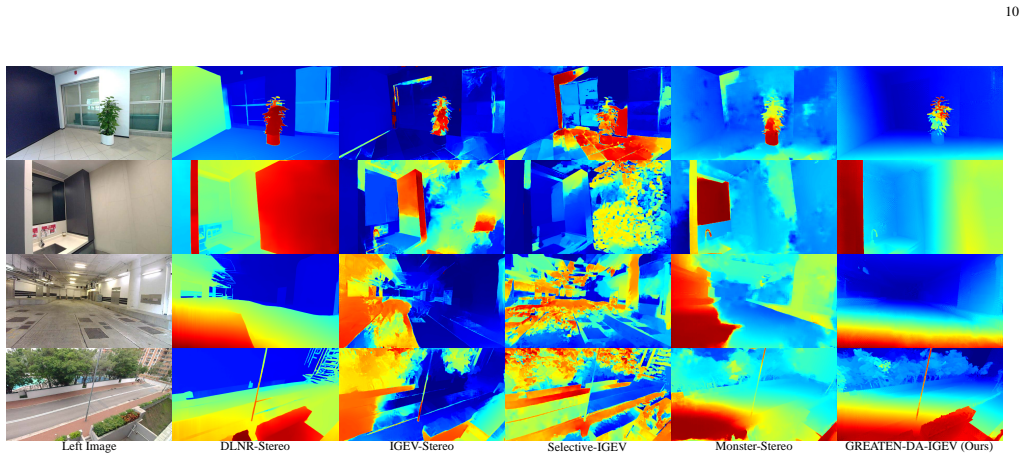
The paper claims that augmenting stereo matching networks with surface normals as domain-invariant, object-intrinsic geometric cues, fused through a gated contextual-geometric module that filters misleading image textures, plus specular-transparent augmentation and sparse spatial-dual-matching attentions, enables models trained solely on synthetic data such as SceneFlow to achieve lower error rates on real datasets while running faster and supporting high-resolution inference.
What carries the argument
The Gated Contextual-Geometric Fusion module that adaptively suppresses unreliable contextual cues from image features and fuses the remainder with normal-driven geometric features to build domain-invariant representations.
If this is right
- Reduces disparity errors by 30% on ETH3D compared to prior methods.
- Achieves 8.5% lower errors on the non-Lambertian Booster dataset.
- Improves results by 14.1% on KITTI-2015 relative to comparable baselines.
- Runs 19.2% faster than the preceding GREAT-IGEV model.
- Supports 3K-resolution inference with disparity ranges up to 768.
Where Pith is reading between the lines
- The same normal-based reinforcement could be tested in related cross-domain tasks such as optical flow or monocular depth estimation where texture cues also shift.
- End-to-end joint training of normal estimation with the stereo network might remove the need for separate normal inputs at inference time.
- The sparse attention patterns may transfer to other dense prediction problems that require both global context and low compute.
Load-bearing premise
Surface normals can be obtained or estimated reliably enough in real scenes to serve as consistent, domain-invariant cues without introducing new errors.
What would settle it
A controlled test on the Booster or ETH3D dataset where the full model with normal inputs produces higher disparity errors than an otherwise identical image-only baseline in non-Lambertian or occluded regions.
Figures






read the original abstract
Despite remarkable advances in image-driven stereo matching over the past decade, Synthetic-to-Realistic ZeroShot (Syn-to-Real) generalization remains an open challenge. This suboptimal generalization performance mainly stems from cross-domain shifts and ill-posed ambiguities inherent in image textures, particularly in occluded, textureless, repetitive, and non-Lambertian (specular/transparent) regions. To improve Synto-Real generalization, we propose GREATEN, a framework that incorporates surface normals as domain-invariant, object-intrinsic, and discriminative geometric cues to compensate for the limitations of image textures. The proposed framework consists of three key components. First, a Gated Contextual-Geometric Fusion (GCGF) module adaptively suppresses unreliable contextual cues in image features and fuses the filtered image features with normal-driven geometric features to construct domain-invariant and discriminative contextual-geometric representations. Second, a Specular-Transparent Augmentation (STA) strategy improves the robustness of GCGF against misleading visual cues in non-Lambertian regions. Third, sparse attention designs preserve the fine-grained global feature extraction capability of GREATStereo for handling occlusion and texture-related ambiguities while substantially reducing computational overhead, including Sparse Spatial (SSA), Sparse Dual-Matching (SDMA), and Simple Volume (SVA) attentions. Trained exclusively on synthetic data such as SceneFlow, GREATEN-IGEV achieves outstanding Syn-to-Real performance. Specifically, it reduces errors by 30% on ETH3D, 8.5% on the non-Lambertian Booster, and 14.1% on KITTI-2015, compared to FoundationStereo, Monster-Stereo, and DEFOM-Stereo, respectively. In addition, GREATEN-IGEV runs 19.2% faster than GREAT-IGEV and supports high-resolution (3K) inference on Middlebury with disparity ranges up to 768.
Editorial analysis
A structured set of objections, weighed in public.
Referee Report
Summary. The paper introduces GREATEN, a stereo matching architecture that augments image-based features with surface normals as domain-invariant geometric cues to address Syn-to-Real generalization gaps. The framework comprises a Gated Contextual-Geometric Fusion (GCGF) module for adaptive fusion, a Specular-Transparent Augmentation (STA) strategy for non-Lambertian robustness, and three sparse attention variants (SSA, SDMA, SVA) for efficiency. Trained solely on synthetic SceneFlow data, GREATEN-IGEV reports error reductions of 30% on ETH3D, 8.5% on Booster, and 14.1% on KITTI-2015 relative to recent baselines, while also claiming 19.2% faster inference and support for 3K resolution.
Significance. If the empirical gains are reproducible and attributable to the geometric cues rather than implementation details, the work would provide a practical route to stronger zero-shot transfer in stereo without real-world fine-tuning. The emphasis on efficiency via sparse attention and the explicit handling of non-Lambertian regions via STA are concrete strengths that could influence downstream applications in robotics and 3D reconstruction.
major comments (3)
- [Experimental results] Experimental section (results tables and text): the reported percentage reductions (30% on ETH3D, 8.5% on Booster, 14.1% on KITTI) are given as single-point comparisons without error bars, standard deviations across runs, or statistical significance tests. This weakens the central claim that the normal-augmented model reliably outperforms the cited baselines.
- [GCGF module and experimental setup] Method description of GCGF and data pipeline: the framework treats surface normals as given inputs for both training and real test images, yet provides no description of how normals are computed or estimated on real benchmarks (ETH3D, Booster, KITTI). Because the weakest link in the Syn-to-Real argument is the reliability of these cues under real illumination and sensor noise, this omission is load-bearing for the generalization claim.
- [Ablation experiments] Ablation study (if present) or supplementary material: without component-wise ablations isolating the contribution of GCGF versus STA versus the sparse attentions, it is impossible to determine whether the observed gains stem from the geometric fusion or from other architectural changes relative to the GREAT-IGEV baseline.
minor comments (2)
- [Abstract] The acronym GREATEN-IGEV is introduced without an explicit expansion or reference to the underlying IGEV backbone in the abstract; a brief parenthetical clarification would improve readability.
- [Figure 2 or equivalent] Figure captions for the architecture diagram should explicitly label the three sparse attention blocks (SSA, SDMA, SVA) and the gating thresholds to match the textual description.
Simulated Author's Rebuttal
We thank the referee for the constructive and detailed comments on our manuscript. These observations highlight important aspects for strengthening the presentation of our results and methods. We address each major comment point by point below and will incorporate the necessary revisions to improve clarity and rigor.
read point-by-point responses
-
Referee: Experimental section (results tables and text): the reported percentage reductions (30% on ETH3D, 8.5% on Booster, 14.1% on KITTI) are given as single-point comparisons without error bars, standard deviations across runs, or statistical significance tests. This weakens the central claim that the normal-augmented model reliably outperforms the cited baselines.
Authors: We agree that single-point comparisons limit the strength of the claims. In the revised manuscript, we will conduct additional training runs with varied random seeds to report mean performance and standard deviations for the key metrics. We will also include statistical significance testing (such as paired t-tests) against the baselines to substantiate the reliability of the reported improvements. revision: yes
-
Referee: Method description of GCGF and data pipeline: the framework treats surface normals as given inputs for both training and real test images, yet provides no description of how normals are computed or estimated on real benchmarks (ETH3D, Booster, KITTI). Because the weakest link in the Syn-to-Real argument is the reliability of these cues under real illumination and sensor noise, this omission is load-bearing for the generalization claim.
Authors: This is a valid observation regarding a missing detail in the experimental setup. Although the manuscript describes normals as inputs, we will expand the data pipeline section in the revision to explicitly describe the normal estimation method applied to each real-world benchmark, including the specific pre-trained estimator, any adaptation steps, and preprocessing. We will also add a brief discussion of the expected robustness of these estimates to real-world variations in illumination and noise. revision: yes
-
Referee: Ablation study (if present) or supplementary material: without component-wise ablations isolating the contribution of GCGF versus STA versus the sparse attentions, it is impossible to determine whether the observed gains stem from the geometric fusion or from other architectural changes relative to the GREAT-IGEV baseline.
Authors: We recognize that isolating the contribution of each proposed component is essential for attributing the performance gains. The current manuscript provides baseline comparisons but lacks exhaustive component ablations. In the revised version, we will include detailed ablation experiments (in the main text or supplementary material) that evaluate the model with and without GCGF, STA, and each sparse attention variant individually, thereby clarifying the source of the Syn-to-Real improvements. revision: yes
Circularity Check
No significant circularity detected
full rationale
The paper presents an empirical architecture (GCGF module, STA augmentation, sparse attentions SSA/SDMA/SVA) that fuses surface normals as additional geometric input with image features, trained exclusively on synthetic SceneFlow data and evaluated via direct error reductions on external real-world benchmarks (ETH3D, Booster, KITTI-2015). No equations, derivations, or parameter-fitting steps are described that reduce a claimed prediction or uniqueness result back to the same fitted quantities or self-citations by construction. References to prior GREAT-IGEV/GREAT-Stereo work are limited to runtime and capability comparisons rather than load-bearing justifications for the central Syn-to-Real gains. The performance numbers are reported as measured outcomes against independent baselines, rendering the derivation chain self-contained and non-circular.
Axiom & Free-Parameter Ledger
free parameters (1)
- Gating thresholds and attention sparsity ratios
axioms (1)
- domain assumption Surface normals are domain-invariant, object-intrinsic, and more discriminative than image textures for cross-domain stereo matching
discussion (0)
Sign in with ORCID, Apple, or X to comment. Anyone can read and Pith papers without signing in.