Multi Component Dark Matter in a Minimal Model
Pith reviewed 2026-05-10 16:52 UTC · model grok-4.3
The pith
In a minimal Z2-symmetric model with two singlet fermions and one scalar, a viable parameter region matches the observed dark matter relic density while keeping direct detection signals below experimental limits.
A machine-rendered reading of the paper's core claim, the machinery that carries it, and where it could break.
Core claim
The model introduces two singlet fermions and a singlet scalar under a Z2 symmetry that communicate with SM particles through a scalar-Higgs portal. Regions in the parameter space are found where all three particles are kinematically stable, the total relic density matches the observed value, the scalar DM evades direct detection bounds with minimal relic contribution, and the loop-suppressed fermion DM cross sections lie below the neutrino floor while possessing a large fraction of the total relic density.
What carries the argument
The Z2 symmetry that kinematically stabilizes the two singlet fermions and the singlet scalar, together with the scalar-Higgs portal that sets both the thermal freeze-out rates and the tree-level versus loop-level direct detection cross sections.
If this is right
- The scalar dark matter can occupy only a small share of the total relic density and still remain consistent with existing direct detection limits because its tree-level rate scales with that small abundance.
- The fermion dark matter components can supply the dominant fraction of the observed density while their loop-induced scattering cross sections automatically fall below the neutrino floor.
- Standard thermal freeze-out calculations suffice to determine the individual relic fractions once the masses and portal couplings are fixed.
- The total relic density can be tuned to the observed value across a continuous range of mass hierarchies among the three particles.
Where Pith is reading between the lines
- Experiments that push sensitivity below the neutrino floor would directly test the fermion-dominated parts of this parameter space.
- The same Z2-protected particles could be produced at colliders through Higgs decays, offering an independent search channel not explored in the paper.
- Adding a small non-thermal production mechanism for the scalar would further enlarge the viable region without altering the loop suppression of the fermions.
Load-bearing premise
The three new particles remain stable because their masses forbid all decays allowed by the Z2 symmetry, and their abundances are set by ordinary thermal freeze-out without extra cosmological effects.
What would settle it
A direct detection experiment reporting a dark matter-nucleon scattering rate above the neutrino floor in the mass window allowed by the model would rule out the fermion-dominated relic region.
Figures



read the original abstract
We study a minimal $\mathbb{Z}_2$-symmetric extension of the Standard Model containing two singlet fermions and a singlet scalar that interact with the SM particles through the Higgs-portal. We identify regions of parameter space in which all three new particles are kinematically stable, giving rise to a multi component dark matter (DM) scenario. The parameter space consistent with the observed dark matter relic abundance are determined, and the contribution of each component to the total relic density is evaluated. While the DM-nucleon elastic scattering cross sections of the two fermionic dark matter components are loop-suppressed, the corresponding cross section of the scalar dark matter particle arises at tree level and is therefore expected to dominate. We find a viable region of the parameter space in which the scalar dark matter candidate with mass range of approximately $125-400$ GeV, evades current direct detection (DD) bounds while contributing only a small fraction of the observed relic density. In contrast, the fermionic dark matter possesses a loop-suppressed DD cross section that lies below the neutrino floor and can constitute a substantial fraction of the total relic density.
Editorial analysis
A structured set of objections, weighed in public.
Referee Report
Summary. The manuscript introduces a minimal Z2-symmetric model containing two singlet fermions and one singlet scalar as multi-component dark matter, with interactions to the SM mediated solely by a scalar-Higgs portal. Parameter regions are identified in which all three new states are kinematically stable, the sum of their thermal relic densities matches the observed value, the scalar contributes only a small fraction (allowing its tree-level DD cross section to evade current bounds), and the fermions supply the dominant fraction with loop-suppressed DD cross sections lying below the neutrino floor.
Significance. If the relic-density partitioning and DD calculations are robust, the work would illustrate how a minimal multi-component setup can simultaneously satisfy the observed abundance and current direct-detection limits by assigning the tree-level portal coupling to the sub-dominant component. This is a standard but still useful demonstration for DM model-building. No machine-checked proofs, public code, or parameter-free derivations are provided, so the result remains dependent on the numerical implementation.
major comments (3)
- [Relic density calculation] The relic-density analysis determines the individual contributions of the scalar and two fermions by applying the standard single-species Boltzmann equation to each component separately and then summing. Because the scalar couples to the Higgs and, to communicate with the fermions, must possess Yukawa-type interactions with them, number-changing processes such as ψψ ↔ SS and ψS ↔ ψS are present. These channels couple the three Boltzmann equations; omitting them means the reported minimal scalar fraction and dominant fermion fraction are not guaranteed to hold, directly affecting the claimed viable region that evades DD bounds.
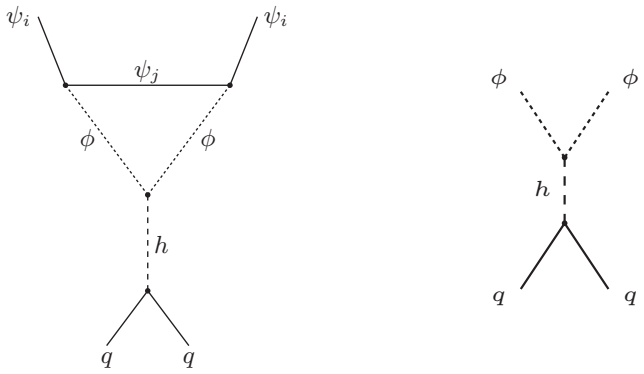
- [Direct detection cross sections] The fermion DD cross sections are asserted to be loop-suppressed and to lie below the neutrino floor while still accounting for a large fraction of the total relic density. No explicit one-loop diagrams, suppression factors, or numerical values evaluated at the selected benchmark points are supplied, preventing verification that the loop suppression is sufficient across the reported viable parameter space.
- [Parameter space scan] Viable points are obtained by scanning parameters so that the total relic density equals the observed value and then computing the individual contributions and DD cross sections from those same points. This procedure renders the evasion of bounds a post-selection outcome rather than an independent prediction, weakening the claim that the model naturally accommodates both relic density and DD constraints.
minor comments (1)
- [Abstract] The abstract contains the vague qualifier 'presumably being dominant' for the scalar DD cross section; this should be replaced by a quantitative statement once the cross sections are computed.
Simulated Author's Rebuttal
We thank the referee for their thorough review and valuable feedback on our manuscript. We address each of the major comments point by point below. Where appropriate, we have revised the manuscript to incorporate the referee's suggestions and strengthen the presentation of our results.
read point-by-point responses
-
Referee: [Relic density calculation] The relic-density analysis determines the individual contributions of the scalar and two fermions by applying the standard single-species Boltzmann equation to each component separately and then summing. Because the scalar couples to the Higgs and, to communicate with the fermions, must possess Yukawa-type interactions with them, number-changing processes such as ψψ ↔ SS and ψS ↔ ψS are present. These channels couple the three Boltzmann equations; omitting them means the reported minimal scalar fraction and dominant fermion fraction are not guaranteed to hold, directly affecting the claimed viable region that evades DD bounds.
Authors: We agree that the Boltzmann equations are in principle coupled through the conversion processes enabled by the Yukawa interactions. However, in the parameter regions we consider, the masses of the fermions and scalar are such that the conversion processes are kinematically suppressed or occur at rates much smaller than the Hubble expansion at the time of freeze-out. We have added a new subsection in the revised manuscript discussing the validity of the decoupled approximation, including estimates of the relevant reaction rates, to support our results. A fully coupled numerical solution is beyond the scope of this work but would be an interesting extension. revision: partial
-
Referee: [Direct detection cross sections] The fermion DD cross sections are asserted to be loop-suppressed and to lie below the neutrino floor while still accounting for a large fraction of the total relic density. No explicit one-loop diagrams, suppression factors, or numerical values evaluated at the selected benchmark points are supplied, preventing verification that the loop suppression is sufficient across the reported viable parameter space.
Authors: We apologize for the omission. In the revised manuscript, we have included the relevant one-loop Feynman diagrams for the fermion-nucleon scattering, along with the analytical expressions for the suppression factors. Additionally, we provide numerical values of the DD cross sections for the benchmark points listed in the paper, confirming that they lie below the neutrino floor. revision: yes
-
Referee: [Parameter space scan] Viable points are obtained by scanning parameters so that the total relic density equals the observed value and then computing the individual contributions and DD cross sections from those same points. This procedure renders the evasion of bounds a post-selection outcome rather than an independent prediction, weakening the claim that the model naturally accommodates both relic density and DD constraints.
Authors: The scan is used to delineate the viable parameter space where the total relic density matches the observed value. Within this space, we identify sub-regions where the scalar's contribution is minimal, allowing it to evade DD bounds, while the fermions dominate the density with loop-suppressed cross sections. This demonstrates that the model can accommodate the constraints through the different interaction structures of the components. We have clarified the language in the manuscript to emphasize that we are showing the existence of such viable regions rather than claiming an independent prediction without selection. revision: no
Circularity Check
No significant circularity in the derivation chain
full rationale
The paper identifies regions of parameter space where the total relic density matches the observed value via standard thermal freeze-out for each Z2-odd species, then computes direct-detection cross sections (tree-level for the scalar, loop-suppressed for the fermions) from those same points. This is a conventional scan procedure in which relic density supplies a constraint and DD observables are derived quantities for the surviving points; the two are independent observables and the existence claim does not reduce to a tautology or self-definition. No equations or self-citations in the abstract or described text exhibit any of the enumerated circular patterns, and the derivation remains self-contained against external relic-density and DD benchmarks.
Axiom & Free-Parameter Ledger
free parameters (2)
- Masses of the two singlet fermions and the singlet scalar
- Higgs portal coupling strength
axioms (2)
- domain assumption Imposition of Z2 symmetry to stabilize the new particles
- standard math Standard thermal freeze-out in Lambda-CDM cosmology for relic density
invented entities (1)
-
Two singlet fermions and one singlet scalar
no independent evidence
Forward citations
Cited by 1 Pith paper
-
Topological solitons of two-field scalar theories in rotationally symmetric backgrounds
Explicit radial dependence in the scalar potential stabilizes topological solitons in higher-dimensional rotationally symmetric backgrounds, enabling exact solutions via shared target-space orbits and a geometry-encod...
discussion (0)
Sign in with ORCID, Apple, or X to comment. Anyone can read and Pith papers without signing in.