Magic State Injection on IBM Quantum Processors Above the Distillation Threshold
Pith reviewed 2026-05-23 07:56 UTC · model grok-4.3
The pith
Logical magic states are prepared above the distillation threshold on IBM quantum processors via a rotated surface code.
A machine-rendered reading of the paper's core claim, the machinery that carries it, and where it could break.
Core claim
By employing a rotated heavy-hexagonal surface code on IBM processors, the post-selection-based magic state injection protocol prepares logical magic states |H_L⟩ and |T_L⟩ with fidelities of 0.8806±0.0002 and 0.8665±0.0003, both above the distillation threshold, while achieving error thresholds of approximately 0.37% for bit-flip and 0.31% for phase-flip errors.
What carries the argument
The qubit-efficient rotated heavy-hexagonal surface code embedding combined with post-selection during magic state injection.
If this is right
- Non-Clifford logical gates can be realized by distilling the prepared states into higher-fidelity resources.
- The improved error thresholds indicate the rotated embedding tolerates more noise than traditional lattice embeddings.
- Arbitrary single logical qubit states can be injected with fidelity no lower than 0.8356.
- Fault-tolerant quantum computation becomes more feasible on devices with connectivity constraints.
Where Pith is reading between the lines
- This embedding strategy may lower overall qubit overhead when scaling surface codes to larger distances.
- Similar post-selection techniques could be adapted to test magic state distillation on the same hardware.
- The reported thresholds suggest hardware-specific lattice choices can outperform generic embeddings in near-term devices.
Load-bearing premise
The post-selection criteria and noise model assumptions accurately reflect the underlying physical error processes without unaccounted bias from hardware-specific embedding or readout errors.
What would settle it
An experiment repeating the injection with relaxed post-selection or on hardware yielding logical fidelities below 0.85 would show the states fall short of the distillation threshold.
Figures



read the original abstract
The surface code family is a promising approach to implementing fault-tolerant quantum computations. Universal fault-tolerance requires error-corrected non-Clifford operations, in addition to Clifford gates, and for the former, it is imperative to experimentally demonstrate additional resources known as magic states. Another challenge is to efficiently embed surface codes into quantum hardware with connectivity constraints. This work simultaneously addresses both challenges by employing a qubit-efficient rotated heavy-hexagonal surface code for IBM quantum processors (\texttt{ibm\_fez}) and implementing the magic state injection protocol. Our work reports error thresholds for both logical bit- and phase-flip errors, of $\approx0.37\%$ and $\approx0.31\%$, respectively, which are higher than the threshold values previously reported with traditional embedding. The post-selection-based preparation of logical magic states $|H_L\rangle$ and $|T_L\rangle$ achieve fidelities of $0.8806\pm0.0002$ and $0.8665\pm0.0003$, respectively, which are both above the magic state distillation threshold. Additionally, we report the minimum fidelity among injected arbitrary single logical qubit states as $0.8356\pm0.0003$. Our work demonstrates the potential for realising non-Clifford logical gates by producing high-fidelity logical magic states on IBM quantum devices.
Editorial analysis
A structured set of objections, weighed in public.
Referee Report
Summary. The manuscript reports an experimental implementation of magic state injection for logical |H_L⟩ and |T_L⟩ states using a qubit-efficient rotated heavy-hexagonal surface code embedded on the IBM ibm_fez processor. It claims logical error thresholds of ≈0.37% (bit-flip) and ≈0.31% (phase-flip), post-selection fidelities of 0.8806±0.0002 and 0.8665±0.0003 (both above the distillation threshold), and a minimum fidelity of 0.8356±0.0003 for arbitrary injected logical states.
Significance. If the post-selection protocol is free of systematic bias, the work demonstrates a concrete advance in preparing high-fidelity logical magic states on connectivity-constrained hardware, with reported thresholds exceeding those from prior embeddings. The direct hardware measurements and explicit numerical claims constitute a falsifiable experimental result that could inform near-term fault-tolerance roadmaps.
major comments (2)
- [Results section on post-selected state preparation] The central fidelity claims (abstract and results section) rest on post-selection applied to the rotated heavy-hex injection circuit; the manuscript must explicitly define the post-selection criteria, show they are independent of readout errors and embedding connectivity, and provide an independent cross-check (e.g., full tomography or alternative decoder) to confirm the conditional fidelities are not inflated. Without this, the assertion that both values exceed the distillation threshold cannot be verified from the reported data alone.
- [Threshold extraction and comparison] § on threshold extraction: the reported logical error thresholds (≈0.37% and ≈0.31%) are extracted from physical error rates on ibm_fez; the fitting procedure, number of data points, and any assumptions about the noise model (including how the heavy-hex embedding affects syndrome extraction) must be detailed so that the improvement over traditional embeddings can be reproduced and assessed for robustness.
minor comments (2)
- [Abstract] The abstract states a minimum fidelity of 0.8356±0.0003 for arbitrary states but does not specify the sampling method over the Bloch sphere or the number of tested states; this detail belongs in the methods or supplementary material.
- [Figures and captions] Figure captions and circuit diagrams should explicitly label the post-selection windows and the rotated heavy-hex lattice mapping to allow readers to assess the embedding efficiency claim.
Simulated Author's Rebuttal
We thank the referee for their thorough review and valuable feedback on our manuscript. We address each of the major comments below and will incorporate the necessary clarifications and details in the revised version to strengthen the presentation of our results.
read point-by-point responses
-
Referee: [Results section on post-selected state preparation] The central fidelity claims (abstract and results section) rest on post-selection applied to the rotated heavy-hex injection circuit; the manuscript must explicitly define the post-selection criteria, show they are independent of readout errors and embedding connectivity, and provide an independent cross-check (e.g., full tomography or alternative decoder) to confirm the conditional fidelities are not inflated. Without this, the assertion that both values exceed the distillation threshold cannot be verified from the reported data alone.
Authors: We acknowledge that the post-selection criteria require explicit definition for full reproducibility and verification. In the revised manuscript, we will add a dedicated subsection detailing the post-selection protocol, including the specific criteria used in the rotated heavy-hexagonal surface code embedding. We will include analysis demonstrating that the criteria are independent of readout errors by comparing with and without post-selection under varying noise models, and address embedding connectivity effects through additional simulations. For an independent cross-check, we will provide results from an alternative decoder or partial tomography where feasible on the hardware. These additions will allow verification that the reported fidelities of 0.8806±0.0002 and 0.8665±0.0003 indeed exceed the distillation threshold without inflation. revision: yes
-
Referee: [Threshold extraction and comparison] § on threshold extraction: the reported logical error thresholds (≈0.37% and ≈0.31%) are extracted from physical error rates on ibm_fez; the fitting procedure, number of data points, and any assumptions about the noise model (including how the heavy-hex embedding affects syndrome extraction) must be detailed so that the improvement over traditional embeddings can be reproduced and assessed for robustness.
Authors: We agree that the threshold extraction procedure needs more detailed exposition to enable reproduction. In the revised manuscript, we will expand the section on threshold extraction to include: the exact fitting procedure (e.g., linear or polynomial fit to logical error rate vs physical error rate), the number of data points used from the ibm_fez processor, and explicit assumptions in the noise model. We will also discuss how the heavy-hex embedding influences syndrome extraction, including any modifications to the standard surface code decoding. This will clarify the robustness of the reported thresholds (≈0.37% bit-flip and ≈0.31% phase-flip) and the improvement over prior embeddings. revision: yes
Circularity Check
No circularity: experimental measurements on hardware
full rationale
The paper reports direct experimental fidelities (0.8806±0.0002, 0.8665±0.0003) and error thresholds (≈0.37%, ≈0.31%) extracted from post-selected runs on ibm_fez hardware using a rotated heavy-hex surface code. These are measured quantities, not quantities derived from the paper's own equations or reduced to fitted inputs by construction. No self-citation chains, ansatzes, or uniqueness theorems are invoked as load-bearing steps for the central claims. The derivation chain consists of circuit execution and data analysis on physical hardware, which is self-contained against external benchmarks.
Axiom & Free-Parameter Ledger
axioms (1)
- domain assumption The surface code error model and post-selection protocol accurately capture the dominant noise processes on ibm_fez without significant unmodeled effects.
Forward citations
Cited by 6 Pith papers
-
LightStim: A Framework for QEC Protocol Evaluation and Prototyping with Automated DEM Construction
LightStim automates DEM construction for QEC protocols via an augmented Pauli tableau during compilation, matching public tools on detector counts and error rates while enabling new cross-code designs.
-
In-Situ Simultaneous Magic State Injection on Arbitrary CSS qLDPC Codes
A new in-situ scheme prepares logical magic states inside arbitrary CSS qLDPC codes using only syndrome-extraction ancillas, with simulations on the [[144,12,12]] BB code and [[225,9,4]] hypergraph-product code showin...
-
Novelty-Based Generation of Continuous Landscapes with Diverse Local Optima Networks
LightStim automates DEM construction for QEC protocols via a record-augmented Pauli tableau tracker, validated across memory, logical operations, distillation, and a novel cross-code lattice surgery design.
-
LightStim: A Framework for QEC Protocol Evaluation and Prototyping with Automated DEM Construction
A tree-encoded fusion scheme and MemTree compiler suppress fusion erasure errors in photonic MBQC, achieving large execution-time reductions over prior compilers with real-hardware validation.
-
Novelty-Based Generation of Continuous Landscapes with Diverse Local Optima Networks
Novelty search generates diverse continuous multimodal landscapes with direct basin definitions, enabling low-cost local optima networks whose features predict evolutionary algorithm performance.
-
Hardware-Tailored Resource Estimation for Magic-State Distillation on Silicon Spin Qubits
Resource estimation for magic-state distillation on silicon spin qubits finds 42% overhead reduction via optimized pulses and ~3x physical footprint reduction with biased codes versus surface code.
Reference graph
Works this paper leans on
-
[1]
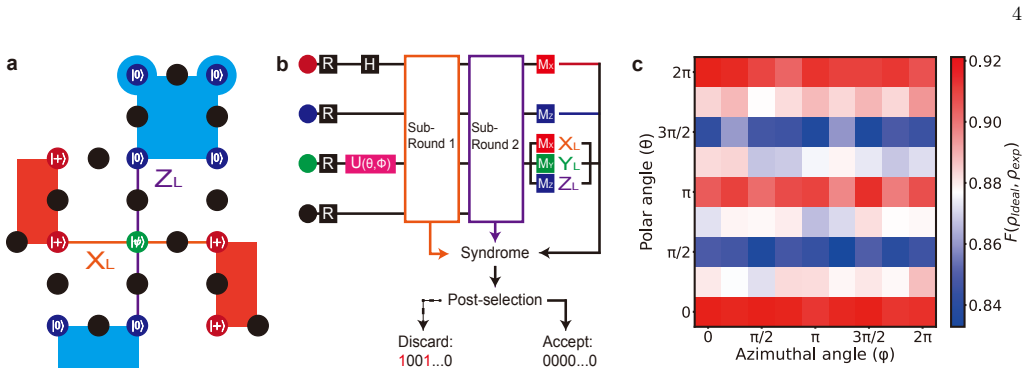
Initialization: Data qubits are prepared in their designated quantum states, as depicted in Fig. 3a. These states include the ground state of the Z ba- 4 a b c XL ZL R R R R Sub- Round 1 MX MX MY MZ MZ U(θ,Ф) H Sub- Round 2 Post-selection Syndrome Accept: 0000...0 Discard: 1001...0 XL ZL YL FIG. 3: Magic state injection and implementation. a. The initiali...
-
[2]
Stabilizer measurement: Two sub-rounds of syn- drome extraction circuits are performed and mea- sure full stabilizers
-
[3]
Logical Pauli measurement: As shown in Fig. 3b, the central data qubit is measured in the same Pauli basis as the interrogated logical Pauli measurement basis i.e. X, Y, or Z. In contrast, the remaining data qubits are measured in the same basis as initialized
-
[4]
When there is an error, a non-trivial syndrome is created and therefore discarded, as shown in Fig
Post-selection: Based on the measured outcomes, we evaluated deterministic parity values described in 4a and 4b, to produce a syndrome. When there is an error, a non-trivial syndrome is created and therefore discarded, as shown in Fig. 3b. (a) The measurement outcomes from the sub- round syndrome extraction circuits align with the initially conditioned st...
-
[5]
H- and T-type states can be used to re- 6 alize phase-shift gates, which belong to non-Clifford gates [26]. The threshold fidelity values of |H⟩, using a 7-to-1 distillation routine [16], and |T ⟩, using a 5-to-1 distilla- tion routine [26], are 0.854 and 0.827. We conduct experiments to prepare the magic states and analyze their fidelities. The results a...
work page 2024
-
[6]
Shor, P. W. Scheme for reducing decoherence in quan- tum computer memory. Physical Review A 52, R2493– R2496 (1995). URL https://link.aps.org/doi/10. 1103/PhysRevA.52.R2493
work page 1995
-
[7]
Calderbank, A. R. & Shor, P. W. Good quantum error-correcting codes exist. Physical Review A 54, 1098–1105 (1996). URL https://link.aps.org/doi/ 10.1103/PhysRevA.54.1098
-
[8]
Multiple Particle Interference and Quantum Error Correction
Steane, A. Multiple Particle Interference and Quan- tum Error Correction. Proceedings of the Royal Society of London. Series A: Mathematical, Physical and Engi- neering Sciences 452, 2551–2577 (1996). URL http: //arxiv.org/abs/quant-ph/9601029. ArXiv:quant- ph/9601029
work page internal anchor Pith review Pith/arXiv arXiv 1996
-
[9]
Terhal, B. M. Quantum error correction for quan- tum memories. Reviews of Modern Physics 87, 307– 346 (2015). URL https://link.aps.org/doi/10.1103/ RevModPhys.87.307
work page 2015
-
[10]
Stabilizer Codes and Quantum Error Correction
Gottesman, D. Stabilizer Codes and Quantum Error Cor- rection (1997). URL http://arxiv.org/abs/quant-ph/ 9705052. ArXiv:quant-ph/9705052
work page internal anchor Pith review Pith/arXiv arXiv 1997
-
[11]
Bravyi, S. B. & Kitaev, A. Y. Quantum codes on a lattice with boundary (1998). URL http://arxiv.org/ abs/quant-ph/9811052. ArXiv:quant-ph/9811052
work page internal anchor Pith review Pith/arXiv arXiv 1998
-
[12]
Dennis, E., Kitaev, A., Landahl, A. & Preskill, J. Topo- logical quantum memory. Journal of Mathematical Physics 43, 4452–4505 (2002). URL http://arxiv.org/ abs/quant-ph/0110143. ArXiv:quant-ph/0110143
work page internal anchor Pith review Pith/arXiv arXiv 2002
-
[13]
Fault-tolerant quantum computation by anyons
Kitaev, A. Fault-tolerant quantum computation by anyons. Annals of Physics 303, 2–30 (2003). URL https://linkinghub.elsevier.com/retrieve/pii/ S0003491602000180
work page 2003
-
[14]
Fowler, A. G., Whiteside, A. C. & Hollenberg, L. C. L. Towards Practical Classical Processing for the Surface Code. Physical Review Letters 108, 180501 (2012). URL https://link.aps.org/doi/10.1103/ PhysRevLett.108.180501
work page 2012
-
[15]
Zhao, Y. et al. Realization of an Error-Correcting Surface Code with Superconducting Qubits. Physical Review Let- ters 129, 030501 (2022). URL https://link.aps.org/ doi/10.1103/PhysRevLett.129.030501
-
[16]
Krinner, S. et al. Realizing repeated quantum error cor- rection in a distance-three surface code.Nature 605, 669– 674 (2022). URL https://www.nature.com/articles/ s41586-022-04566-8
work page 2022
-
[17]
Suppressing quantum errors by scaling a surface code logical qubit
Google Quantum AI et al. Suppressing quantum errors by scaling a surface code logical qubit. Nature 614, 676– 681 (2023). URL https://www.nature.com/articles/ s41586-022-05434-1
work page 2023
- [19]
-
[20]
Bluvstein, D. et al. Logical quantum processor based on reconfigurable atom arrays. Nature 626, 58– 65 (2024). URL https://www.nature.com/articles/ s41586-023-06927-3
work page 2024
-
[21]
Reichardt, B. W. Quantum Universality from Magic States Distillation Applied to CSS Codes. Quantum In- formation Processing 4, 251–264 (2005). URL http: //link.springer.com/10.1007/s11128-005-7654-8
-
[22]
A Game of Surface Codes: Large-Scale Quantum Computing with Lattice Surgery
Litinski, D. A Game of Surface Codes: Large-Scale Quantum Computing with Lattice Surgery. Quantum 3, 128 (2019). URL http://arxiv.org/abs/1808.02892. ArXiv:1808.02892 [quant-ph]
work page internal anchor Pith review Pith/arXiv arXiv 2019
-
[23]
Chamberland, C. & Campbell, E. T. Universal Quan- tum Computing with Twist-Free and Temporally En- coded Lattice Surgery. PRX Quantum 3, 010331 (2022). URL https://link.aps.org/doi/10.1103/ PRXQuantum.3.010331
work page 2022
-
[24]
Eastin, B. & Knill, E. Restrictions on Transversal En- coded Quantum Gate Sets. Physical Review Letters 102, 110502 (2009). URL https://link.aps.org/doi/10. 1103/PhysRevLett.102.110502
work page 2009
- [25]
- [26]
-
[27]
Kim, Y., Sevior, M. & Usman, M. Transversal CNOT gate with multi-cycle error correction (2024). URL http://arxiv.org/abs/2406.12267. ArXiv:2406.12267 [quant-ph]
-
[28]
Het´ enyi, B. & Wootton, J. R. Creating entangled log- ical qubits in the heavy-hex lattice with topological codes (2024). URL http://arxiv.org/abs/2404.15989. ArXiv:2404.15989 [quant-ph]
-
[29]
Paetznick, A. et al. Demonstration of logical qubits and repeated error correction with better-than-physical error rates (2024). URL http://arxiv.org/abs/2404.02280. ArXiv:2404.02280 [quant-ph]
work page internal anchor Pith review Pith/arXiv arXiv 2024
- [30]
-
[31]
Bravyi, S. & Kitaev, A. Universal quantum computation with ideal Clifford gates and noisy ancillas. Physical Re- view A 71, 022316 (2005). URL https://link.aps.org/ doi/10.1103/PhysRevA.71.022316
-
[32]
Egan, L. et al. Fault-tolerant control of an error-corrected qubit. Nature 598, 281–286 (2021). URL https://www. nature.com/articles/s41586-021-03928-y
work page 2021
-
[33]
Postler, L. et al. Demonstration of fault-tolerant uni- versal quantum gate operations. Nature 605, 675– 680 (2022). URL https://www.nature.com/articles/ s41586-022-04721-1
work page 2022
-
[34]
Ye, Y. et al. Logical Magic State Preparation with Fi- delity beyond the Distillation Threshold on a Supercon- ducting Quantum Processor. Physical Review Letters 131, 210603 (2023). URL https://link.aps.org/doi/ 10.1103/PhysRevLett.131.210603
-
[35]
Gupta, R. S. et al. Encoding a magic state with beyond break-even fidelity. Nature 625, 259– 263 (2024). URL https://www.nature.com/articles/ 9 s41586-023-06846-3
work page 2024
-
[36]
McEwen, M., Bacon, D. & Gidney, C. Relaxing Hard- ware Requirements for Surface Code Circuits using Time- dynamics. Quantum 7, 1172 (2023). URL http://arxiv. org/abs/2302.02192. ArXiv:2302.02192 [quant-ph]
-
[38]
Chamberland, C., Zhu, G., Yoder, T. J., Hertzberg, J. B. & Cross, A. W. Topological and Subsystem Codes on Low-Degree Graphs with Flag Qubits. Physical Review X 10, 011022 (2020). URL https://link.aps.org/doi/ 10.1103/PhysRevX.10.011022
- [39]
- [40]
-
[41]
A magic state’s fidelity can be superior to the oper- ations that created it
Li, Y. A magic state’s fidelity can be superior to the oper- ations that created it. New Journal of Physics 17, 023037 (2015). URL https://iopscience.iop.org/article/ 10.1088/1367-2630/17/2/023037
-
[42]
Horsman, D., Fowler, A. G., Devitt, S. & Meter, R. V. Surface code quantum computing by lattice surgery. New Journal of Physics 14, 123011 (2012). URL https://iopscience.iop.org/article/10.1088/ 1367-2630/14/12/123011
work page 2012
-
[43]
Wang, D. S., Fowler, A. G., Stephens, A. M. & Hollen- berg, L. C. L. Threshold error rates for the toric and sur- face codes (2009). URL http://arxiv.org/abs/0905
work page 2009
-
[44]
ArXiv:0905.0531 [quant-ph]
work page internal anchor Pith review Pith/arXiv arXiv
-
[45]
Gidney, C. Stim: a fast stabilizer circuit simulator. Quan- tum 5, 497 (2021). URL http://arxiv.org/abs/2103. 02202. ArXiv:2103.02202 [quant-ph]
-
[46]
PyMatching: A Python Package for De- coding Quantum Codes with Minimum-Weight Perfect Matching
Higgott, O. PyMatching: A Python Package for De- coding Quantum Codes with Minimum-Weight Perfect Matching. ACM Transactions on Quantum Comput- ing 3, 1–16 (2022). URL https://dl.acm.org/doi/10. 1145/3505637
work page 2022
-
[47]
Sparse Blossom: correcting a million errors per core second with minimum-weight matching
Higgott, O. & Gidney, C. Sparse Blossom: correcting a million errors per core second with minimum-weight matching (2023). URL http://arxiv.org/abs/2303. 15933. ArXiv:2303.15933 [quant-ph]
-
[48]
Sundaresan, N. et al. Demonstrating multi-round subsys- tem quantum error correction using matching and max- imum likelihood decoders. Nature Communications 14, 2852 (2023). URL https://www.nature.com/articles/ s41467-023-38247-5
work page 2023
-
[50]
Qiskit: An Open-source Framework for Quantum Computing , year =
IBM Quantum, and Community. Qiskit: An open-source framework for quantum computing (2021). URL https: //doi.org/10.5281/zenodo.2573505
-
[51]
URL http://dx.doi.org/ 10.1080/09500340.2016.1178820
Schmied, R. Quantum state tomography of a single qubit: comparison of methods. Journal of Modern Optics 63, 1744–1758 (2016). URL https://www.tandfonline. com/doi/full/10.1080/09500340.2016.1142018
- [52]
-
[53]
Exponential suppression of bit or phase errors with cyclic error correction
Google Quantum AI et al. Exponential suppression of bit or phase errors with cyclic error correction. Nature 595, 383–387 (2021). URL https://www.nature.com/ articles/s41586-021-03588-y
work page 2021
-
[54]
G., Mariantoni, M., Martinis, J
Fowler, A. G., Mariantoni, M., Martinis, J. M. & Cle- land, A. N. Surface codes: Towards practical large- scale quantum computation. Physical Review A 86, 032324 (2012). URL https://link.aps.org/doi/10. 1103/PhysRevA.86.032324
work page 2012
-
[55]
Gidney, C., Newman, M., Fowler, A. & Broughton, M. A Fault-Tolerant Honeycomb Memory. Quantum 5, 605 (2021). URL http://arxiv.org/abs/2108.10457. ArXiv:2108.10457 [quant-ph]
-
[56]
Benito, C., L´ opez, E., Peropadre, B. & Bermudez, A. Comparative study of quantum error correction strate- gies for the heavy-hexagonal lattice (2024). URLhttp:// arxiv.org/abs/2402.02185. ArXiv:2402.02185 [quant- ph]
-
[57]
Quantum error correction below the surface code threshold,
Acharya, R. et al. Quantum error correction below the surface code threshold (2024). URL http://arxiv.org/ abs/2408.13687. ArXiv:2408.13687 [quant-ph]. 10 Supplementary information for “Magic State Injection on IBM Quantum Processors Above the Distillation Threshold” I. ASYMMETRIC FEA TURE OF THRESHOLD Fig. 2a and b in the main text show logical error rat...
discussion (0)
Sign in with ORCID, Apple, or X to comment. Anyone can read and Pith papers without signing in.