A Plug-and-Play Method for Guided Multi-contrast MRI Reconstruction based on Content/Style Modeling
Pith reviewed 2026-05-23 20:59 UTC · model grok-4.3
The pith
A content/style model enables plug-and-play guided reconstruction of undersampled MRI by replacing aliased content from a reference contrast scan.
A machine-rendered reading of the paper's core claim, the machinery that carries it, and where it could break.
Core claim
A content/style model of two-contrast MR images is learned from partially paired image-domain data; the disentanglement allows the reconstruction step to become a direct replacement of the aliased content estimate by reference content, which is then combined with an MR data-consistency projection and a content-correction step to produce an iterative scheme that requires no k-space training data and remains generalizable across contrasts.
What carries the argument
The content/style model that explicitly separates contrast-independent content from contrast-specific style, turning prior incorporation into a simple replacement operation inside the iterative reconstruction.
If this is right
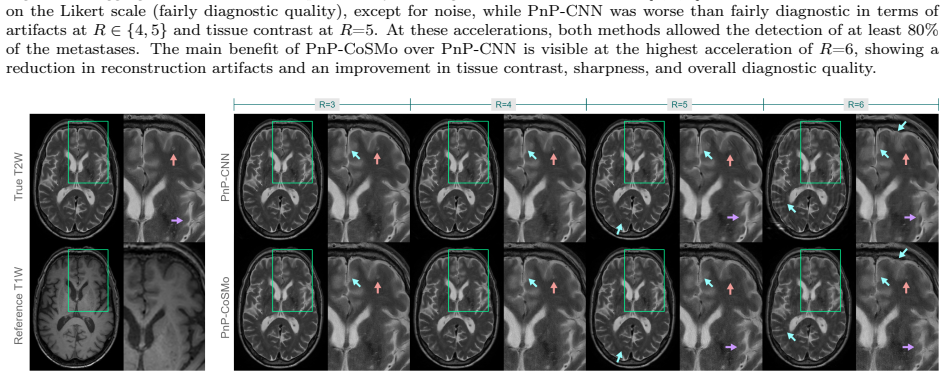
- Up to 32.6 percent greater acceleration is possible at a fixed SSIM on multi-coil datasets compared with non-guided reconstruction.
- Image quality matches or exceeds that of end-to-end trained methods while requiring only image-domain training data.
- The same trained model transfers across different contrasts without retraining on raw k-space.
- The scheme supplies an explicit account of shared versus non-shared generative factors between the two contrasts.
- Convergence behavior and interpretability can be examined directly through the replacement and correction steps.
Where Pith is reading between the lines
- The modular replacement operator could be swapped for other learned priors, allowing hybrid reconstruction pipelines that mix multiple reference scans.
- Because the content replacement is explicit, the method could support visual inspection of transferred information for clinical review.
- The reduction in training-data requirements suggests the approach may lower barriers to deploying guided reconstruction on new scanner hardware or protocols.
- Similar content-style separation might be tested on other multi-modal medical imaging tasks where one modality can serve as a reference for another.
Load-bearing premise
The content and style factors learned from partially paired image-domain datasets remain accurately separable even when applied to aliased, undersampled images during reconstruction.
What would settle it
If the replacement operation is tested on paired contrasts that share no common anatomical content (for example, brain versus knee scans), the iterative scheme should produce no improvement or outright degradation in SSIM relative to non-guided reconstruction.
Figures






read the original abstract
Since the various MR contrasts of a given anatomy contain redundant information, one contrast can be used to guide the reconstruction of another undersampled contrast acquired subsequently in the same session. To solve this reconstruction problem leveraging multi-contrast side information, several end-to-end learning-based methods have been proposed. However, a key challenge is the requirement for large paired training datasets comprising raw k-space data and aligned reference images. We propose a modular plug-and-play method, which requires no k-space training data and relies solely on partially paired image-domain datasets. A content/style model of two-contrast MR image data is first learned and subsequently applied as a plug-and-play operator in iterative reconstruction. The disentanglement of content and style allows explicit representation of contrast-independent and contrast-specific factors. Consequently, incorporating prior information into the reconstruction reduces to a simple replacement operation on the aliased content of the estimated image using high-quality content derived from the reference scan. Combining this operation with an MR data consistency step, followed by a corrective procedure for the content estimate, yields an iterative scheme. We name this novel approach PnP-CoSMo. It offers, by design, cross-contrast generalizability and provides an explanatory framework based on the shared and non-shared generative factors underlying the two given contrasts. We explore various aspects, including interpretability and convergence, via simulations. Furthermore, its practicality is demonstrated on the public NYU fastMRI DICOM dataset, showing equivalent or superior quality and greater generalizability compared to end-to-end methods. On two in-house multi-coil datasets, PnP-CoSMo enabled up to 32.6% greater acceleration over non-guided reconstruction at given SSIM.
Editorial analysis
A structured set of objections, weighed in public.
Referee Report
Summary. The manuscript introduces PnP-CoSMo, a modular plug-and-play iterative method for guided multi-contrast MRI reconstruction. It first learns a content/style disentanglement model from partially paired image-domain datasets (no k-space data required), then applies the model in reconstruction by replacing aliased content in the target contrast with high-quality content from a reference scan, followed by data consistency and a corrective step for the content estimate. The approach is claimed to offer cross-contrast generalizability by design and is evaluated on the NYU fastMRI DICOM dataset (equivalent/superior quality to end-to-end methods) plus two in-house multi-coil datasets (up to 32.6% greater acceleration at fixed SSIM versus non-guided reconstruction).
Significance. If the central assumption on stable disentanglement holds, the result is significant for reducing reliance on scarce paired k-space training data while retaining an interpretable generative-factor framework; the plug-and-play modularity and explicit separation of shared versus contrast-specific factors distinguish it from black-box end-to-end networks. The reported acceleration gains on in-house data and generalizability claims would be practically relevant if reproducible.
major comments (3)
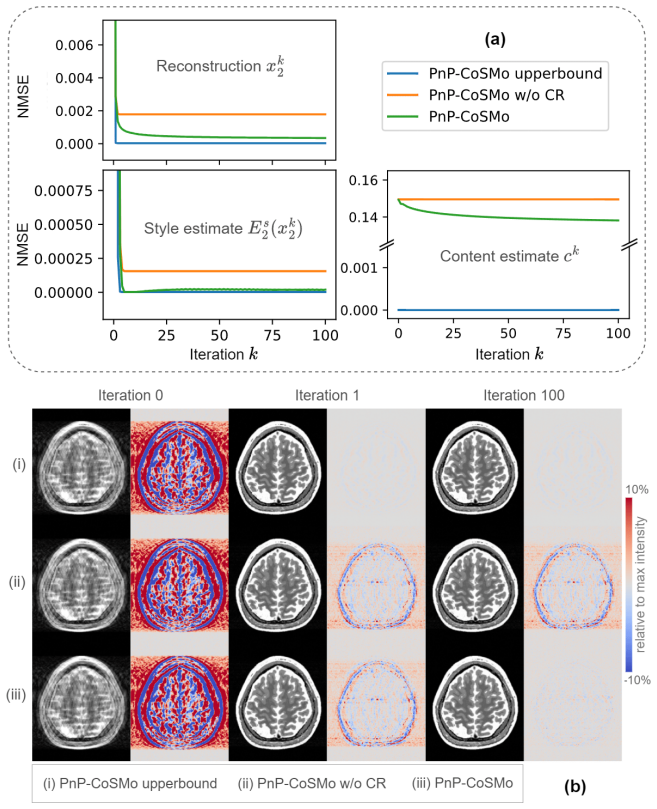
- [Method (content replacement and corrective procedure)] The core assumption that the content encoder yields consistent latent representations for fully-sampled reference images and aliased iterates (trained exclusively on clean image-domain pairs) is load-bearing for the replacement operation and subsequent convergence. No experiment or analysis demonstrates invariance of the content code to undersampling artifacts; the corrective procedure is described only at high level without a convergence guarantee or ablation on aliasing severity.
- [Experiments (in-house dataset results)] Table reporting the 32.6% acceleration gain on the two in-house multi-coil datasets lacks details on coil sensitivity estimation, data exclusion criteria, number of subjects, or statistical testing; without these, it is impossible to verify whether the gain is robust or driven by dataset-specific factors.
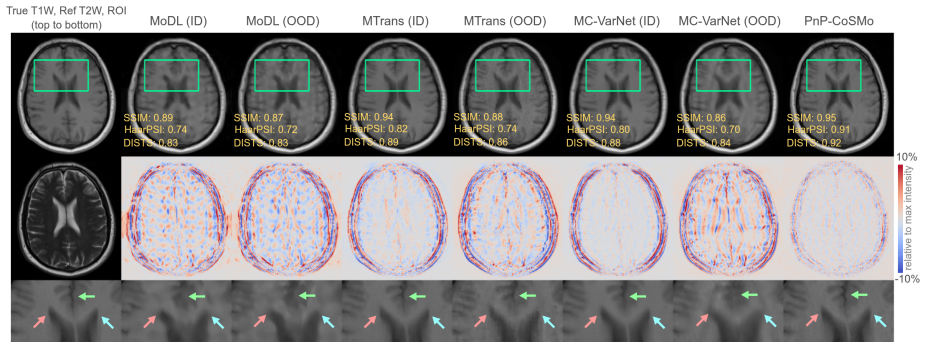
- [Experiments (generalizability evaluation)] The claim of greater generalizability versus end-to-end methods is supported only by qualitative or aggregate SSIM comparisons on fastMRI; no cross-dataset transfer experiment (e.g., model trained on one contrast pair applied to a third unseen contrast) is shown to isolate the benefit of the disentanglement design.
minor comments (2)
- [Method] Notation for the content and style encoders is introduced without an explicit equation defining the replacement operator; adding a compact equation would improve clarity.
- [Simulations] Figure captions for the simulation experiments on interpretability and convergence do not state the acceleration factor or noise level used, making direct comparison to the in vivo results difficult.
Simulated Author's Rebuttal
We thank the referee for their constructive and detailed comments on our manuscript. We address each major comment point by point below, indicating where revisions will be made.
read point-by-point responses
-
Referee: [Method (content replacement and corrective procedure)] The core assumption that the content encoder yields consistent latent representations for fully-sampled reference images and aliased iterates (trained exclusively on clean image-domain pairs) is load-bearing for the replacement operation and subsequent convergence. No experiment or analysis demonstrates invariance of the content code to undersampling artifacts; the corrective procedure is described only at high level without a convergence guarantee or ablation on aliasing severity.
Authors: We agree that explicit validation of content-code invariance to undersampling is important for the replacement step. The manuscript already includes simulations exploring interpretability and convergence of the overall scheme, but these do not directly ablate aliasing severity on the encoder. In the revision we will add a targeted ablation that measures content-code stability across increasing acceleration factors and will expand the description of the corrective procedure with additional analysis of its effect on convergence. revision: yes
-
Referee: [Experiments (in-house dataset results)] Table reporting the 32.6% acceleration gain on the two in-house multi-coil datasets lacks details on coil sensitivity estimation, data exclusion criteria, number of subjects, or statistical testing; without these, it is impossible to verify whether the gain is robust or driven by dataset-specific factors.
Authors: We acknowledge that these experimental details are necessary for reproducibility. The revised manuscript will include the coil-sensitivity estimation method, subject count, exclusion criteria, and any statistical tests performed on the reported acceleration gains. revision: yes
-
Referee: [Experiments (generalizability evaluation)] The claim of greater generalizability versus end-to-end methods is supported only by qualitative or aggregate SSIM comparisons on fastMRI; no cross-dataset transfer experiment (e.g., model trained on one contrast pair applied to a third unseen contrast) is shown to isolate the benefit of the disentanglement design.
Authors: The cross-contrast generalizability follows directly from the explicit content/style factorization, which isolates shared anatomical content from contrast-specific style and thereby permits the same trained model to be used on any contrast pair without k-space retraining. The fastMRI results already compare performance across multiple contrast combinations. While an additional cross-dataset transfer experiment would provide further isolation of the design benefit, the current aggregate results together with the modular formulation already substantiate the claim; we will clarify this distinction in the discussion. revision: partial
Circularity Check
No significant circularity; derivation is self-contained
full rationale
The paper presents a plug-and-play iterative reconstruction scheme that learns a content/style model from partially paired image-domain data and applies replacement plus data consistency steps. No equations, predictions, or central claims reduce by construction to fitted inputs or self-citations; the method is modular and evaluated empirically on external datasets (NYU fastMRI and in-house multi-coil). The reported acceleration gains and generalizability are measured outcomes, not tautological re-statements of the training procedure or target metrics. No load-bearing self-citation chains or ansatzes imported from prior author work are evident in the provided text.
Axiom & Free-Parameter Ledger
axioms (1)
- domain assumption Content and style factors can be disentangled in multi-contrast MR images from partially paired image-domain datasets
discussion (0)
Sign in with ORCID, Apple, or X to comment. Anyone can read and Pith papers without signing in.