Effect of surfactant kinetics on the wetting following the drop impact onto rough surfaces
Pith reviewed 2026-07-03 04:51 UTC · model grok-4.3
The pith
Surfynol 465 produces larger final coverage than Triton X-100 or SDS on rough surfaces at twice the critical micelle concentration due to matching pure water spreading.
A machine-rendered reading of the paper's core claim, the machinery that carries it, and where it could break.
Core claim
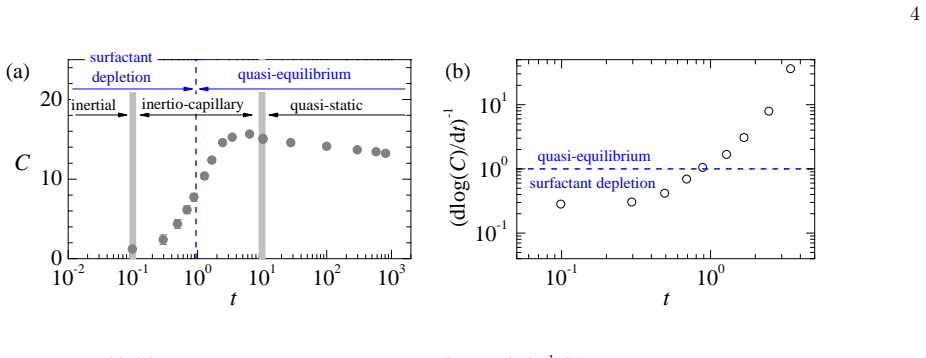
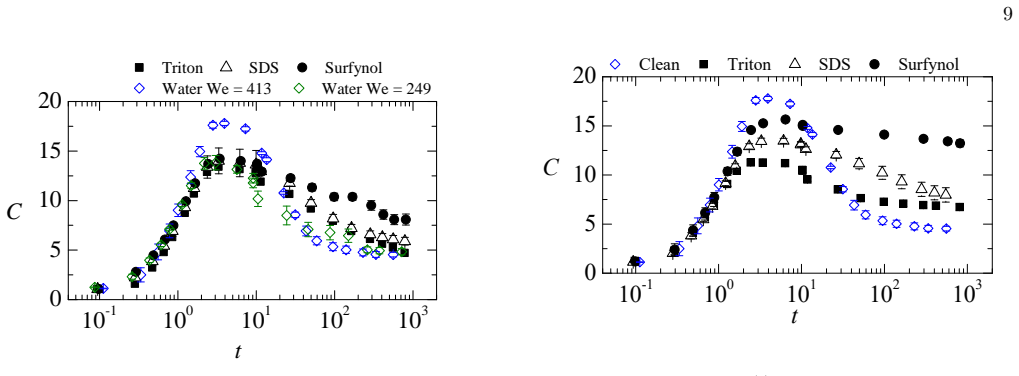
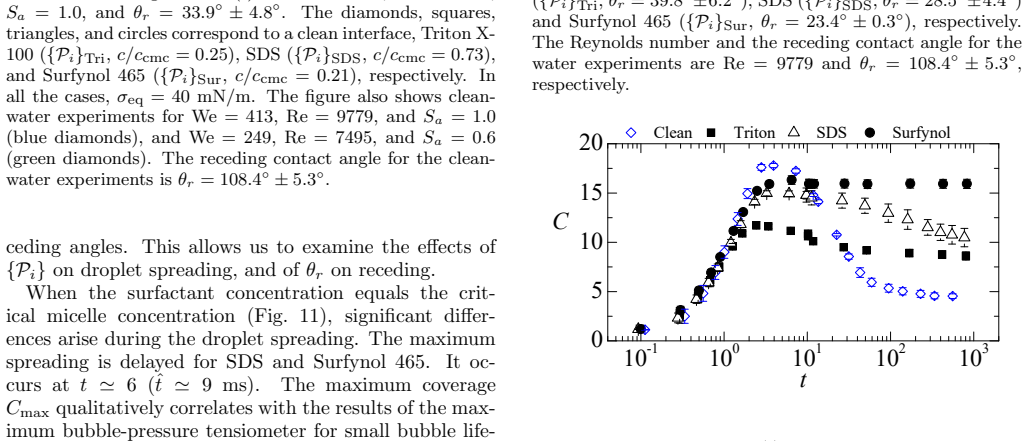
The evolution of the coverage area during spreading is nearly the same for pure water droplets and those containing Surfynol 465, indicating that surfactant depletion is negligible during the rapid spreading stage. Surfynol 465 produces larger coverage areas than Triton X-100 and SDS. The final coverage area is governed by the quasi-static recession of the triple contact line, which is controlled by the receding contact angle. Surfynol 465 consistently yields substantially larger final coverage areas across the range of surface roughness considered.
What carries the argument
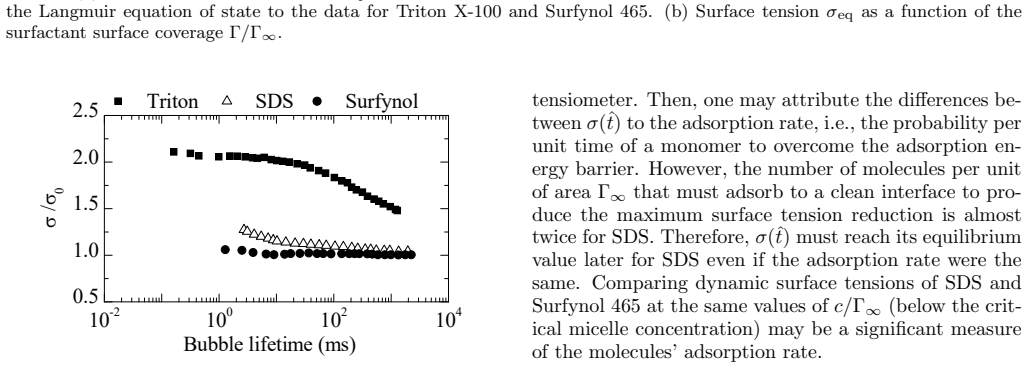
Dynamic surface tension set by surfactant adsorption kinetics, which determines the receding contact angle that controls quasi-static recession of the contact line after maximum spread.
If this is right
- Surfactant adsorption kinetics have negligible effect on the spreading phase at sufficiently high Weber numbers.
- Final wetted area after impact is controlled by the receding contact angle rather than by the maximum extent of spreading.
- Pronounced differences between surfactants appear only when concentration exceeds the critical micelle concentration.
- The relative ordering of surfactants by final coverage remains consistent across the studied range of surface roughness.
Where Pith is reading between the lines
- Surfactants whose adsorption is slower than Surfynol 465 could produce even larger final coverage if they allow more time before recession begins.
- The same recession-controlled mechanism may govern coverage in other high-speed deposition processes on textured substrates such as inkjet printing.
- Direct in-situ measurement of surface tension during the impact event itself would test whether the proposed kinetic depletion effect holds at the observed time scales.
Load-bearing premise
The observed differences in final coverage are caused by the distinct dynamic surface tensions and adsorption kinetics of the three surfactants rather than by unmeasured differences in viscosity, molecular interactions with the surface, or other surfactant-specific properties.
What would settle it
Direct measurement of the receding contact angle for each surfactant solution on the same rough surfaces, followed by verification that the measured angles predict the observed final coverage areas.
Figures

read the original abstract
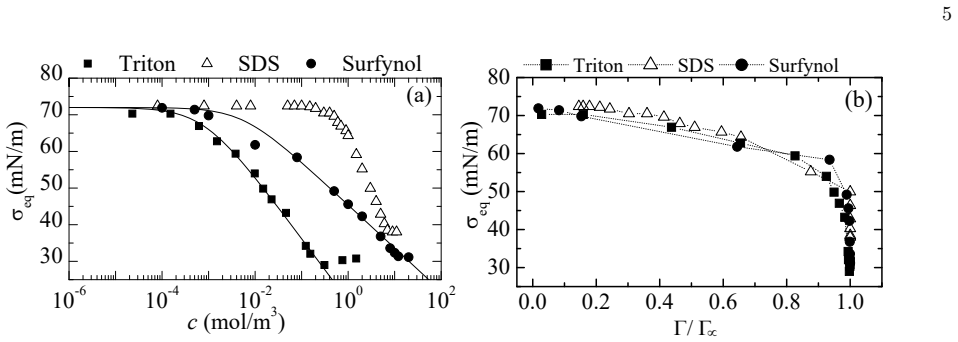
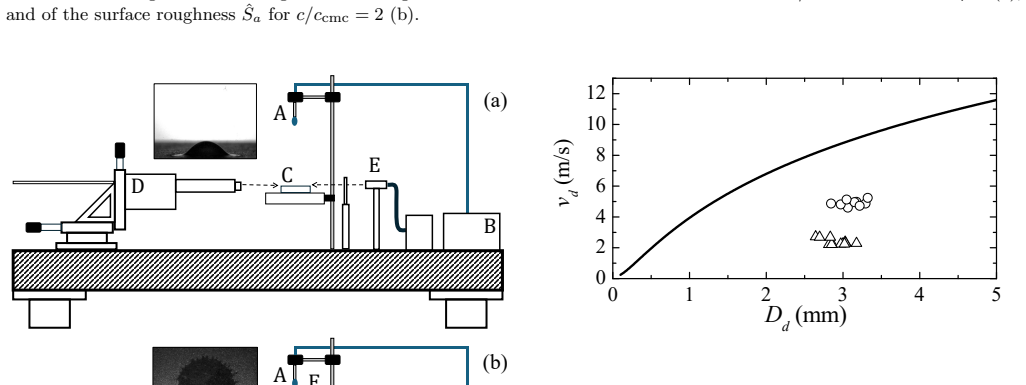
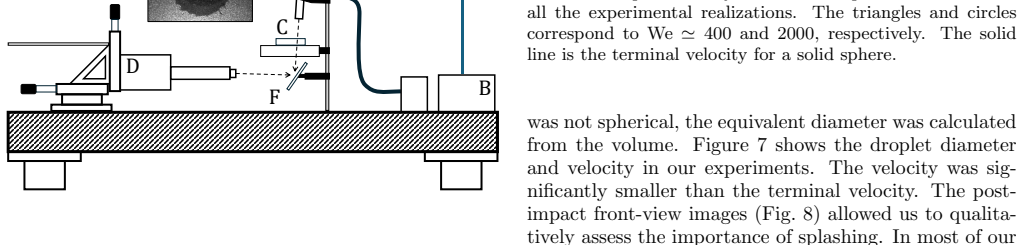
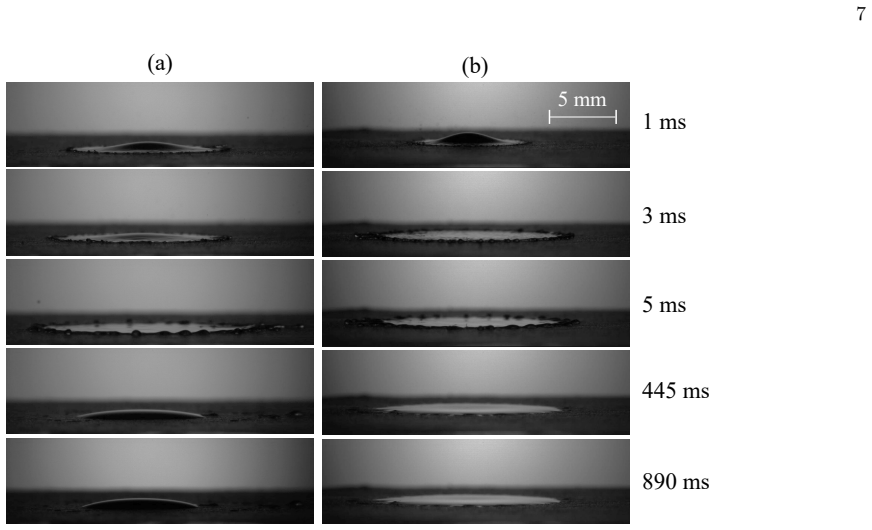
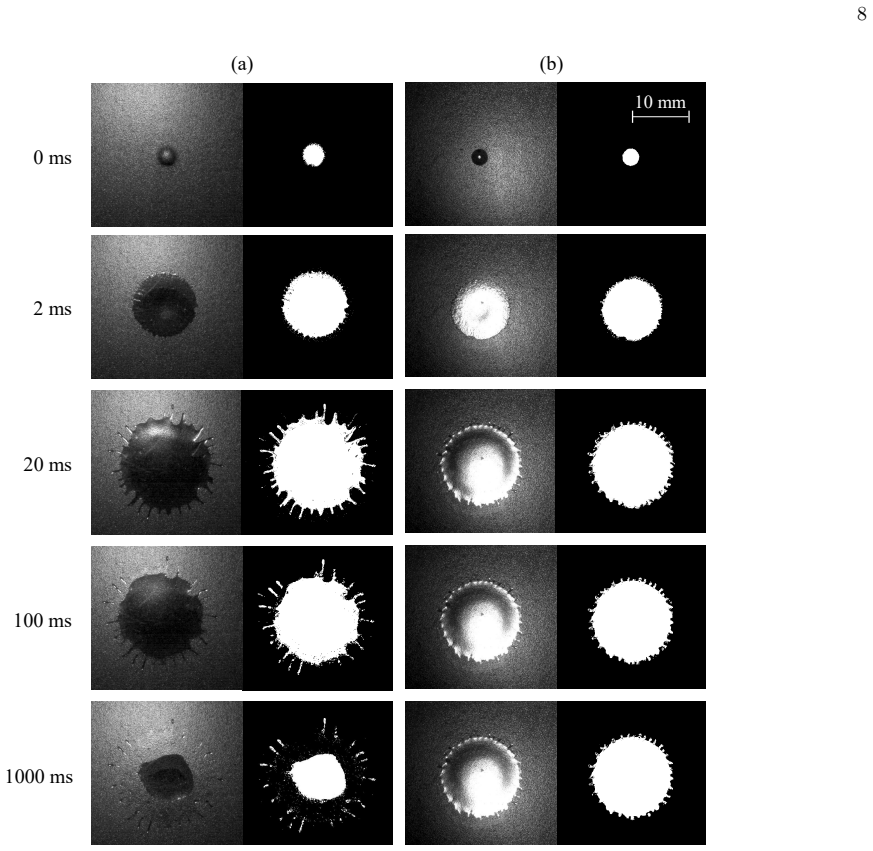
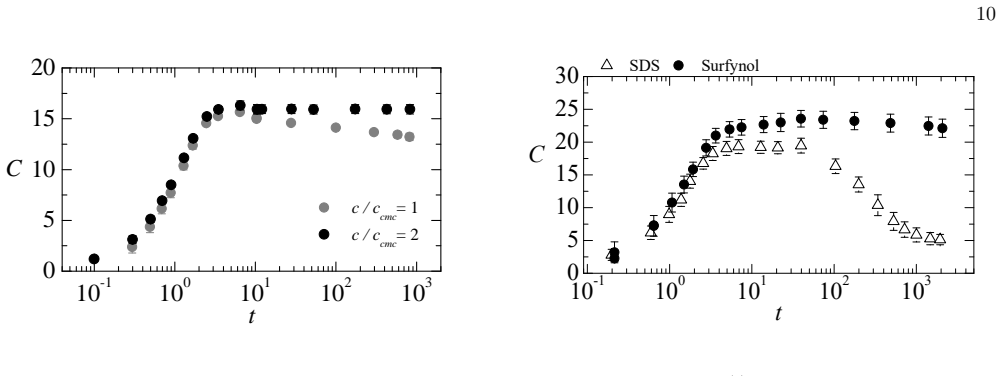
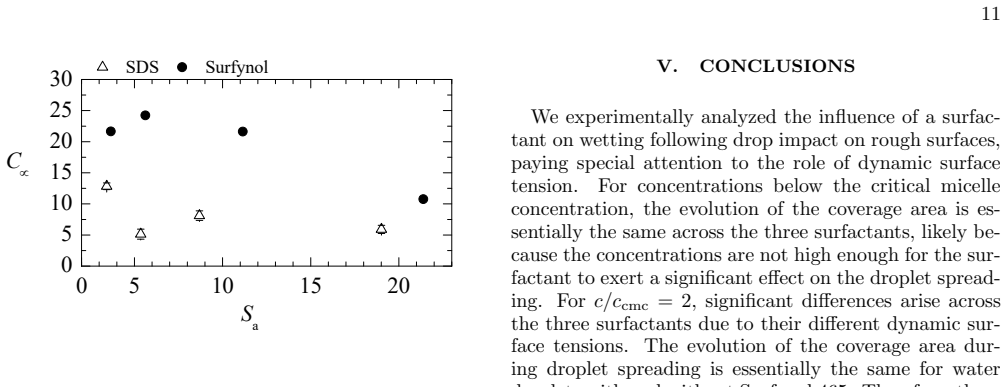
We experimentally analyze the effect of a surfactant on wetting following drop impact on rough surfaces, paying special attention to the role of dynamic surface tension. To this end, we compare the results obtained with Triton X-100, SDS, and Surfynol 465. For concentrations below the critical micelle concentration $c_{\textin{cmc}}$, the evolution of the coverage area is nearly identical for all three surfactants, suggesting that the surfactant concentration is too low to significantly influence droplet spreading. In contrast, pronounced differences emerge due to the distinct dynamic surface tensions of the surfactants at $c/c_{\textin{cmc}}=2$. The evolution of the coverage area during spreading is nearly the same for pure water droplets and those containing Surfynol 465, indicating that surfactant depletion is negligible during the rapid spreading stage. As the Weber number increases, droplet spreading becomes progressively less sensitive to surface tension, thereby reducing the influence of surfactant adsorption kinetics. Nevertheless, Surfynol 465 produces larger coverage areas than Triton X-100 and SDS. The final coverage area is governed by the quasi-static recession of the triple contact line, which is controlled by the receding contact angle. Surfynol 465 consistently yields substantially larger final coverage areas across the range of surface roughness considered in this study.
Editorial analysis
A structured set of objections, weighed in public.
Referee Report
Summary. The manuscript experimentally compares the post-impact spreading and final coverage of droplets containing Triton X-100, SDS, and Surfynol 465 on rough surfaces, at concentrations below and above the CMC and across a range of Weber numbers. It concludes that below CMC the coverage evolution is surfactant-independent, while at c/c_cmc=2 Surfynol 465 yields larger final areas than the other two surfactants because its dynamic surface tension and adsorption kinetics differ, with final coverage set by quasi-static recession governed by the receding contact angle.
Significance. If the distinctions hold after proper controls, the work isolates the contribution of surfactant kinetics to the recession phase on rough surfaces and shows that spreading sensitivity to surface tension decreases with increasing Weber number; this could inform models of droplet deposition in coating or printing processes.
major comments (2)
- [Abstract] Abstract: the claim that 'pronounced differences emerge due to the distinct dynamic surface tensions of the surfactants at c/c_cmc=2' and that Surfynol 465 produces larger final coverage 'across the range of surface roughness' requires that bulk properties (viscosity, density) and surface interactions are matched across the three surfactants; no such measurements or equivalence checks are reported, which is load-bearing for attributing the coverage differences to adsorption kinetics rather than other surfactant-specific effects.
- [Abstract] Abstract: the assertion that 'the final coverage area is governed by the quasi-static recession of the triple contact line, which is controlled by the receding contact angle' is presented without any reported receding-angle data for the surfactant solutions on the rough surfaces, leaving the mechanistic link between observed coverage and receding angle unverified.
minor comments (1)
- The abstract would be strengthened by stating the number of replicates, presence of error bars, and the specific roughness and Weber-number ranges examined.
Simulated Author's Rebuttal
We thank the referee for the careful reading and constructive comments. We respond point-by-point to the major comments below.
read point-by-point responses
-
Referee: [Abstract] Abstract: the claim that 'pronounced differences emerge due to the distinct dynamic surface tensions of the surfactants at c/c_cmc=2' and that Surfynol 465 produces larger final coverage 'across the range of surface roughness' requires that bulk properties (viscosity, density) and surface interactions are matched across the three surfactants; no such measurements or equivalence checks are reported, which is load-bearing for attributing the coverage differences to adsorption kinetics rather than other surfactant-specific effects.
Authors: We agree that explicit checks on bulk properties would strengthen the attribution to adsorption kinetics. Although all solutions are dilute (c/c_cmc=2) and prepared in the same base solvent, we will add a new subsection reporting measured viscosity and density values for each surfactant solution to confirm they differ by less than 2% from water. Surface interactions are surfactant-specific by nature, but the use of three chemically distinct surfactants at matched reduced concentrations supports isolating the role of dynamic surface tension. revision: yes
-
Referee: [Abstract] Abstract: the assertion that 'the final coverage area is governed by the quasi-static recession of the triple contact line, which is controlled by the receding contact angle' is presented without any reported receding-angle data for the surfactant solutions on the rough surfaces, leaving the mechanistic link between observed coverage and receding angle unverified.
Authors: The link is inferred from the post-spreading quasi-static recession phase and the dependence of final area on surface roughness. We acknowledge that direct receding contact angle data on the rough surfaces were not reported. We will add these measurements (obtained via tilted-plate or sessile-drop methods on the same substrates and solutions) in the revised manuscript to verify the proposed mechanism. revision: yes
Circularity Check
No circularity: purely experimental comparisons with no derivations or self-referential predictions
full rationale
The paper reports direct experimental measurements of coverage area evolution for different surfactants at matched concentrations, with conclusions drawn from observed differences in spreading and recession. No equations, fitted models, predictions from parameters, or self-citations of uniqueness theorems appear in the provided text. All load-bearing claims rest on measured data rather than reducing to inputs by construction. This matches the default expectation for non-circular experimental work.
Axiom & Free-Parameter Ledger
axioms (1)
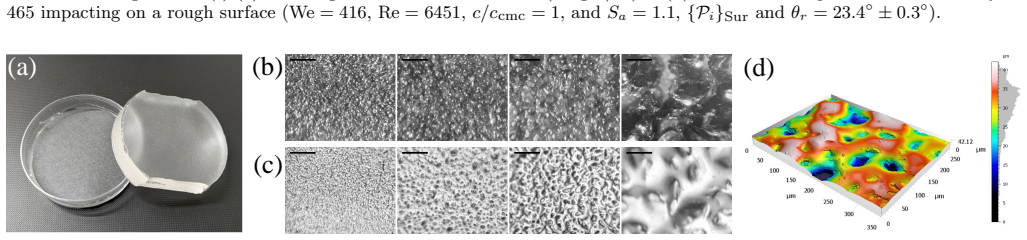
- domain assumption Roughness parameters of the test surfaces are consistent and the dominant variable controlling wetting behavior across the compared conditions.
Reference graph
Works this paper leans on
-
[1]
This has been attributed to the in- crease in the diffusion speed towards the newly formed interface as the chain length increases [28]
studied how the surfactant chain length affects the droplet spreading. This has been attributed to the in- crease in the diffusion speed towards the newly formed interface as the chain length increases [28]. This paper experimentally analyzes the spreading and retraction of surfactant-loaded droplets on rough sur- faces. Special attention will be paid to ...
-
[2]
instantaneous adsorp- tion
used the same methodology to measure the rough- ness of some plant leaves, obtaining arithmetical mean height values up to 2.4µm. B. Surfactants We conducted experiments with Triton X-100 (Sigma- Aldrich), SDS (Sigma-Aldrich), and Surfynol 465 (Evonik).We dissolved the surfactant in ultra-pure Milli- Q water (ρ= 998 kg/m 3 andµ= 1.0 mPa·s) using a magneti...
2000
-
[3]
Drop impact dynamics: Splashing, spread- ing, receding, bouncing
A. L. Yarin, “Drop impact dynamics: Splashing, spread- ing, receding, bouncing...” Annu. Rev. Fluid Mech.38, 159–192 (2006)
2006
-
[4]
Drop impact on a solid surface,
C. Josserand and S.T. Thoroddsen, “Drop impact on a solid surface,” Annu. Rev. Fluid Mech.48, 365–391 (2016)
2016
-
[5]
Experiments of drops impacting a smooth solid surface: A model of the critical impact speed for drop splashing,
G. Riboux and J. M. Gordillo, “Experiments of drops impacting a smooth solid surface: A model of the critical impact speed for drop splashing,” Phys. Rev. Lett.113, 024507 (2014)
2014
-
[6]
Droplet splashing on rough surfaces,
T. de Goede, K. de Bruin, N. Shahidzadeh, and D. Bonn, “Droplet splashing on rough surfaces,” Phys. Rev. Fluids 6, 043604 (2021)
2021
-
[7]
The effect of surface roughness on the contact line and splashing dynamics of impacting droplets
M.A. Quetzeri-Santiago, A.A. Castrej´ on-Pita, and J.R. Castrej´ on-Pita, “The effect of surface roughness on the contact line and splashing dynamics of impacting droplets.” Sci. Rep.9, 15030 (2019). 12
2019
-
[8]
Interaction between droplet impact and surface roughness considering the effect of vibration,
X. Chen, A. Du, K. Liang, Z. Li, M. Zhang, C. Yang, and X. Wang, “Interaction between droplet impact and surface roughness considering the effect of vibration,” Int. J. Heat Mass Transf.220, 125018 (2024)
2024
-
[9]
Dynamics of droplet impact on solid surface with different roughness,
C.Tang, M. Qin, X. Weng, X. Zhang, P. Zhang, J. Li, and Z. Huang, “Dynamics of droplet impact on solid surface with different roughness,” Int. J, of Multiph. Flow96, 56–69 (2017)
2017
-
[10]
Viscous droplets impact on rough surfaces,
L. Liu, G. Cai, B. Jiang, B. He, and P.A. Tsai, “Viscous droplets impact on rough surfaces,” Int. J. Multiph. Flow 192, 105345 (2025)
2025
-
[11]
Effect of surface roughness on hydrodynamic characteristics of an impinging droplet,
R.K. Singh, P.D. Hodgson, N. Sen, and S. Das, “Effect of surface roughness on hydrodynamic characteristics of an impinging droplet,” Langmuir37, 3038–3048 (2021)
2021
-
[12]
Influence of leaf surface wettability on the drop splash phenomenon,
E. Papierowska, R. Mazur, T. Sta´ nczyk, M. Beczek, J. Szewi´ nska, A. Sochan, M. Ry˙ zak, J. Szaty lowicz, and A. Bieganowski, “Influence of leaf surface wettability on the drop splash phenomenon,” Agric. For. Meteorol.279, 107762 (2019)
2019
-
[13]
Mechanisms controlling leaf retention of agricultural spray solutions,
W. Wirth, S. Storp, and W. Jacobsen, “Mechanisms controlling leaf retention of agricultural spray solutions,” Pestic. Sci.33, 411–420 (1991)
1991
-
[14]
Controlling liquid splash on superhydrophobic surfaces by a vesicle surfactant,
M. Song, J. Ju, S. Luo, Y. Han, Z. Dong, Y. Wang, Z. Gu, L. Zhang, R. Hao, and L. Jiang, “Controlling liquid splash on superhydrophobic surfaces by a vesicle surfactant,” Sci. Adv.3, e1602188 (2017)
2017
-
[15]
Control the entire journey of pesticide ap- plication on superhydrophobic plant surface by dynamic covalent trimeric surfactant coacervation,
B. Liu, Y. Fan, H. Li, W. Zhao, S. Luo, H. Wang, B. Guan, Q. Li, J. Yue, Z. Dong, Y. Wang, and L. Jiang, “Control the entire journey of pesticide ap- plication on superhydrophobic plant surface by dynamic covalent trimeric surfactant coacervation,” Adv. Funct. Mater.31, 2006606 (2021)
2021
-
[16]
Regulating droplet impact and wetting behaviors on hy- drophobic weed leaves by a double-chain cationic surfac- tant,
Z. Li, Y. Ma, K. Zhao, C. Zhang, Y. Gao, and F. Du, “Regulating droplet impact and wetting behaviors on hy- drophobic weed leaves by a double-chain cationic surfac- tant,” ACS Sustainable Chem. Eng.9, 2891–2901 (2021)
2021
-
[17]
Droplet splash and spread on superhy- drophobic lotus leaves: Direct regulation by tuning the chain length of surfactant,
Z. Li, K. Zhao, Y. Wang, Z. Zheng, C. Zhang, Y. Gao, and F. Du, “Droplet splash and spread on superhy- drophobic lotus leaves: Direct regulation by tuning the chain length of surfactant,” Colloids Surf. A Physic- ochem. Eng. Asp.648, 129178 (2022)
2022
-
[18]
Regulating droplet impact and wetting behav- iors on hydrophobic leaves using a nonionic surfactant,
R. Zhao, M. Yu, Z. Sun, L. Li, X. Guo, Y. Xu, and X. Wu, “Regulating droplet impact and wetting behav- iors on hydrophobic leaves using a nonionic surfactant,” J. Colloid Interface Sci.629, 926–937 (2023)
2023
-
[19]
Dynamic surface tension effects in impact of a drop with a solid surface,
X. Zhang and O. A. Basaran, “Dynamic surface tension effects in impact of a drop with a solid surface,” J. Colloid Interface Sci.187, 166–178 (1997)
1997
-
[20]
Retarding spreading of sur- factant drops on solid surfaces: Interplay between the Marangoni effect and capillary flows,
P. Bazazi and S. H. Hejazi, “Retarding spreading of sur- factant drops on solid surfaces: Interplay between the Marangoni effect and capillary flows,” Phys. Rev. Fluids 5, 084006 (2020)
2020
-
[21]
Uniform spread of high-speed drops on superhydrophobic surface by live-oligomeric surfactant jamming,
S. Luo, Z. Chen, Z. Dong, Y. Fan, Y. Chen, B. Liu, C. Yu, C. Li, H. Dai, H. Li, Y. Wang, and L. Jiang, “Uniform spread of high-speed drops on superhydrophobic surface by live-oligomeric surfactant jamming,” Adv. Mater.31, 1904475 (2019)
2019
-
[22]
Spherical-micelle-driven deposition of high-speed im- pacting water droplets on superhydrophobic surfaces,
Y. Jiang, M. Wang, J. Wei, Y. Fan, and Y. Wang, “Spherical-micelle-driven deposition of high-speed im- pacting water droplets on superhydrophobic surfaces,” J. Mater. Chem. A10, 23175–23184 (2022)
2022
-
[23]
Dynamic surface tension and adsorption mechanisms of surfactants at the air-water in- terface,
J. Eastoe and J. S. Dalton, “Dynamic surface tension and adsorption mechanisms of surfactants at the air-water in- terface,” Adv. Colloid Interface Sci.85, 103–144 (2000)
2000
-
[24]
Surfactant dynamics: hidden variables controlling fluid flows,
H. Manikantan and T. M. Squires, “Surfactant dynamics: hidden variables controlling fluid flows,” J. Fluid Mech. 892, P1 (2020)
2020
-
[25]
Dynamic surface ten- sion of surfactants in the presence of high salt concentra- tions,
M. J. Qazi, S. J. Schlegel, E. H. G. Backus, M. Bonn, D. Bonn, and N. Shahidzadeh, “Dynamic surface ten- sion of surfactants in the presence of high salt concentra- tions,” Langmuir36, 7956–7964 (2020)
2020
-
[26]
Deposition and spread of aque- ous pesticide droplets on hydrophobic/superhydrophobic surfaces by fast aggregation of surfactants,
Y. Fan and Y. Wang, “Deposition and spread of aque- ous pesticide droplets on hydrophobic/superhydrophobic surfaces by fast aggregation of surfactants,” Langmuir 39, 5631–5640 (2023)
2023
-
[27]
Effect of sur- factants on the splashing dynamics of drops impacting smooth substrates,
N. Varghese, T. C. Sykes, M. A. Quetzeri-Santiago, A. A. Castrej´ on-Pita, and J. R. Castrej´ on-Pita, “Effect of sur- factants on the splashing dynamics of drops impacting smooth substrates,” Langmuir40, 8781–8790 (2024)
2024
-
[28]
Con- trolling droplet deposition with surfactants,
H. Hoffman, R. Sijs, T. de Goede, and D. Bonn, “Con- trolling droplet deposition with surfactants,” Phys. Rev. Fluids6, 033601 (2021)
2021
-
[29]
Impact behaviors on su- perhydrophobic surfaces for water droplets of asymmetric double-chain quaternary ammonium surfactants,
H. Li, Z. Cai, and Y. Wang, “Impact behaviors on su- perhydrophobic surfaces for water droplets of asymmetric double-chain quaternary ammonium surfactants,” Lang- muir36, 14113–4122 (2020)
2020
-
[30]
Controlling im- pact behavior on superhydrophobic surfaces for droplets of nonionic surfactants by tailoring hydrophilic chain length,
Z. Bao, A. Zeng, T. Gao, Y. Gao, Q. He, Y. Huang, J. Chou, L. Yu, C. Zhang, and F. Du, “Controlling im- pact behavior on superhydrophobic surfaces for droplets of nonionic surfactants by tailoring hydrophilic chain length,” J. Mol. Liquids346, 117071 (2022)
2022
-
[31]
Unifying theory of scaling in drop impact: Forces and maximum spreading diameter,
V. Sanjay and D. Lohse, “Unifying theory of scaling in drop impact: Forces and maximum spreading diameter,” Phys. Rev. Lett.134, 104003 (2025)
2025
-
[32]
3d optical surface profiler for quantifying leaf surface roughness,
J. R. Abbott and H. Zhu, “3d optical surface profiler for quantifying leaf surface roughness,” Surf. Topogr.: Metrol. Prop.7, 045016 (2019)
2019
-
[33]
Radio- tracer studies on adsorption of surface active substance at aqueous surface. I. Accurate measurement of adsorp- tion of Tritiated Sodium Dodecylsulfate,
K. Tajima, M. Muramatsu, and T. Sasaki, “Radio- tracer studies on adsorption of surface active substance at aqueous surface. I. Accurate measurement of adsorp- tion of Tritiated Sodium Dodecylsulfate,” Bull. Chem. Soc. Japan43, 1991–1998 (1970)
1991
-
[34]
Colloid-chemical properties of non- ionic gemini surfactants Surfynol 400 series with different degrees of oxyethylation,
Y. A. Penkina, I. M. Zolnikov, A. E. Pomazyonkova, and G. V. Avramenko, “Colloid-chemical properties of non- ionic gemini surfactants Surfynol 400 series with different degrees of oxyethylation,” Butlerov Communications46, 92–101 (2016)
2016
-
[35]
Global linear stability of the bubble rising in the presence of a soluble surfactant,
M. A. Herrada, J. M. L´ opez-Herrera, D. Fern´ andez- Mart´ ınez, M. G. Cabezas, and J. M. Montanero, “Global linear stability of the bubble rising in the presence of a soluble surfactant,” J. Fluid Mech.1031, A45 (2026)
2026
-
[36]
Guidelines to measurements of reproducible contact angles using a sessile-drop technique,
J. Drelich, “Guidelines to measurements of reproducible contact angles using a sessile-drop technique,” Surf. In- nov.1, 248–254 (2013)
2013
-
[37]
Time evolu- tion of liquid drop impact onto solid, dry surfaces
R. Rioboo, M. Marengo, and C. Tropea, “Time evolu- tion of liquid drop impact onto solid, dry surfaces.” Exp. Fluids33, 112–124 (2002)
2002
-
[38]
Maximum diameter of impacting liquid droplets,
N. Laan, K. G. de Bruin, D. Bartolo, C. Josserand, and D. Bonn, “Maximum diameter of impacting liquid droplets,” Phys. Rev. Appl.2, 044018 (2014)
2014
-
[39]
Max- imal deformation of an impacting drop,
C. Clanet, C. B´ eguin, D. Richard, and D. Qu´ er´ e, “Max- imal deformation of an impacting drop,” J. Fluid Mech. 517, 199–208 (2004)
2004
-
[40]
Contact time of a bouncing drop,
D. Richard and C. Clanet abd D. Qu´ er´ e, “Contact time of a bouncing drop,” Nature417, 811–811 (2002)
2002
-
[41]
Influence of surfactant kinetics on rapid interface cre- 13 ation via microjet impact on liquid pools,
D. Fern´ andez-Mart´ ınez, E. J. Vega, J. M. Montanero, U. J. Guti´ errez-Hern´ andez, and D. Fernandez-Rivas, “Influence of surfactant kinetics on rapid interface cre- 13 ation via microjet impact on liquid pools,” J. Colloid Int. Sci.717, 140335 (2026)
2026
-
[42]
Interface pinch-off in the presence of a soluble surfactant
M. Rubio, S. Rodr´ ıguez-Aparicio, J. M. Montanero, and M. A. Herrada, “Interface pinch-off in the presence of a soluble surfactant,” arXiv:2605.03504v1 , 1–21 (2026)
work page internal anchor Pith review Pith/arXiv arXiv 2026
-
[43]
Mi- crodroplet impact at very high velocity,
C. W. Visser, Y. Tagawa, C. Sun, and D. Lohse, “Mi- crodroplet impact at very high velocity,” Soft Matter8, 10732 (2012)
2012
-
[44]
Rough- ness measurement of leaf surface based on shape from focus,
Z. Zhang, F. Liu, Z. Zhou, Y. He, and H. Fang, “Rough- ness measurement of leaf surface based on shape from focus,” Plant Methods17, 72 (2021)
2021
-
[45]
Effects of leaf surface roughness and contact angle on in vivo measurement of droplet retention,
J. Ma, K. Liu, X. Dong, C. Chen, B. Qiu, and S. Zhang, “Effects of leaf surface roughness and contact angle on in vivo measurement of droplet retention,” Agronomy12, 2228 (2022)
2022
-
[46]
Foliar uptake of pesti- cides—Present status and future challenge,
C. J. Wang and Z. Q. Liu, “Foliar uptake of pesti- cides—Present status and future challenge,” Pesticide Biochemistry and Physiology87, 1–8 (2007)
2007
discussion (0)
Sign in with ORCID, Apple, or X to comment. Anyone can read and Pith papers without signing in.