Irreducible Representations as Multireference Indicators for Diradicaloid Systems
Pith reviewed 2026-07-02 16:56 UTC · model grok-4.3
The pith
A nontrivial many-electron irreducible representation excludes single-reference closed-shell descriptions.
A machine-rendered reading of the paper's core claim, the machinery that carries it, and where it could break.
Core claim
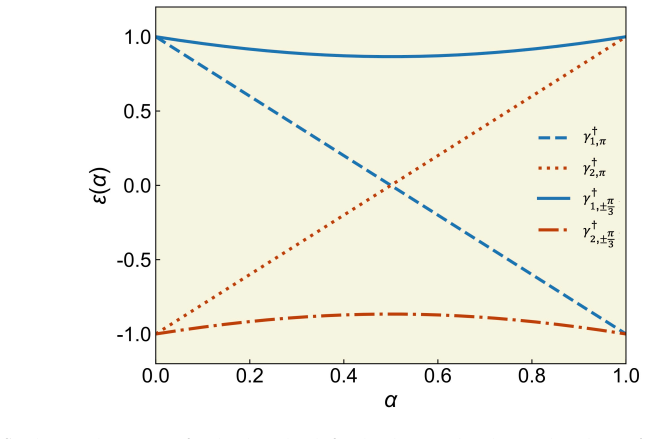
For a time-reversal-invariant Hamiltonian, a symmetry-preserving, closed-shell Slater determinant must transform as the trivial irreducible representation of its point group. Therefore, a nontrivial, many-electron irreducible representation excludes such a description. In the obstructed pathway of the model, frontier-orbital degeneracy at a high-symmetry point yields a singlet ground state with two-configuration character and a nontrivial irreducible representation, while the control pathway retains the trivial representation.
What carries the argument
The many-electron irreducible representation of the ground-state wavefunction under the molecular point group, which acts as a symmetry filter excluding single-determinant closed-shell forms.
If this is right
- Irreducible representations supply a low-cost screening tool to flag obstructions to a single-reference description.
- The diagnostic is consistent with exact diagonalization results and with a two-state effective model in the diradicaloid regime.
- The Frobenius norm of the two-particle cumulant corroborates the same multireference regime identified by the representation label.
Where Pith is reading between the lines
- The same symmetry argument could be applied to other point groups or to periodic systems where the little group replaces the molecular point group.
- Combining the representation label with natural-orbital occupation numbers might yield a hybrid diagnostic that is both cheap and quantitative.
- The criterion is most useful as an initial filter before more expensive multireference calculations are launched.
Load-bearing premise
A symmetry-preserving closed-shell Slater determinant must transform as the trivial irreducible representation for any time-reversal-invariant Hamiltonian.
What would settle it
A concrete counter-example would be a molecular ground state that transforms under a nontrivial irreducible representation yet is still accurately reproduced by a single closed-shell Slater determinant to within chemical accuracy.
Figures




read the original abstract
Multireference behavior in molecules often arises when a small gap between frontier orbitals results in mixing of closed and open-shell configurations. Standard multireference diagnostics of this regime usually rely on correlated wavefunctions, natural-orbital occupations, or reduced density matrices. Here, we examine a complementary, symmetry-based criterion for a model system. For a time-reversal-invariant Hamiltonian, a symmetry-preserving, closed-shell Slater determinant must transform as the trivial irreducible representation of its point group. Therefore, a nontrivial, many-electron irreducible representation excludes such a description. We compare two pathways within the same model to demonstrate this. Along the control pathway, the frontier orbitals remain separated and the ground state retains a trivial irreducible representation over the weak-to-intermediate interaction regime. Along the obstructed pathway, a high-symmetry point produces a frontier-orbital degeneracy, resulting in a singlet ground state with two-configuration character and a nontrivial irreducible representation. Exact diagonalization, a two-state effective model, and the Frobenius norm of the two-particle cumulant provide a consistent picture in this regime, demonstrating that irreducible representations can serve as a low-cost diagnostic of multireference character in diradicaloid models. While symmetry is not a quantitative measure of correlation strength, it does offer a computationally inexpensive screening tool to identify obstructions to a single-reference description.
Editorial analysis
A structured set of objections, weighed in public.
Referee Report
Summary. The manuscript claims that for time-reversal-invariant Hamiltonians, a symmetry-preserving closed-shell Slater determinant must transform as the trivial irreducible representation of the molecular point group; therefore a nontrivial many-electron irrep excludes a single-reference closed-shell description and serves as a low-cost indicator of multireference (diradicaloid) character. This is demonstrated in a model system by contrasting a control pathway (separated frontier orbitals, trivial irrep retained) with an obstructed pathway (high-symmetry degeneracy, singlet ground state with two-configuration character and nontrivial irrep). Consistency is shown via exact diagonalization, a two-state effective Hamiltonian, and the Frobenius norm of the two-particle cumulant.
Significance. If the central symmetry argument holds, the work supplies a computationally inexpensive, symmetry-based screening tool that complements existing diagnostics relying on natural-orbital occupations or reduced density matrices. The approach rests on standard representation theory rather than fitted parameters, and the model comparisons (exact diagonalization, effective Hamiltonian, cumulant norm) are presented as independent checks, which is a strength. The paper correctly notes that the indicator is not quantitative but useful for identifying obstructions to a single-reference description.
minor comments (3)
- The abstract states the symmetry argument but does not show the explicit character table or the decomposition of the antisymmetrized product; a short derivation or reference to the relevant group-theory identity in the main text would improve clarity without altering the claim.
- The manuscript would benefit from a brief statement of the specific point group and the explicit many-electron irrep labels (e.g., A1 vs. B2) realized in the obstructed pathway, so that readers can reproduce the nontrivial assignment.
- Figure captions or the methods section should specify the basis set and the precise definition of the two-particle cumulant whose Frobenius norm is reported, to allow direct comparison with other cumulant-based diagnostics.
Simulated Author's Rebuttal
We thank the referee for their positive assessment of our manuscript, accurate summary of the central symmetry argument, and recommendation for minor revision. The referee correctly identifies the strengths of the approach, including its basis in representation theory and the consistency checks with exact diagonalization, effective Hamiltonian, and cumulant norm.
Circularity Check
No significant circularity detected
full rationale
The paper's derivation rests on a standard group-theoretic argument: for a time-reversal-invariant Hamiltonian, the character of a closed-shell Slater determinant under point-group operations is +1 because each doubly-occupied orbital pair contributes the symmetric part of Γ ⊗ Γ, which always includes the trivial representation. This is presented as a direct consequence of the antisymmetrized product construction and does not rely on fitted parameters, self-citations, or redefinitions of inputs as outputs. The two pathways, exact diagonalization, two-state model, and cumulant norm are introduced as independent consistency checks on the model system rather than as derivations that reduce to the symmetry claim by construction. No load-bearing step equates a prediction to its own input.
Axiom & Free-Parameter Ledger
axioms (1)
- domain assumption For a time-reversal-invariant Hamiltonian, a symmetry-preserving, closed-shell Slater determinant must transform as the trivial irreducible representation of its point group.
Reference graph
Works this paper leans on
-
[1]
Lischka, D
H. Lischka, D. Nachtigallov, A.J.A. Aquino, P.G. Szalay, F. Plasser, F.B.C. Machado and M. Bar- batti, Chem. Rev. 118 (15), 7293–7361 (2018)
2018
-
[2]
Vitillo, C.J
J.G. Vitillo, C.J. Cramer and L. Gagliardi, Isr. J. Chem. 62 (1-2) (2022)
2022
-
[3]
J.W. Park, R. Al-Saadon, M.K. MacLeod, T. Shiozaki and B. Vlaisavljevich, Chem. Rev. 120 (13), 5878–5909 (2020)
2020
-
[4]
Wardzala, M.R
J.J. Wardzala, M.R. Hennefarth, V. Agarawal, B. Jangid, A. Seal, M.R. Hermes, D.S. King and L. Gagliardi, Chem. Rev. 126 (8), 4592–4618 (2026)
2026
-
[5]
Abe, Chem
M. Abe, Chem. Rev. 113 (9), 7011–7088 (2013)
2013
-
[6]
Stuyver, B
T. Stuyver, B. Chen, T. Zeng, P. Geerlings, F. De Proft and R. Hoffmann, Chem. Rev. 119 (21), 11291–11351 (2019)
2019
-
[7]
Ganoe and J
B. Ganoe and J. Shee, Faraday Discuss. 254 (0), 53–75 (2024)
2024
-
[8]
X. Xu, L. Soriano-Agueda, X. Lpez, E. Ramos-Cordoba and E. Matito, J. Chem. Phys. 162 (12) (2025)
2025
-
[9]
Coe and M.J
J.P. Coe and M.J. Paterson, J. Chem. Theory Comput. 11 (9), 4189–4196 (2015)
2015
-
[10]
Ortiz, R.A
R. Ortiz, R.A. Boto, N. Garca-Martnez, J.C. Sancho-Garca, M. Melle-Franco and J.N. Fernndez- Rossier, Nano Lett. 19 (9), 5991–5997 (2019)
2019
-
[11]
Muechler, J
L. Muechler, J. Maciejko, T. Neupert and R. Car, Phys. Rev. B 90, 245142 (2014)
2014
-
[12]
Mirzanejad and L
A. Mirzanejad and L. Muechler, Chemphyschem 26 (2), e202400786 (2025)
2025
-
[13]
Yao and S.A
H. Yao and S.A. Kivelson, Phys. Rev. Lett. 105, 166402 (2010)
2010
-
[14]
Scuseria, C.A
G.E. Scuseria, C.A. Jimnez-Hoyos, T.M. Henderson, K. Samanta and J.K. Ellis, J. Chem. Phys. 135 (12), 124108 (2011)
2011
-
[15]
Jimnez-Hoyos, T.M
C.A. Jimnez-Hoyos, T.M. Henderson, T. Tsuchimochi and G.E. Scuseria, J. Chem. Phys. 136 (16), 164109 (2012)
2012
-
[16]
Song, T.M
R. Song, T.M. Henderson and G.E. Scuseria, J. Phys. Chem. A 128 (31), 6593–6600 (2024)
2024
-
[17]
Izsk, A.V
R. Izsk, A.V. Ivanov, N.S. Blunt, N. Holzmann and F. Neese, J. Chem. Theory Comput. 19 (10), 2703–2720 (2023)
2023
-
[18]
Song, J.S
Z. Song, J.S. Bersson and L.M. Thompson, J. Chem. Phys. 162 (10), 104107 (2025)
2025
-
[19]
Altmann and P
S.L. Altmann and P. Herzig, Point Group Theory Tables (Clarendon Press, Oxford, England, 1994). 16
1994
-
[20]
Dresselhaus, G
M.S. Dresselhaus, G. Dresselhaus and A. Jorio, Group Theory , 2008th ed. (Springer, Berlin, Ger- many, 2007)
2007
-
[21]
Ellis and H.H
R.L. Ellis and H.H. Jaffe, J. Chem. Educ. 48 (2), 92 (1971)
1971
-
[22]
D.I. Ford, J. Chem. Educ. 49 (5), 336 (1972)
1972
-
[23]
Juhsz and D.A
T. Juhsz and D.A. Mazziotti, J. Chem. Phys. 125 (17), 174105 (2006)
2006
-
[24]
Lieb, Phys
E.H. Lieb, Phys. Rev. Lett. 62 (10), 1201–1204 (1989)
1989
-
[25]
Monino, M
E. Monino, M. Boggio-Pasqua, A. Scemama, D. Jacquemin and P.F. Loos, J. Phys. Chem. A 126 (28), 4664–4679 (2022)
2022
-
[26]
Schensted, A Short Course on the Application of Group Theory to Quantum Mechanics (NEO Press, Ann Arbor, Mich., 1967)
I.V. Schensted, A Short Course on the Application of Group Theory to Quantum Mechanics (NEO Press, Ann Arbor, Mich., 1967)
1967
-
[27]
basic block,
F.A. Matsen, J. Am. Chem. Soc. 92 (12), 3525–3538 (1970). Appendix A. F ormalism: Calculating Many-Electron Irreducible Representations As an example of how to calculate many-electron irreps for an open-shell system, we consider a single-excitation on the unobstructed pathway at α = 1 2 . This single-excitation results in three electrons in e1g and one el...
1970
discussion (0)
Sign in with ORCID, Apple, or X to comment. Anyone can read and Pith papers without signing in.