REVIEW 2 major objections 1 minor 24 references
A selective trigger activates a distilled vision-language model only on detected semantic anomalies, allowing robots to improve safety margins in dynamic scenes without continuous high-latency computation.
Reviewed by Pith at T0; open to challenge. T0 means a machine referee read the full paper against a public rubric. the ladder, T0–T4 →
T0 review · grok-4.3
2026-06-25 20:55 UTC pith:5FVGETBJ
load-bearing objection The paper sketches an event-triggered distilled VLM plus semantic MPC setup to cut latency in robot navigation, but the abstract supplies no numbers or trigger performance data so the claims stay untested. the 2 major comments →
Event-Adaptive Motion Planning with Distilled Vision-Language Model in Safety-Critical Situations
The pith
A machine-rendered reading of the paper's core claim, the machinery that carries it, and where it could break.
Core claim
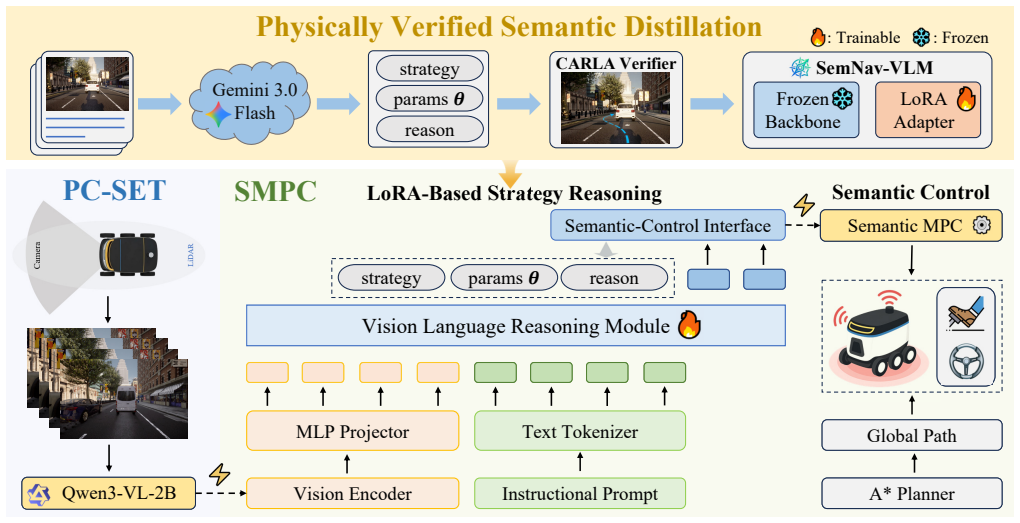
EAMP uses the prompt-configurable semantic event trigger to selectively invoke a physically verified distilled SemNav-VLM that maps detected anomalies to strategy-level decisions, which the semantic model predictive control module then translates into reconfigurations of control objectives, thereby aligning high-level semantic reasoning with low-level execution and improving safety margins over baselines while preserving efficiency.
What carries the argument
The prompt-configurable semantic event trigger (PC-SET) that monitors short clips for behavioral anomalies and selectively activates the distilled SemNav-VLM before passing strategy outputs to semantic model predictive control.
Load-bearing premise
The prompt-configurable semantic event trigger can detect behavioral anomalies from short clips reliably enough to avoid both missed events and destabilizing false positives or added latency.
What would settle it
A controlled test in which the trigger either fails to activate before a collision occurs or triggers so frequently that the added latency causes the robot to miss a safe trajectory.
If this is right
- The selective activation avoids the latency that would arise from continuous vision-language model calls inside the control loop.
- Semantic strategy decisions are translated into dynamic changes to optimization objectives and geometric references inside model predictive control.
- Experiments demonstrate improved dynamic safety margins in safety-critical logistics scenarios compared with existing baselines.
- Real-time efficiency is preserved because the vision-language model runs only on triggered events.
Where Pith is reading between the lines
- The trigger-plus-distillation pattern could be tested in other real-time domains such as autonomous vehicles where semantic anomalies also drive safety decisions.
- If the trigger generalizes across environments, the same distillation process might reduce the need for always-on large models on embedded hardware.
- A direct follow-on experiment would measure false-positive rates of the trigger across varied lighting and agent densities to quantify stability margins.
Editorial analysis
A structured set of objections, weighed in public.
Referee Report
Summary. The paper proposes Event-Adaptive Motion Planning (EAMP), a framework for VLM-based robot navigation in safety-critical scenarios. A prompt-configurable semantic event trigger (PC-SET) continuously monitors short temporal clips to detect behavioral anomalies and selectively activates an event-triggered distilled SemNav-VLM (fine-tuned via physically verified semantic distillation) to produce discrete strategy-level decisions; these are then translated by a semantic model predictive control (SMPC) module into reconfigurations of optimization objectives and geometric references. The abstract claims that extensive experiments in logistics scenarios show EAMP aligns high-level reasoning with low-level control, significantly improving dynamic safety margins over baselines while preserving real-time efficiency.
Significance. If the quantitative performance claims hold after proper validation, the selective-triggering and distillation approach would address a core deployment barrier for VLMs in continuous robot control by avoiding constant high-latency inference, offering a practical path to integrate commonsense reasoning into safety-critical navigation without destabilizing execution.
major comments (2)
- [Abstract] Abstract: the central claim of 'significantly improving dynamic safety margins over existing baselines' is unsupported by any quantitative metrics, error bars, baseline details, ablation data, or statistical tests, so the contribution cannot be evaluated from the manuscript text.
- [Abstract and §3] PC-SET description (Abstract and §3): the load-bearing assumption that PC-SET reliably detects behavioral anomalies from short temporal clips (without excessive false negatives that would leave the system on baseline planning) receives no detection algorithm, threshold, training procedure, false-negative analysis, or edge-case coverage; without this, safety-margin gains cannot be attributed to VLM intervention.
minor comments (1)
- [Abstract] The phrase 'physically verified semantic distillation' is used without defining the verification procedure or citing the underlying method.
Simulated Author's Rebuttal
We thank the referee for the constructive feedback on the abstract claims and PC-SET module. We address each major comment below and will revise the manuscript to strengthen the presentation of results and implementation details.
read point-by-point responses
-
Referee: [Abstract] Abstract: the central claim of 'significantly improving dynamic safety margins over existing baselines' is unsupported by any quantitative metrics, error bars, baseline details, ablation data, or statistical tests, so the contribution cannot be evaluated from the manuscript text.
Authors: The abstract summarizes the key outcome; the supporting quantitative evidence (specific dynamic safety margin values with error bars, baseline comparisons including names and metrics, ablation studies, and statistical tests) appears in Section 5 with tables and figures. To address the concern, we will revise the abstract to include the primary quantitative results (e.g., percentage improvements and key p-values) so the claim is directly supported within the abstract itself. revision: yes
-
Referee: [Abstract and §3] PC-SET description (Abstract and §3): the load-bearing assumption that PC-SET reliably detects behavioral anomalies from short temporal clips (without excessive false negatives that would leave the system on baseline planning) receives no detection algorithm, threshold, training procedure, false-negative analysis, or edge-case coverage; without this, safety-margin gains cannot be attributed to VLM intervention.
Authors: We agree the current description emphasizes the role of PC-SET without sufficient implementation detail. In the revision we will expand Section 3 (and reference it from the abstract) to specify the anomaly detection algorithm (semantic feature deviation over clips), threshold selection and training procedure, quantitative false-negative rates from the logistics experiments, and coverage of edge cases. This will allow readers to evaluate triggering reliability and attribute safety gains to the VLM intervention. revision: yes
Circularity Check
No circularity detected; framework description contains no equations or self-referential derivations
full rationale
The paper presents EAMP as an engineering framework (PC-SET trigger + distilled SemNav-VLM + SMPC) evaluated empirically in logistics scenarios. No derivation chain, equations, fitted parameters renamed as predictions, or load-bearing self-citations appear in the abstract or described structure. The central claims rest on experimental safety-margin improvements rather than any mathematical reduction to inputs. This is the normal non-circular outcome for a systems paper without symbolic derivations.
Axiom & Free-Parameter Ledger
read the original abstract
Robot navigation in safety-critical scenarios faces significant challenges from unforeseen semantic events, where collisions arise primarily from the unpredictable behaviors of dynamic agents rather than unseen objects. While large vision-language models (VLMs) offer remarkable capabilities in commonsense reasoning, frequently invoking them within the continuous control loop introduces severe computational latency, fundamentally destabilizing physical execution. To address these challenges, we propose event-adaptive motion planning (EAMP), an efficient framework for VLM-based robot navigation. Specifically, a prompt-configurable semantic event trigger (PC-SET) selectively activates semantic intervention by continuously monitoring short temporal clips for behavioral anomalies. Upon triggering, an event-triggered distilled SemNav-VLM, fine-tuned via physically verified semantic distillation, maps detected anomalies into discrete strategy-level decisions. Subsequently, a semantic model predictive control (SMPC) module translates these strategies into dynamic reconfigurations of optimization objectives and geometric references. Extensive experiments in safety-critical logistics scenarios demonstrate that EAMP effectively aligns high-level reasoning with low-level control, significantly improving dynamic safety margins over existing baselines while preserving real-time efficiency.
Figures



Reference graph
Works this paper leans on
-
[1]
Few-shot testing of autonomous vehicles with scenario similarity learning,
S. Li, H. He, J. Yang, J. Hu, Y. Zhang, and S. Feng, “Few-shot testing of autonomous vehicles with scenario similarity learning,”IEEE Transactions on Intelligent Transportation Systems, vol. 26, no. 12, pp. 22 804–22 817, 2025
2025
-
[2]
Lead: Learning-enhanced adaptive decision-making for autonomous driving in dynamic environments,
H. Huang, J. Liu, B. Zhang, S. Zhao, B. Li, and J. Wang, “Lead: Learning-enhanced adaptive decision-making for autonomous driving in dynamic environments,”IEEE Transactions on Intelligent Trans- portation Systems, vol. 26, no. 5, pp. 6142–6156, 2025
2025
-
[3]
Openbench: A new benchmark and baseline for semantic navigation in smart logistics,
J. Wang, D. Huo, Z. Xu, Y. Shi, Y. Yan, Y. Wanget al., “Openbench: A new benchmark and baseline for semantic navigation in smart logistics,” inProceedings of the IEEE International Conference on Robotics and Automation (ICRA), 2025, pp. 16 202–16 208
2025
-
[4]
Languagempc: Large language models as decision makers for autonomous driving,
H. Sha, Y. Mu, Y. Jiang, L. Chen, C. Xu, P. Luoet al., “Languagempc: Large language models as decision makers for autonomous driving,” arXiv preprint arXiv:2310.03026, 2023
-
[5]
Hey robot! personalizing robot navigation through model predictive control with a large language model,
D. Martinez-Baselga, O. de Groot, L. Knoedler, J. Alonso-Mora, L. Ri- azuelo, and L. Montano, “Hey robot! personalizing robot navigation through model predictive control with a large language model,” in Proceedings of the IEEE International Conference on Robotics and Automation (ICRA), 2025, pp. 11 002–11 009
2025
-
[6]
Dilu: A knowledge-driven approach to autonomous driving with large language models,
L. Wen, D. Fu, X. Li, X. Cai, T. Ma, P. Caiet al., “Dilu: A knowledge-driven approach to autonomous driving with large language models,” inProceedings of the International Conference on Learning Representations (ICLR), 2024
2024
-
[7]
Rda: An accelerated collision free motion planner for autonomous navigation in cluttered environments,
R. Han, S. Wang, S. Wang, Z. Zhang, Q. Zhang, Y. C. Eldaret al., “Rda: An accelerated collision free motion planner for autonomous navigation in cluttered environments,”IEEE Robotics and Automation Letters, vol. 8, no. 3, pp. 1715–1722, 2023
2023
-
[8]
Model predic- tive control for autonomous ground vehicles: A review,
S. Yu, M. Hirche, Y. Huang, H. Chen, and F. Allg ¨ower, “Model predic- tive control for autonomous ground vehicles: A review,”Autonomous Intelligent Systems, vol. 1, no. 1, p. 4, 2021
2021
-
[9]
Drivegpt: Scaling autoregressive behavior models for driving,
X. Huang, E. M. Wolff, P. Vernaza, T. Phan-Minh, H. Chen, D. S. Haydenet al., “Drivegpt: Scaling autoregressive behavior models for driving,” inProceedings of the International Conference on Machine Learning (ICML), 2025
2025
-
[10]
Enhancing autonomous driving systems with on-board deployed large language models,
N. Baumann, C. Hu, P. Sivasothilingam, H. Qin, L. Xie, M. Magno et al., “Enhancing autonomous driving systems with on-board deployed large language models,” inProceedings of Robotics: Science and Systems (RSS), 2025
2025
-
[11]
System-1.x: Learning to balance fast and slow planning with language models,
S. Saha, A. Prasad, J. C.-Y. Chen, P. Hase, E. Stengel-Eskin, and M. Bansal, “System-1.x: Learning to balance fast and slow planning with language models,” inProceedings of the International Conference on Learning Representations (ICLR), 2025
2025
-
[12]
Opportunistic collaborative planning with large vision model guided control and joint query-service optimization,
J. Chen, S. Wang, G. Li, W. Xu, G. Zhu, D. W. K. Nget al., “Opportunistic collaborative planning with large vision model guided control and joint query-service optimization,” inProceedings of the IEEE/RSJ International Conference on Intelligent Robots and Systems (IROS), 2025, pp. 951–958
2025
-
[13]
Carla: An open urban driving simulator,
A. Dosovitskiy, G. Ros, F. Codevilla, A. Lopez, and V. Koltun, “Carla: An open urban driving simulator,” inProceedings of the Conference on Robot Learning (CoRL), 2017
2017
-
[14]
Lmdrive: Closed-loop end-to-end driving with large language models,
H. Shao, Y. Hu, L. Wang, G. Song, S. L. Waslander, Y. Liuet al., “Lmdrive: Closed-loop end-to-end driving with large language models,” inProceedings of the IEEE/CVF Conference on Computer Vision and Pattern Recognition (CVPR), 2024, pp. 15 120–15 130
2024
-
[15]
Drivevlm: The convergence of autonomous driving and large vision-language models,
X. Tian, J. Gu, B. Li, Y. Liu, Y. Wang, Z. Zhaoet al., “Drivevlm: The convergence of autonomous driving and large vision-language models,” inProceedings of the Conference on Robot Learning (CoRL), 2024
2024
-
[16]
Rilaas: Robot inference and learning as a service,
A. K. Tanwani, R. Anand, J. E. Gonzalez, and K. Goldberg, “Rilaas: Robot inference and learning as a service,”IEEE Robotics and Automation Letters, vol. 5, no. 3, pp. 4423–4430, 2020
2020
-
[17]
Vlmpc: Vision-language model predictive control for robotic manipulation,
W. Zhao, J. Chen, Z. Meng, D. Mao, R. Song, and W. Zhang, “Vlmpc: Vision-language model predictive control for robotic manipulation,” in Proceedings of Robotics: Science and Systems (RSS), 2024
2024
-
[18]
Adadrive: Self-adaptive slow-fast system for language-grounded autonomous driving,
R. Zhang, J. Xie, W. Zhang, W. Chen, X. Tan, X. Wanet al., “Adadrive: Self-adaptive slow-fast system for language-grounded autonomous driving,” inProceedings of the IEEE/CVF International Conference on Computer Vision (ICCV), 2025, pp. 5112–5121
2025
-
[19]
Beamvlm for low-altitude economy: Generative beam prediction via vision-language models,
C. Kou, C. You, M. Wu, D. Wen, Z. Zhang, and C. Xing, “Beamvlm for low-altitude economy: Generative beam prediction via vision-language models,”arXiv preprint arXiv:2602.19929, 2026
-
[20]
Epsilon: An efficient plan- ning system for automated vehicles in highly interactive environments,
W. Ding, L. Zhang, J. Chen, and S. Shen, “Epsilon: An efficient plan- ning system for automated vehicles in highly interactive environments,” IEEE Transactions on Robotics, vol. 38, no. 2, pp. 1118–1138, 2022
2022
-
[21]
Planning- oriented autonomous driving,
Y. Hu, J. Yang, L. Chen, K. Li, C. Sima, X. Zhuet al., “Planning- oriented autonomous driving,” inProceedings of the IEEE/CVF Conference on Computer Vision and Pattern Recognition (CVPR), 2023, pp. 17 853–17 862
2023
-
[22]
Rt-2: Vision- language-action models transfer web knowledge to robotic control,
B. Zitkovich, T. Yu, S. Xu, P. Xu, T. Xiao, F. Xiaet al., “Rt-2: Vision- language-action models transfer web knowledge to robotic control,” in Proceedings of the Conference on Robot Learning (CoRL), 2023
2023
-
[23]
LoRA: Low-rank adaptation of large language models,
E. J. Hu, Y. Shen, P. Wallis, Z. Allen-Zhu, Y. Li, S. Wanget al., “LoRA: Low-rank adaptation of large language models,” inProceedings of the International Conference on Learning Representations (ICLR), 2022
2022
-
[24]
S. Bai, Y. Cai, R. Chen, K. Chen, X. Chen, Z. Chenget al., “Qwen3-vl technical report,”arXiv preprint arXiv:2511.21631, 2025
work page internal anchor Pith review Pith/arXiv arXiv 2025
discussion (0)
Sign in with ORCID, Apple, or X to comment. Anyone can read and Pith papers without signing in.