Uniaxial-Stress-Induced Magnetic Transitions in the Triangular-Lattice Antiferromagnet PdCrO2
Pith reviewed 2026-06-27 14:49 UTC · model grok-4.3
The pith
Uniaxial stress induces a first-order magnetic transition in PdCrO2 that shrinks the lattice constant by 0.21% and stiffens the material substantially.
A machine-rendered reading of the paper's core claim, the machinery that carries it, and where it could break.
Core claim
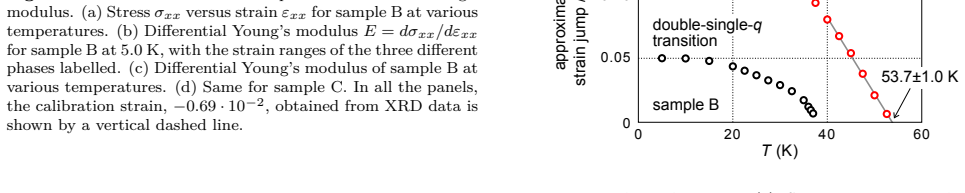
A new first-order stress-induced magnetic transition occurs in PdCrO2 at which the lattice constant shrinks by 0.21%. Across the transition the Young's modulus increases by about 80 GPa and the Poisson ratio falls from about 1 to about 0.4, indicating that the magnetic order locks and becomes insensitive to lattice strain. This locking might occur because the new stress-induced magnetic order nests the Fermi surface of the Pd sheets.
What carries the argument
The stress-induced magnetic transition that locks the magnetic order and renders it insensitive to further lattice strain.
If this is right
- The magnetic order becomes locked against lattice strain after the transition.
- Laboratory-achievable stress can induce substantial changes in magnetic structure because the Cr-Cr interaction is sensitive to interatomic separation.
- Other frustrated magnets, including candidate spin liquids, may show similarly strong coupling between magnetic and elastic degrees of freedom.
Where Pith is reading between the lines
- If the nesting picture is correct, the critical stress value could be predicted from electronic-structure calculations without new experiments.
- The large drop in Poisson ratio implies that the material becomes markedly more anisotropic under stress, which could be tested by measuring directional sound velocities across the transition.
- Applying the same uniaxial-stress protocol to other triangular-lattice antiferromagnets would test whether Fermi-surface nesting is a general mechanism for producing such locking.
Load-bearing premise
The observed elastic stiffening results from the magnetic order locking due to Fermi-surface nesting rather than other stress-dependent electronic or structural effects.
What would settle it
A band-structure calculation or spectroscopic measurement that checks whether the new magnetic structure produces Fermi-surface nesting on the Pd sheets at the transition stress.
Figures




read the original abstract
Uniaxial stress is a promising method to tune magnetic frustration, allowing its effects to be studied in a precise way. In this work, uniaxial stress is applied to the triangular-lattice antiferromagnet PdCrO2. The Cr-Cr magnetic interaction is very sensitive to interatomic separation, so laboratory-achievable stress can induce substantial changes in magnetic structure. Results from three types of measurement are presented: X-ray diffraction, the stress-strain relationship, and neutron diffraction. The combined data show that the elastic moduli of PdCrO2 are strongly affected by stress-induced changes in magnetic structure. A new, first-order stress-induced magnetic transition is observed, at which the lattice constant shrinks by 0.21%. The lattice stiffens dramatically across this transition: the Young's modulus increases by about 80 GPa, and the Poisson ratio falls from about 1 to about 0.4. This stiffening indicates that the magnetic order "locks," that is, becomes insensitive to lattice strain. This locking might occur because the new stress-induced magnetic order nests the Fermi surface of the Pd sheets. Other frustrated magnets, including candidate spin liquids, may show similarly strong coupling between magnetic and elastic degrees of freedom.
Editorial analysis
A structured set of objections, weighed in public.
Referee Report
Summary. The manuscript reports a first-order uniaxial-stress-induced magnetic transition in the triangular-lattice antiferromagnet PdCrO2, established by combining X-ray diffraction, stress-strain curves, and neutron diffraction. At the transition the c-axis lattice constant contracts by 0.21%; the Young's modulus jumps upward by ~80 GPa while the Poisson ratio drops from ~1 to ~0.4. The elastic stiffening is interpreted as the magnetic order becoming locked to the lattice, with a possible origin in Fermi-surface nesting of the Pd sheets.
Significance. If the reported numbers and transition hold, the work provides direct experimental evidence of unusually strong magnetoelastic coupling in a frustrated magnet, where modest uniaxial stress produces both a magnetic reconfiguration and large, abrupt changes in elastic moduli. The use of three independent probes (diffraction plus mechanical response) against external standards is a clear strength and makes the central observations reproducible and falsifiable.
major comments (1)
- [Abstract] Abstract and discussion: the suggestion that the observed locking 'might occur because the new stress-induced magnetic order nests the Fermi surface of the Pd sheets' is stated without any explicit comparison of the magnetic propagation vector determined by neutron diffraction against calculated Pd-sheet nesting vectors. This leaves the proposed mechanism as an untested hypothesis and opens the possibility that the modulus jump arises instead from stress-dependent Cr-Cr exchange or undetected structural degrees of freedom.
Simulated Author's Rebuttal
We thank the referee for their positive evaluation and constructive feedback. We address the single major comment below.
read point-by-point responses
-
Referee: [Abstract] Abstract and discussion: the suggestion that the observed locking 'might occur because the new stress-induced magnetic order nests the Fermi surface of the Pd sheets' is stated without any explicit comparison of the magnetic propagation vector determined by neutron diffraction against calculated Pd-sheet nesting vectors. This leaves the proposed mechanism as an untested hypothesis and opens the possibility that the modulus jump arises instead from stress-dependent Cr-Cr exchange or undetected structural degrees of freedom.
Authors: We agree that the manuscript presents the Fermi-surface nesting idea as a possible origin for the observed locking without performing or reporting an explicit comparison of the neutron-determined propagation vector to calculated Pd-sheet nesting vectors. The suggestion is offered as a hypothesis motivated by the known electronic structure of the Pd layers and the abrupt nature of the transition, but it is not tested within this work. We will revise the abstract and discussion to state more explicitly that the mechanism remains speculative and that alternatives, such as stress-induced changes in Cr-Cr exchange or undetected structural effects, cannot be excluded on the basis of the present data. revision: yes
Circularity Check
No circularity: purely experimental measurements with no derivations or self-referential predictions
full rationale
The paper reports direct experimental results from X-ray diffraction, stress-strain curves, and neutron diffraction on PdCrO2 under uniaxial stress. The observed first-order transition (0.21% lattice contraction), Young's modulus jump (~80 GPa), and Poisson ratio change (~1 to ~0.4) are measured quantities against external standards, not derived from fitted parameters or prior self-citations. The abstract's speculative phrasing ('might occur because... nests the Fermi surface') is an interpretation, not a load-bearing derivation or prediction that reduces to inputs by construction. No equations, ansatze, or uniqueness theorems are invoked that could create circularity. The central claims rest on independent data.
Axiom & Free-Parameter Ledger
Reference graph
Works this paper leans on
-
[1]
Simple Variational Wave Functions for Two-Dimensional Heisenberg Spin-1/2 Antiferromagnets.Phys
D A Huse and V Elser. Simple Variational Wave Functions for Two-Dimensional Heisenberg Spin-1/2 Antiferromagnets.Phys. Rev. Lett., 60:2531, 1988
1988
-
[2]
Phase diagram for a class of spin-1/2 Heisenberg models interpolating between the square-lattice, the triangular-lattice, and the linear-chain limits.Phys
Z Weihong, R H McKenzie, and R P Singh. Phase diagram for a class of spin-1/2 Heisenberg models interpolating between the square-lattice, the triangular-lattice, and the linear-chain limits.Phys. Rev. B, 59:14367, 1999. Uniaxial-stress-induced magnetic transitions in the triangular-lattice antiferromagnet PdCrO 2 12
1999
-
[3]
Spin-liquid and magnetic phases in the anisotropic triangular lattice: The case ofκ-(ET)2X.Phys
L F Tocchio, A Parola, C Gros, and F Becca. Spin-liquid and magnetic phases in the anisotropic triangular lattice: The case ofκ-(ET)2X.Phys. Rev. B, 80:064419, 2009
2009
-
[4]
Phase diagram of the anisotropic triangular lattice Hubbard model.Phys
A Szasz and J Motruk. Phase diagram of the anisotropic triangular lattice Hubbard model.Phys. Rev. B, 103:235132, 2021
2021
-
[5]
Spin Liquid State in an Organic Mott Insulator with a Triangular Lattice.Phys
Y Shimizu, K Miyagawa, K Kanoda, M Maesato, and G Saito. Spin Liquid State in an Organic Mott Insulator with a Triangular Lattice.Phys. Rev. Lett., 91:107001, 2003
2003
-
[6]
Temperature dependence of structural and electronic properties of the spin-liquid candidateκ-(BEDT-TTF)2Cu2(CN)3.Phys
H O Jeschke, M de Souze, R Valent´ ı, R Sekhar Manna, M Lang, and J A Schlueter. Temperature dependence of structural and electronic properties of the spin-liquid candidateκ-(BEDT-TTF)2Cu2(CN)3.Phys. Rev. B, 85:035125, 2012
2012
-
[7]
Probing and tuning geometric frustration in an organic quantum magnet via elastocaloric measurements under strain.Sci
F Lieberich, Y Saito, Y Agarmani, T Sasaki, N Yoneyama, S M Winter, M Lang, and E Gati. Probing and tuning geometric frustration in an organic quantum magnet via elastocaloric measurements under strain.Sci. Advances, 11:eadz0699, 2025
2025
-
[8]
La structure des substances magnetiques.J
J Villain. La structure des substances magnetiques.J. Phys. Chem. Solids, 11(3):303–309, 1959
1959
-
[9]
A new type of antiferromagnetic structure in the rutile type crystal.J
A Yoshimori. A new type of antiferromagnetic structure in the rutile type crystal.J. Phys. Soc. Japan, 14(6):807– 821, 1959
1959
-
[10]
On the 90 ◦Exchange Interaction between Cations (Cr 3+, Mn 2+, Fe 3+ and Ni2+) in Oxides.J
K Motida and S Miyahara. On the 90 ◦Exchange Interaction between Cations (Cr 3+, Mn 2+, Fe 3+ and Ni2+) in Oxides.J. Phys. Soc. Japan, 28:1188, 1970
1970
-
[11]
Magnetic interactions in PdCrO 2 and their effects on its magnetic structure.Phys
M D Le, S Jeon, A I Kolesnikov, D J Voneshen, A S Gibbs, J S Kim, J Jeong, H-J Noh, C Park, J Yu, T G Perring, and J-G Park. Magnetic interactions in PdCrO 2 and their effects on its magnetic structure.Phys. Rev. B, 98:024429, 2018
2018
-
[12]
E. V. Komleva, V. Yu. Irkhin, I. V. Solovyev, M. I. Katsnelson, and S. V. Streltsov. Unconventional magnetism and electronic state in the frustrated layered system PdCrO2.Phys. Rev. B, 102:174438, 2020
2020
-
[13]
Hardy, C
V. Hardy, C. Martin, F. Damay, and G. Andr´ e. Magnetic couplings in the quasi-2D triangular Heisenberg antifer- romagnetsα-Cr2O4 (A = Ca, Sr, Ba).J. Magn. Magn. Mat., 330:111, 2013
2013
-
[14]
Quantum oscillations and magnetic reconstruction in the delafossite PdCrO2.Phys
C W Hicks, A S Gibbs, Li Zhao, P Kushwaha, H Borrmann, A P Mackenzie, H Takatsu, S Yonezawa, Y Maeno, and E A Yelland. Quantum oscillations and magnetic reconstruction in the delafossite PdCrO2.Phys. Rev. B, 92:014425, 2015
2015
-
[15]
Quantum Oscillations of the Metallic Triangular-Lattice Antiferromagnet PdCrO2.Phys
J M Ok, Y J Jo, K Kim, T Shishidou, E S Choi, H-J Noh, T Oguchi, B I Min, and J S Kim. Quantum Oscillations of the Metallic Triangular-Lattice Antiferromagnet PdCrO2.Phys. Rev. Lett., 111:176405, 2013
2013
-
[16]
Direct Observation of Localized Spin Antiferromagnetic Transition in PdCrO 2 by Angle-Resolved Photoemission Spectroscopy.Sci
H-J Noh, J Jeong, B Chang, D Jeong, H S Moon, E-J Cho, J M Ok, J S Kim, K Kim, B I Min, H-K Lee, J-Y Kim, B-G Park, H-D Kim, and S Lee. Direct Observation of Localized Spin Antiferromagnetic Transition in PdCrO 2 by Angle-Resolved Photoemission Spectroscopy.Sci. Rep., 4(1):3680, 2014
2014
-
[17]
Probing spin correlations using angle-resolved photoemission in a coupled metallic/Mott insulator system.Sci
V Sunko, F Mazzola, S Kitamura, S Khim, P Kushwaha, O J Clark, M D Watson, I Markovi´ c, D Biswas, L Pourovskii, T K Kim, T-L Lee, P K Thakur, H Rosner, A Georges, R Moessner, T Oka, A P Mackenzie, and P D C King. Probing spin correlations using angle-resolved photoemission in a coupled metallic/Mott insulator system.Sci. Adv., 6:eaaz0611, 2020
2020
-
[18]
Unconventional Anomalous Hall Effect in the Metallic Triangular-Lattice Magnet PdCrO 2.Phys
H Takatsu, S Yonezawa, S Fujimoto, and Y Maeno. Unconventional Anomalous Hall Effect in the Metallic Triangular-Lattice Magnet PdCrO 2.Phys. Rev. Lett., 105:137201, 2010
2010
-
[19]
Impact of short-range order on transport properties of the two- dimensional metal PdCrO 2.Phys
R Daou, R Fr´ esard, S H´ ebert, and A Maignan. Impact of short-range order on transport properties of the two- dimensional metal PdCrO 2.Phys. Rev. B, 92:245115, 2015
2015
-
[20]
Large anomalous Hall conductivity induced by spin chirality fluctuation in an ultraclean frustrated antiferromagnet PdCrO 2.Comm Phys., 7:162, 2024
H-S Jeon, H-W Seo, J-H Seo, Y H Kim, E S Choi, Y-J Jo, H N Lee, J M Ok, and J S Kim. Large anomalous Hall conductivity induced by spin chirality fluctuation in an ultraclean frustrated antiferromagnet PdCrO 2.Comm Phys., 7:162, 2024
2024
-
[21]
Critical behavior of the metallic triangular-lattice Heisenberg antiferromagnet PdCrO 2.Phys
H Takatsu, H Yoshizawa, S Yonezawa, and Y Maeno. Critical behavior of the metallic triangular-lattice Heisenberg antiferromagnet PdCrO 2.Phys. Rev. B, 79:104424, 2009
2009
-
[22]
Magnetic structure of the conductive triangular-lattice antiferromagnet PdCrO 2.Phys
H Takatsu, G N´ enert, H Kadowaki, H Yoshizawa, M Enderle, S Yonezawa, Y Maeno, J Kim, N Tsuji, M Takata, Y Zhao, M Green, and C Broholm. Magnetic structure of the conductive triangular-lattice antiferromagnet PdCrO 2.Phys. Rev. B, 89:104408, 2014
2014
-
[23]
Heisenberg spins on an anisotropic triangular lattice: PdCrO 2 under uniaxial stress.New J
D Sun, D A Sokolov, R Waite, S Khim, P Manuel, F Orlandi, D D Khalyavin, A P Mackenzie, and C W Hicks. Heisenberg spins on an anisotropic triangular lattice: PdCrO 2 under uniaxial stress.New J. Phys., 23(12):123050, 2021
2021
-
[24]
Sanchez, P Malinowski, J Mutch, J Liu, J-W Kim, P J Ryan, and J-H Chu
J J. Sanchez, P Malinowski, J Mutch, J Liu, J-W Kim, P J Ryan, and J-H Chu. The transport–structural correspondence across the nematic phase transition probed by elasto X-ray diffraction.Nat. Mater., 20(11):1519–1524, 2021
2021
-
[25]
Giant lattice softening at a Lifshitz transition in Sr2RuO4.Science, 382(6669):447–450, 2023
H M L Noad, K Ishida, Y-S Li, E Gati, V Stangier, N Kikugawa, D A Sokolov, M Nicklas, B Kim, I I Mazin, M Garst, J Schmalian, A P Mackenzie, and C W Hicks. Giant lattice softening at a Lifshitz transition in Sr2RuO4.Science, 382(6669):447–450, 2023
2023
-
[26]
Probing Quantum Materials with Uniaxial Stress.Annual Reviews of Condensed Matter Physics, 16:417, 2025
C W Hicks, F Jerzembeck, H M L Noad, M E Barber, and A P Mackenzie. Probing Quantum Materials with Uniaxial Stress.Annual Reviews of Condensed Matter Physics, 16:417, 2025
2025
-
[27]
Single crystal growth of the metallic triangular-lattice antiferromagnet PdCrO 2 .J
H Takatsu and Y Maeno. Single crystal growth of the metallic triangular-lattice antiferromagnet PdCrO 2 .J. Cryst. Growth, 312(23):3461–3465, 2010
2010
-
[28]
Flux growth in a horizontal configuration: An analog to vapor transport growth.Phys
J-Q Yan, B C Sales, M A Susner, and M A McGuire. Flux growth in a horizontal configuration: An analog to vapor transport growth.Phys. Rev. Mater., 1:023402, 2017
2017
-
[29]
Mackenzie, S Nakatsuji, and C W Hicks
M Ikhlas, K R Shirer, P-Y Yang, A P. Mackenzie, S Nakatsuji, and C W Hicks. A tunable stress dilatometer and measurement of the thermal expansion under uniaxial stress of Mn 3Sn.Appl. Phys. Lett., 117(23):233502, 2020
2020
-
[30]
Piezoelectric-based apparatus for strain tuning.Rev
C W Hicks, M E Barber, S D Edkins, D O Brodsky, and A P Mackenzie. Piezoelectric-based apparatus for strain tuning.Rev. Sci. Instrum., 85(6):065003, 2014
2014
-
[31]
Application of signal separation to diffraction image compression and serial crystallography.J
J Kieffer, J Orlans, N Coquelle, S Debionne, S Basu, A Homs, G Santoni, and D De Sanctis. Application of signal separation to diffraction image compression and serial crystallography.J. Appl. Crystallogr., 58(1):138– 153, 2025
2025
-
[32]
PhD thesis, Technische Universitaet Dresden, 2025
N Stilkerich.Uniaxial pressure-driven magnetic phase transitions in the frustrated antiferromagnet PdCrO 2. PhD thesis, Technische Universitaet Dresden, 2025
2025
-
[33]
Piezoelectric-based uniaxial pressure cell with integrated force and displacement sensors.Rev
M E Barber, A Steppke, A P Mackenzie, and C W Hicks. Piezoelectric-based uniaxial pressure cell with integrated force and displacement sensors.Rev. Sci. Instrum., 90:023904, 2019
2019
-
[34]
Wish: The new powder and single crystal magnetic diffractometer on the second target station
L C Chapon, P Manuel, P G Radaelli, C Benson, L Perrott, S Ansell, N J Rhodes, D Raspino, D Duxbury, E Spill, and J Norris. Wish: The new powder and single crystal magnetic diffractometer on the second target station. Neutron News, 22(2):22–25, 2011
2011
-
[35]
Elastic tensor of Sr2RuO4.Phys
J Paglione, C Lupien, W A MacFarlane, J M Perz, L Taillefer, Z Q Mao, and Y Maeno. Elastic tensor of Sr2RuO4.Phys. Rev. B, 65:220506, 2002. Uniaxial-stress-induced magnetic transitions in the triangular-lattice antiferromagnet PdCrO 2 13
2002
-
[36]
doi: 10.5286/SOFT- WARE/MANTID6.8
Mantid 6.8.0: Manipulation and Analysis Toolkit for In- strument Data.; Mantid Project. doi: 10.5286/SOFT- WARE/MANTID6.8
-
[37]
Arnold, J
O. Arnold, J. C. Bilheux, J. M. Borreguero, A. Buts, S. I. Campbell, L. Chapon, M. Doucet, N. Draper, R. Fer- raz Leal, M. A. Gigg, V. E. Lunch, A. Markvardsen, D. J. Mikkelson, R. L. Mikkelson, R. Miller, K. Palmen, P. Parker, G. Passos, T. G. Perring, P. F. Peterson, and J. Zikovsky. Mantid—Data analysis and visualization package for neutron scattering ...
2014
-
[38]
Magnetic frustration and spontaneous rotational symmetry breaking in PdCrO 2.Phys
D Sun, D A Sokolov, J M Bartlett, J Sannigrahi, S Khim, P Kushwaha, D D Khalyavin, P Manuel, A S Gibbs, H Takagi, A P Mackenzie, and C W Hicks. Magnetic frustration and spontaneous rotational symmetry breaking in PdCrO 2.Phys. Rev. B, 100:094414, 2019
2019
-
[39]
Quantum Oscillations and High Carrier Mobility in the Delafossite PdCoO2.Phys
C W Hicks, A S Gibbs, A P Mackenzie, H Takatsu, Y Maeno, and E A Yelland. Quantum Oscillations and High Carrier Mobility in the Delafossite PdCoO2.Phys. Rev. Lett., 109:116401, 2012
2012
-
[40]
Min, and H-D Kim
H-J Noh, J-W Jeong, J-H Jeong, E-J Cho, S B Kim, K Kim, B I. Min, and H-D Kim. Anisotropic Electric Conductivity of Delafossite PdCoO 2 Studied by Angle- Resolved Photoemission Spectroscopy.Phys. Rev. Lett., 102:256404, 2009
2009
-
[41]
The superconductivity of Sr2RuO4 underc-axis uniaxial stress.Nature Commun., 13:4596, 2022
F Jerzembeck, H S Røising, A Steppke, H Rosner, D A Sokolov, N Kikugawa, T Scaffidi, S H Simon, A P Mackenzie, and C W Hicks. The superconductivity of Sr2RuO4 underc-axis uniaxial stress.Nature Commun., 13:4596, 2022
2022
-
[42]
M. E. Barber, H.-H. Kim, T. Loew, M. Le Tacon, M. Minola, M. Konczykowski, B. Keimer, A. P. Mackenzie, and C. W. Hicks. Dependence ofT c of YBa2Cu3O6.67 on in-plane uniaxial stress.Phys. Rev. B, 106:184516, 2022
2022
-
[43]
J. Cao, E. Ertekin, V. Srinivasan, W. Fan, S. Huang, H. Zheng, J. W. L. Yim, D. R. Khanal, D. F. Ogletree, J. C. Grossman, and J. Wu. Strain engineering and one-dimensional organization of metal–insulator domains in single-crystal vanadium dioxide beams.Nature Nanotech., 4:732, 2009
2009
-
[44]
Data Availability The neutron scattering data are available at https://data.isis.stfc.ac.uk/doi/STUDY/... 120633327/. The XRD and stress-strain data are available at https://doi.org/10.25500/edata.bham.00001577
-
[45]
Appendix 9.1. Conversion from sensor units to force and displacement To convert the raw force and displacement sensor capacitances to force and displacement, we apply the following relations [25]: F= ϵ0kfAf ( 1 Cf−Cf,offset − 1 Cf,0−Cf,offset ) −kflexD, D=ϵ0Ad ( 1 Cd−Cd,offset − 1 Cd,0−Cd,offset ) . kf is the spring constant of the force sensor flexures, ...
-
[46]
magnetic reflection was found to move under uniaxial stress at rate dh/dσ=−0.047±0.009 GPa−1, over a range of stress extending from zero to the double-single-qtransition. In the small-σregime, and assuming thatJdepends on interatomic separation only,dh/dσis given in the above magnetic model by dh dσ= (1 +ν) √ 3 8π 1 E a0 J0 dJ da,(10) whereνis the Poisson...
discussion (0)
Sign in with ORCID, Apple, or X to comment. Anyone can read and Pith papers without signing in.