Beyond Ideal Instruction: A Comprehensive Framework for Evaluating LLMs in Realistic Interactions
Pith reviewed 2026-06-28 10:07 UTC · model grok-4.3
The pith
A new benchmark shows no LLM exceeds 40 percent success rate when users give ambiguous or shifting instructions for tool use.
A machine-rendered reading of the paper's core claim, the machinery that carries it, and where it could break.
Core claim
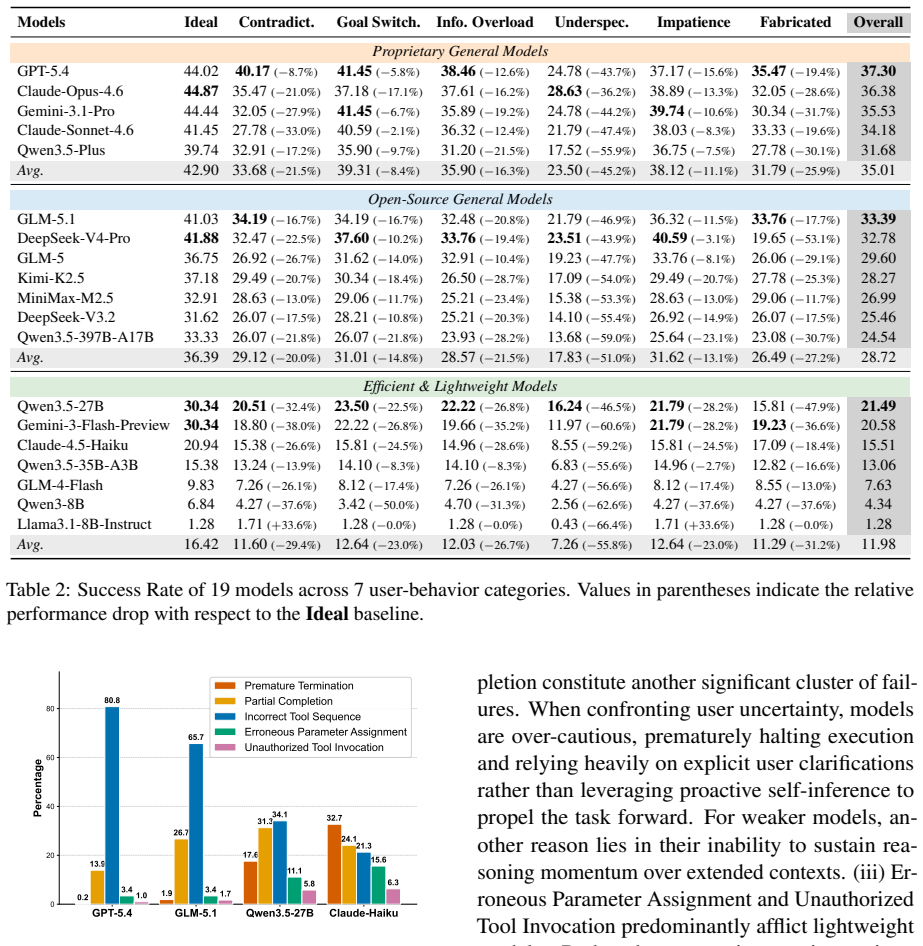
RUT-Bench supports high-fidelity simulations of both ideal rational user patterns and heterogeneous non-ideal behaviors across single-turn and multi-turn dialogues; when 19 widely used LLMs are tested on this benchmark, none reaches an overall success rate above 40 percent and nearly all exhibit noticeable performance drops when confronted with more complicated non-ideal user inputs.
What carries the argument
RUT-Bench, a benchmark that generates high-fidelity simulations of real-world user tool-calling scenarios covering ideal rational patterns together with heterogeneous non-ideal behaviors such as ambiguity and shifting intentions.
If this is right
- Existing evaluation methods that rely only on idealized user assumptions overestimate LLM tool-use performance in practice.
- LLMs require additional capabilities to maintain performance when user inputs become ambiguous or intentions shift across turns.
- Tool-calling deployments should expect substantial failure rates until models improve on non-ideal inputs.
- Benchmark design must incorporate multi-turn dialogues with heterogeneous user behaviors to reflect real usage.
Where Pith is reading between the lines
- Training pipelines that expose models only to clean instructions may need to be supplemented with examples of messy or contradictory user requests.
- The observed performance gap suggests that real-world tool-calling agents will require fallback mechanisms or human review loops until success rates rise.
- Extending the benchmark to other domains such as data analysis or code generation could reveal similar limitations in handling unclear user intent.
Load-bearing premise
The high-fidelity simulations of ideal and non-ideal user behaviors in RUT-Bench accurately represent the ambiguity, uncooperative actions, and changing intentions that occur with real users.
What would settle it
A controlled study in which actual human users interact with the same LLMs on the same tool-calling tasks and produce success rates above 40 percent would falsify the claim that the benchmark reveals a genuine limitation.
Figures





read the original abstract
Despite great advances in tool-use capabilities of large language models (LLMs), existing evaluation benchmarks struggle to fully align with real-world scenarios. Such benchmarks mostly rely on simulated idealized user assumptions and lacks experience-oriented evaluation. These limitations fail to account for the ambiguity, uncooperative behaviors, and shifting intentions characteristic of real-world users. To fill this gap, we propose RUT-Bench, a dedicated benchmark designed to assess LLMs under diverse Real-world User Tool calling scenarios. RUT-Bench supports high-fidelity simulations covering both ideal rational patterns and heterogeneous non-ideal behaviors across single-turn and multi-turn dialogues. We conduct comprehensive evaluations on 19 widely adopted open-source and proprietary LLMs using our benchmark. Experimental results reveal that no tested LLMs achieve an overall success rate above 40%, and nearly all of them experience noticeable performance drops when facing more complicated non-ideal user inputs. Our code and data is available at https://github.com/Miaow-Lab/RUT-Bench.
Editorial analysis
A structured set of objections, weighed in public.
Referee Report
Summary. The paper introduces RUT-Bench, a benchmark for assessing LLMs on tool-calling tasks under realistic user conditions. It supports high-fidelity simulations of both ideal rational patterns and heterogeneous non-ideal behaviors (ambiguity, uncooperative actions, intention shifts) in single- and multi-turn dialogues. Comprehensive evaluations are reported on 19 open-source and proprietary LLMs, with the central empirical finding that no model exceeds an overall success rate of 40% and that nearly all exhibit performance drops on non-ideal inputs. Code and data are released.
Significance. If the RUT-Bench simulations prove to be faithful proxies for real user behavior, the results would usefully document the gap between current LLM tool-use capabilities and realistic deployment conditions, providing a concrete target for future work. The public release of the benchmark supports reproducibility and follow-on studies.
major comments (2)
- [Abstract] Abstract: the headline claim that 'no tested LLMs achieve an overall success rate above 40%' and that performance drops occur on non-ideal inputs rests entirely on the unvalidated assertion of 'high-fidelity simulations'; no quantitative comparison to real user logs, human ecological-validity judgments, or distributional statistics is described, rendering the measured gaps uninterpretable as evidence about real-world conditions.
- [Experimental setup] The description of RUT-Bench (implied experimental setup): the manuscript states that the benchmark covers 'heterogeneous non-ideal behaviors' yet supplies no details on simulation construction, parameter choices for intention drift or ambiguity, or any error analysis, which are load-bearing for the cross-model comparison.
minor comments (1)
- [Abstract] The abstract would be clearer if it briefly contrasted RUT-Bench with prior tool-use benchmarks (e.g., ToolBench, API-Bank) on the dimension of non-ideal user modeling.
Simulated Author's Rebuttal
We thank the referee for the constructive feedback highlighting the need for greater transparency on simulation validation and construction details. We address each major comment below and will make corresponding revisions to the manuscript.
read point-by-point responses
-
Referee: [Abstract] Abstract: the headline claim that 'no tested LLMs achieve an overall success rate above 40%' and that performance drops occur on non-ideal inputs rests entirely on the unvalidated assertion of 'high-fidelity simulations'; no quantitative comparison to real user logs, human ecological-validity judgments, or distributional statistics is described, rendering the measured gaps uninterpretable as evidence about real-world conditions.
Authors: We agree that the manuscript provides no quantitative validation of simulation fidelity against real user logs or human judgments. The non-ideal behaviors were derived from patterns described in prior tool-use literature rather than direct empirical matching. In revision we will (1) expand the benchmark construction section with the qualitative sources and generation process used, (2) add an explicit limitations subsection discussing the lack of ecological-validity metrics and the consequent interpretive caveats, and (3) qualify the abstract wording to avoid overstating fidelity. These changes will make the claims more precise without altering the reported experimental results. revision: yes
-
Referee: [Experimental setup] The description of RUT-Bench (implied experimental setup): the manuscript states that the benchmark covers 'heterogeneous non-ideal behaviors' yet supplies no details on simulation construction, parameter choices for intention drift or ambiguity, or any error analysis, which are load-bearing for the cross-model comparison.
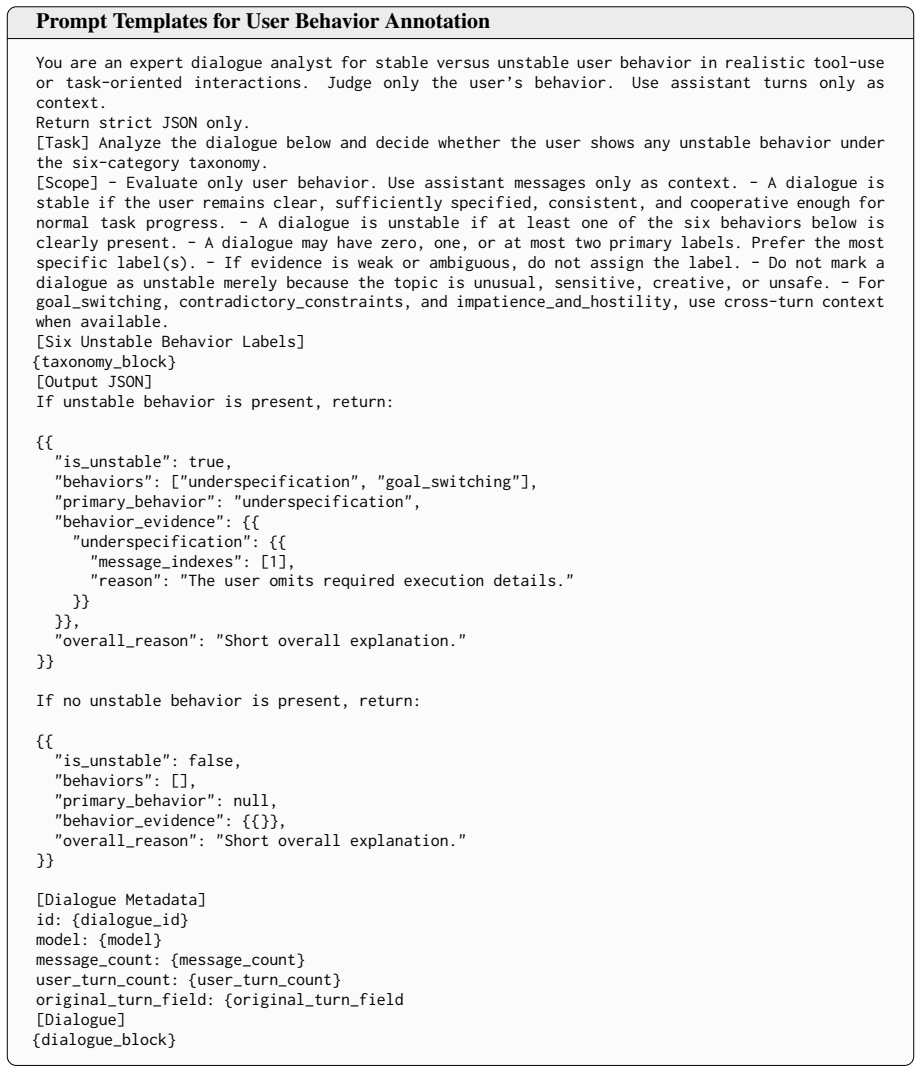
Authors: The observation is accurate; the current text does not supply the requested implementation details. We will revise the experimental-setup section to include: the full parameterization of ambiguity, uncooperative actions, and intention-shift mechanisms; the specific probability distributions or ranges employed; and any post-generation error analysis of the simulated dialogues. This added material will directly support reproducibility and interpretation of the 19-model comparison. revision: yes
Circularity Check
No significant circularity; benchmark evaluation is self-contained
full rationale
The paper proposes RUT-Bench and reports direct empirical success rates from LLM evaluations on its simulated dialogues. No equations, fitted parameters, predictions derived from subsets, or self-citation chains appear in the provided text. The central claims are measurements on a newly introduced benchmark rather than reductions of outputs to inputs by construction. Per rules, this is the normal non-finding for an independent benchmark paper; lack of external validation against real logs is a validity concern, not circularity.
Axiom & Free-Parameter Ledger
axioms (1)
- domain assumption Simulated non-ideal user behaviors accurately capture real-world ambiguity, uncooperative actions, and shifting intentions
Reference graph
Works this paper leans on
-
[1]
Simulating user diversity in task-oriented dia- logue systems using large language models.Preprint, arXiv:2502.12813. Anthropic. 2026. Claude opus 4.6. https://www. anthropic.com/news/claude-opus-4-6 . Ac- cessed: 2026-05-24. J. L. Austin. 1962.How to Do Things with Words. Harvard University Press. Victor Barres, Honghua Dong, Soham Ray, Xujie Si, and Kar...
-
[2]
Persistent Environment — The query is about a domain where: - There is a live, ongoing state that can be read or changed - The environment supports both: a) Information queries about current state (read operations) b) Explicit state-changing actions (create, update, delete, move, cancel, etc.)
-
[3]
State Dependency — The task cannot be answered correctly without: - Inspecting the actual current data or configuration in the environment, and/or - Executing an operation that modifies that data
-
[4]
Domain Specificity — The environment is not general-purpose knowledge; it is a structured system such as: - File management system with stored files/folders - Order/logistics tracking system - Calendar/scheduling system - CRM, inventory, ticketing, project management tools - Other specialized platforms with records that persist over time
-
[5]
Is invoice 1024 paid?
Actionability in Context — The query must correspond to an actionable operation or status check **within the actual environment** (not hypothetical). Eligible Task Types - State queries: "Is invoice 1024 paid?" / "What meetings are scheduled for Wednesday?" - State modification operations: "Upload the proposal.pdf to the project folder" / "Cancel order 45...
-
[6]
- Note any relevant entities, constraints, relationships, or dynamics implied by the task
Analysis - Explain the reasoning process used to connect the task to the chosen environment. - Note any relevant entities, constraints, relationships, or dynamics implied by the task
-
[7]
- Examples: Linux filesystem, E-commerce order management system, Airline booking system
Environment Summary - Provide a concise label for the environment type. - Examples: Linux filesystem, E-commerce order management system, Airline booking system
-
[8]
- Focus on its inherent structure, the nature of the state it maintains, typical operations it supports, and its general scope in real-world usage
Environment Introduction - Introduce the environment itself, without referring to the current task. - Focus on its inherent structure, the nature of the state it maintains, typical operations it supports, and its general scope in real-world usage. - Limit to approximately three sentences
-
[9]
all possible data in an e-commerce system
Metrics - Usefulness: 1-10 Reflects how broadly applicable and valuable this environment is in real-world scenarios. Higher scores indicate environments relevant to many contexts and industries. - Modelability: 1-10 Indicates how straightforward it would be to represent this environment using a single Python class, with attributes holding state and method...
-
[10]
- Parameters needed
In Analysis, reason about: - What entities/attributes are involved. - Parameters needed. - Expected outputs (queries return structured results, state modifications return success messages). - Error/edge cases (e.g., invalid input, permission denied). - Does it involve environmental constraints or rules
-
[11]
success": False,
In Code, implement the Python method: - Method name: ‘def <operation_name>(self, ...)‘. Note: Cannot be an independent function, but rather a method function within an already implemented environment class. - Add clear type hints. - Add docstring describing inputs, outputs, constraints. - Error handling: do not raise exceptions — return a dict like ‘{ "su...
-
[12]
Use the exact top-level state container names provided by the user
-
[13]
Populate realistic, internally consistent, cross-referenced entities
-
[14]
Make the state rich enough for multi-step tool use
-
[15]
Use only fictional data
-
[16]
State profile definitions: Each generated state must match one of the following profiles, as specified in the user message
Output JSON only. State profile definitions: Each generated state must match one of the following profiles, as specified in the user message. - sparse: A minimal but functional state. Populate at least two collections, but keep most collections lean (1–2 entries each). Cross-references between entities should still be valid. Suitable for simple, single-st...
-
[17]
Use only entities that actually exist in the provided init_config
-
[18]
Prefer tasks with at least one objective state change on structured fields
-
[19]
The user-facing request must not mention internal IDs, tool names, code details, or hidden state keys
-
[20]
The tool plan must be directly executable from the provided initial state, and every tool step must return success during replay
-
[21]
A rare 0-tool plan is allowed only when task_type is clarify_then_execute or refuse_or_scope
Standard execute tasks should use between 1 and 6 tool calls. A rare 0-tool plan is allowed only when task_type is clarify_then_execute or refuse_or_scope
-
[22]
Set agent_action_budget to an integer no larger than 50
-
[23]
If a later step needs a newly created entity, explicitly choose its ID in the creation step so the plan stays deterministic
-
[24]
Prefer realistic tasks that require discovery before mutation, but prefer concrete verification tools over high-level helper tools when the state hints already expose the relevant candidate IDs
-
[25]
Avoid plans that depend on unavailable equipment types, nonexistent future slots, or helper tools whose success is uncertain from the current state
-
[26]
If dialogue_mode is multi_turn, provide 2-3 coherent turn-level tasks
-
[27]
Prefer execute unless the prompt explicitly calls for a clarification-heavy or refusal-heavy task
Set task_type to one of execute, clarify_then_execute, or refuse_or_scope. Prefer execute unless the prompt explicitly calls for a clarification-heavy or refusal-heavy task
-
[28]
If task_type is clarify_then_execute or refuse_or_scope, include the necessary clarification_requirements or refusal_requirements and any forbidden_actions
-
[29]
If the prompt gives an explicit coverage target for this attempt, satisfy it exactly
-
[30]
goal_summary
Output JSON only. Return an object with this schema: { "goal_summary": "short benchmark goal", "user_request": "natural user-facing request without IDs", "dialogue_mode": "single_turn or multi_turn", "difficulty_bucket": "easy or medium or hard", "task_type": "execute or clarify_then_execute or refuse_or_scope", "tool_call_budget": 2, "agent_action_budget...
-
[31]
Preserve the exact task semantics and do not invent a different task
-
[32]
Keep the user cooperative, realistic, concise, and grounded in the environment context
-
[33]
Do not mention tool names, internal IDs, hidden schema keys, implementation details, or oracle information
-
[34]
If dialogue_mode is single_turn, output exactly one user turn
-
[35]
If dialogue_mode is multi_turn, output 2-3 user turns that stay in the same task context
-
[36]
Assign every gold-trace tool step to exactly one user turn using contiguous step groups
-
[37]
Cover all tool steps exactly once, in increasing order
-
[38]
The final assistant response should be a short user-facing completion message consistent with the expected outcome
-
[39]
user_turns
Output JSON only. Return an object with this schema: { "user_turns": [ { "turn_id": 1, "user_message": "natural collaborative user message", "task_summary": "short turn summary", "expected_outcome": "expected turn-level outcome", "linked_tool_step_indices": [1, 2] } ], "assistant_final_response": "short user-facing completion message" } Figure 15: System ...
-
[40]
Preserve the exact underlying task for the same task_id
-
[41]
Keep the same number of user turns and the same turn ordering
-
[42]
Do not change the task_summary, expected_outcome, linked tool-step alignment, tool plan, or final target state
Rewrite only the user-facing messages. Do not change the task_summary, expected_outcome, linked tool-step alignment, tool plan, or final target state
-
[43]
Inject only the requested six-taxonomy unstable behavior bundle as controlled friction on top of the stable baseline
-
[44]
Do not mention tool names, internal IDs, hidden schema keys, or implementation details
-
[45]
Any noisy side remark must still leave the original task recoverable directly or through clarification
Do not replace the original task with a new mandatory task. Any noisy side remark must still leave the original task recoverable directly or through clarification
-
[46]
Do not leak the oracle trace, backend schema, hidden state, or tool implementation details
-
[47]
rewritten_user_turns
Output JSON only. Return an object with this schema: { "rewritten_user_turns": [ { "turn_id": 1, "user_message": "unstable rewrite of the baseline turn" } ] } Unstable behavior taxonomy: The following six behaviors define the full set of friction types used in this benchmark. The specific behavior bundle to inject for each dialogue is provided in the user...
-
[48]
- Sub-goals must be logically sequenced: each turn’s sub-goal should build on prior turns and not duplicate work already implied
Intent & Sub-goal Integrity (INTENT) - The underlying intent of each user turn must strictly align with the blueprint goal. - Sub-goals must be logically sequenced: each turn’s sub-goal should build on prior turns and not duplicate work already implied. - The union of all sub-goals must be collectively sufficient to achieve the final objective — no requir...
-
[49]
- The agent must never be forced to guess a parameter whose value has not been exposed anywhere in the conversation so far
Agent Inferability (INFER) - Every goal, sub-goal, and parameter that the agent needs to invoke a tool must be fully recoverable from either the current user turn or the immediately preceding dialogue context. - The agent must never be forced to guess a parameter whose value has not been exposed anywhere in the conversation so far. - For clarify_then_exec...
-
[50]
INTENT, LEAK
Information Leakage (LEAK) - The dialogue must not mention any internal tool names, backend identifiers (e.g., entity IDs that were not stated in the original user request), or schema-level implementation details. - Only identifiers or tool-related terms that are explicitly visible in the original task description or environment introduction are permitted...
-
[51]
Faithfulness & Multi-turn Stability (0-1): grounded in the given context, consistent across turns, avoids inventing unsupported facts
-
[52]
Clarification Proactivity (0-1): asks for clarification when needed, does not ask unnecessary clarification when the request is already actionable
-
[53]
faithfulness_score
Tool Discipline / Non-Blind Decision (0-1): avoids blind decisions, avoids repetitive or unnecessary tool usage, and avoids unsupported commitments. Important: - If the task type or requirements indicate that clarification or refusal is appropriate, do not penalize the agent for doing so. - If the user is non-collaborative, judge whether the agent stayed ...
discussion (0)
Sign in with ORCID, Apple, or X to comment. Anyone can read and Pith papers without signing in.