Euclid preparation. Probing galaxy evolution within cosmic voids in Euclid-like simulations
Pith reviewed 2026-06-29 06:16 UTC · model grok-4.3
The pith
Galaxies closer to void centers are less massive, more actively star-forming, and more disc-dominated than those in denser regions.
A machine-rendered reading of the paper's core claim, the machinery that carries it, and where it could break.
Core claim
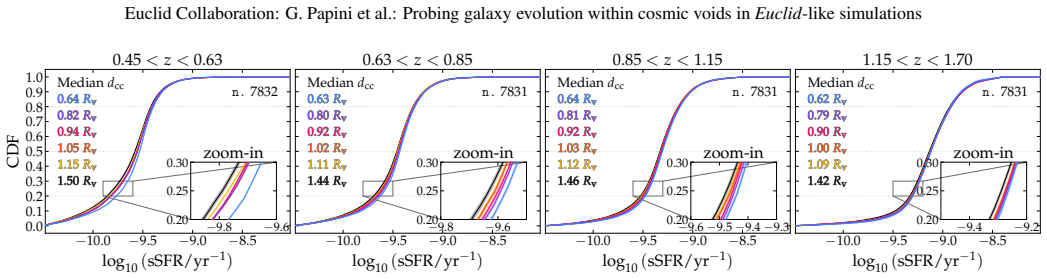
Galaxies located closer to void centres (d_cc ≲ 0.7 R_v) are less massive, more actively star-forming, and more disc-dominated than galaxies in denser regions. Merger histories indicate that void galaxies do not experience fewer mergers, but rather that mergers occur later relative to galaxies in high-density regions. These results support a scenario in which the environment regulates the timing and nature of mergers rather than their overall frequency, producing a slower evolutionary path in low-density regions.
What carries the argument
Void-centric distance (d_cc) and local density contrast classification applied to the GAEA mock-observation lightcone with H-alpha selection, used to compare stellar mass, specific star formation rate, bulge-to-total ratio, halo mass, and merger histories across environments.
If this is right
- Environment controls the timing of mergers rather than their total number.
- Low-density regions produce slower galaxy evolution through delayed assembly.
- The trends provide a framework for interpreting forthcoming Euclid observations of voids.
- Results may depend on the specific methods used to parametrize environment and select galaxies.
Where Pith is reading between the lines
- Galaxy formation models may need explicit environment-dependent timing for mergers to match these patterns.
- Comparison with other hydrodynamical simulations could test whether the delayed-merger signal is robust to different feedback prescriptions.
- Real Euclid data releases could extend this to higher redshifts or different tracers once selection effects are calibrated.
- The approach could be applied to other large-scale structure features such as filaments to map how density gradients affect merger timing across all environments.
Load-bearing premise
The void-centric distance and local density contrast classification combined with the GAEA mock lightcone and H-alpha selection faithfully reproduces environmental effects without dominant biases from simulation assumptions or observational selection effects.
What would settle it
If real Euclid H-alpha observations find no systematic difference in stellar mass, star formation rate, or bulge fraction between galaxies at d_cc ≲ 0.7 R_v and those in denser regions, or if merger timing shows no delay in voids.
Figures




read the original abstract
The evolution of galaxies is profoundly influenced by the environment in which they reside. Cosmic voids serve as pristine laboratories for studying galaxy evolution in the relative absence of the complex physical processes that dominate denser environments. In this study, we investigate galaxy properties and merger histories as a function of environment using the GAlaxy Evolution and Assembly (GAEA) mock-observation lightcone replicating the Euclid Deep Survey as foreseen for the first Euclid data release. The H$\alpha$-selected galaxy sample spans the redshift range $0.4 < z < 1.8$, corresponding to the interval over which H$\alpha$ is accessible to Euclid slitless spectroscopy. We classify galaxies based on their void-centric distance and local density contrast, and compare their stellar mass, specific star formation rate, bulge-to-total stellar mass ratio, and halo mass across different environments. We further analyse the merger histories of these galaxies to study their assembly evolution. We find that galaxies located closer to void centres ($d_{\rm cc} \lesssim 0.7 R_{\rm v}$) are less massive, more actively star-forming, and more disc-dominated than galaxies in denser regions. Merger histories indicate that void galaxies do not experience fewer mergers, but rather that mergers occur later relative to galaxies in high-density regions. These results support a scenario in which the environment regulates the timing and nature of mergers rather than their overall frequency, producing a slower evolutionary path in low-density regions. We conclude by discussing the extent to which these trends are shaped by environmental parametrisation methods and observational selection effects. Our analysis provides a framework for interpreting forthcoming Euclid data and demonstrates Euclid's potential to identify cosmic voids and probe environmental effects on galaxy evolution.
Editorial analysis
A structured set of objections, weighed in public.
Referee Report
Summary. The manuscript analyzes galaxy evolution in cosmic voids using the GAEA semi-analytic model to generate a mock-observation lightcone replicating the Euclid Deep Survey. For an Hα-selected sample at 0.4 < z < 1.8, galaxies are classified by void-centric distance d_cc and local density contrast. The central findings are that galaxies with d_cc ≲ 0.7 R_v are less massive, have higher specific star formation rates, are more disc-dominated, and experience mergers at later times than galaxies in denser regions; the environment is argued to regulate merger timing rather than frequency.
Significance. If the reported trends are robust, the work supplies concrete predictions for environmental trends observable with Euclid's slitless spectroscopy and offers a simulation framework for interpreting void galaxy populations in the first data release. The direct use of an Euclid-mimicking lightcone is a strength for applicability.
major comments (1)
- [Abstract (final paragraph)] Abstract, final paragraph: the claim that the trends support a general scenario in which 'the environment regulates the timing and nature of mergers' rests on results from a single semi-analytic model (GAEA) with fixed prescriptions for star formation, feedback, and merger-driven bulge growth. No comparison is presented to an independent model or hydrodynamical simulation using the same void finder and density contrast definition, leaving open whether the differences arise from GAEA-specific assumptions rather than universal environmental physics.
minor comments (1)
- The abstract states that merger histories show mergers occur later in voids but provides no quantitative measures (e.g., median merger lookback time or merger rate per galaxy as a function of d_cc). Adding these in the results section would make the 'delayed mergers' claim more precise.
Simulated Author's Rebuttal
We thank the referee for their constructive review and positive assessment of the manuscript's relevance to Euclid. We address the single major comment below.
read point-by-point responses
-
Referee: Abstract (final paragraph)] Abstract, final paragraph: the claim that the trends support a general scenario in which 'the environment regulates the timing and nature of mergers' rests on results from a single semi-analytic model (GAEA) with fixed prescriptions for star formation, feedback, and merger-driven bulge growth. No comparison is presented to an independent model or hydrodynamical simulation using the same void finder and density contrast definition, leaving open whether the differences arise from GAEA-specific assumptions rather than universal environmental physics.
Authors: We agree that the manuscript presents results from a single model and that the abstract phrasing implies a more general conclusion than is strictly warranted. In the revised version we will edit the final paragraph of the abstract to state that the reported trends are found within the GAEA model and that they support an environmental regulation of merger timing in this framework. We will also expand the discussion section to note the model dependence and to identify a multi-model comparison (using identical void and density definitions) as a valuable direction for future work. Because such a comparison lies outside the scope of the present study, we do not claim universality. revision: yes
Circularity Check
No circularity: results are direct simulation outputs
full rationale
The paper reports galaxy property trends (mass, sSFR, B/T, merger timing) as direct outputs of applying a void finder and density contrast classification to the GAEA mock lightcone. No equations, fitted parameters, or self-citations reduce these trends to inputs defined from the same data; the classification and comparisons are independent of the reported results. The analysis is self-contained against the simulation benchmark.
Axiom & Free-Parameter Ledger
Reference graph
Works this paper leans on
-
[1]
Acker, A., Jasniewicz, G., Koeppen, J., & Stenholm, B. 1989, A&AS, 80, 201 Alpaslan, M., Robotham, A. S. G., Obreschkow, D., et al. 2014, MNRAS, 440, L106 Benavides, J. A., Sales, L. V ., & Abadi, M. G. 2020, MNRAS, 498, 3852 Beygu, B., Kreckel, K., van der Hulst, J. M., et al. 2016, MNRAS, 458, 394 Blumenthal, G. R., Faber, S. M., Primack, J. R., & Rees,...
-
[2]
is an open-source code designed for the automatic identification of topological structures, including voids, walls, filaments, and nodes. For a discrete input data set, it first computes the Delaunay tessellation of the input point set and then applies discrete Morse theory together with persistence analysis to identify statistically significant topologic...
2026
-
[3]
Article number, page 24 Euclid Collaboration: G
The CDFs were computed over 100 realisations of the mass-matching procedure; the shaded area represents their 1σdispersion. Article number, page 24 Euclid Collaboration: G. Papini et al.: Probing galaxy evolution within cosmic voids inEuclid-like simulations Appendix B: Testing reconstruction on a lightcone without observational biases In this work, we ha...
2024
discussion (0)
Sign in with ORCID, Apple, or X to comment. Anyone can read and Pith papers without signing in.