Millimeter-wave Detections of Symbiotic Stars in SPT and ACT Data
Pith reviewed 2026-07-01 07:28 UTC · model grok-4.3
The pith
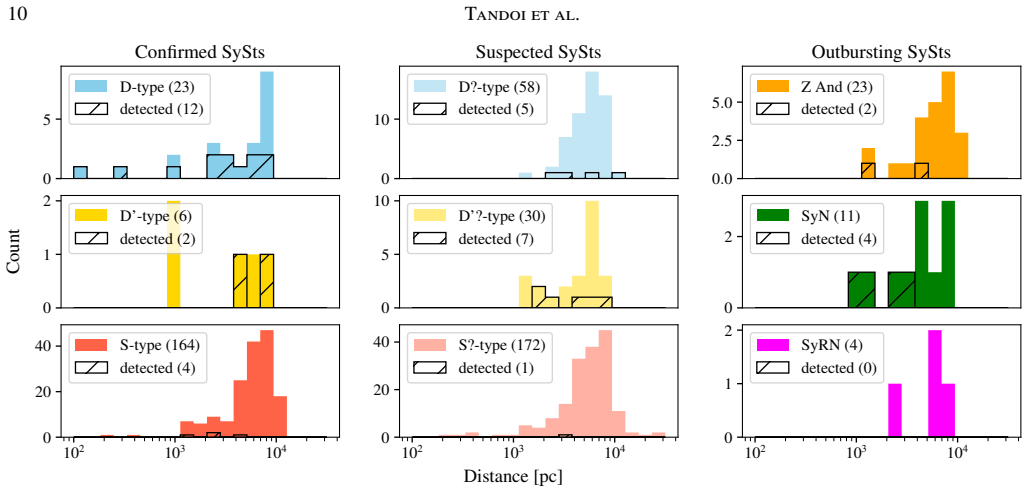
Forced photometry of 828 symbiotic star candidates in SPT and ACT data yields 31 millimeter detections above 3 sigma.
A machine-rendered reading of the paper's core claim, the machinery that carries it, and where it could break.
Core claim
Forced photometry on the 828 candidate symbiotic star locations in SPT and ACT data results in 31 unique objects detected with more than a 3σ significance using two frequency bands: 18 confirmed and 13 suspected symbiotic stars. Millimeter-wave emission from symbiotic stars is primarily a combination of free-free emission of the ionization region and optically thick blackbody emission of the cooler dust components of the system. When combined with contemporaneous multi-wavelength observations, millimeter-wave observations can be used to test binary models of symbiotic stars and provide insight on the geometry and physical properties of these systems.
What carries the argument
Forced photometry at the catalog positions of symbiotic star candidates within the SPT-3G and ACT DR6 millimeter maps.
If this is right
- Millimeter light curves combined with optical and infrared data can test models of mass transfer and binary geometry in symbiotic systems.
- The observed lag and variability in CN Cha near its optical nova rise indicates that millimeter emission can trace changes in the ionization region or dust on timescales of months to years.
- Upper limits on the remaining 797 non-detected candidates constrain the typical millimeter brightness of the population.
- Coadded thumbnails for non-detections provide a reference set for future searches or stacking analyses.
Where Pith is reading between the lines
- The same forced-photometry approach on existing or future millimeter surveys could be extended to other classes of stellar binaries or transients that produce free-free or dust emission.
- If millimeter variability lags optical changes systematically, it could map the radial structure of the ionized wind or dust shell without needing resolved imaging.
- Cross-matching with upcoming wide-field optical surveys would increase the number of candidates available for millimeter follow-up.
Load-bearing premise
The millimeter signals are physically tied to the symbiotic star candidates rather than arising from unrelated background sources or noise fluctuations.
What would settle it
High-resolution millimeter imaging that places the detected emission at a position clearly offset from the optical or infrared location of any given candidate.
Figures




read the original abstract
We present the results of a joint targeted search of candidate symbiotic stars at millimeter wavelengths using the South Pole Telescope (SPT) and the Atacama Cosmology Telescope (ACT). Candidates are selected from the New Online Database of Symbiotic Variables, restricting to objects that are within either the SPT-3G or ACT~DR6 footprint, covering most of the southern hemisphere and up to a declination of $+20^\circ$. Forced photometry on the 828 candidate symbiotic star locations in SPT and ACT data results in 31 unique objects detected with more than a $3\sigma$ significance using two frequency bands: 18 confirmed and 13 suspected symbiotic stars. We provide the SPT and ACT 95/98, 150, and 220~GHz light curves, along with optical and infrared light curves from 2016--2026, as well as spectral energy distributions, physical parameters from the literature, and brief summaries regarding the nature of each individual object. Using Herschel SPIRE data from 2013, we place upper limits on millimeter flux for CN Cha near the beginning of the optical rise in its 2012/2013 nova, which suggests a strong variability and lag at millimeter wavelengths and results in a rare observance of a Galactic millimeter slow transient. In addition, we provide coadded thumbnails and light curves for the remaining 797 candidate symbiotic stars that did not pass our detection thresholds. Millimeter-wave emission from symbiotic stars is primarily a combination of free-free emission of the ionization region and optically thick blackbody emission of the cooler dust components of the system. When combined with contemporaneous multi-wavelength observations, millimeter-wave observations can be used to test binary models of symbiotic stars and provide insight on the geometry and physical properties of these systems.
Editorial analysis
A structured set of objections, weighed in public.
Referee Report
Summary. The manuscript reports a targeted search for millimeter emission from 828 symbiotic star candidates drawn from the New Online Database of Symbiotic Variables that fall within the SPT-3G or ACT DR6 footprints. Forced photometry yields 31 unique >3σ detections in two frequency bands (18 classified as confirmed symbiotic stars and 13 as suspected), with accompanying 95/98, 150, and 220 GHz light curves, optical/IR light curves (2016–2026), SEDs, literature parameters, and Herschel SPIRE upper limits. One object (CN Cha) shows evidence of strong millimeter variability and lag relative to its 2012/2013 optical nova. Coadded thumbnails and light curves are supplied for the 797 non-detections. The emission mechanism is described as a combination of free-free emission from the ionized region and optically thick dust emission.
Significance. If the positional associations hold, the work supplies the first systematic millimeter catalog of symbiotic stars, directly enabling tests of binary geometry and physical parameters when combined with contemporaneous multi-wavelength data. The provision of full light curves, SEDs, non-detection products, and the rare Galactic millimeter slow-transient candidate (CN Cha) adds immediate scientific utility and reproducibility value.
major comments (1)
- [Abstract and forced-photometry results] Abstract and results on forced photometry: the claim that the 31 detections represent symbiotic-star emission rests on positional coincidence with the input catalog. No quantitative false-association probability (accounting for millimeter source density and beam size) is presented, leaving open the possibility that a non-negligible fraction are background sources or noise spikes. This directly affects the reliability of the 18 confirmed / 13 suspected classifications and the physical interpretation of the sample.
minor comments (2)
- [Abstract] Abstract: the frequency bands are given as “95/98, 150, and 220 GHz”; clarify which instrument supplies the 95 GHz versus 98 GHz channel and whether both are required for the two-band detection criterion.
- [Methods] The manuscript states that full methods and error-analysis details are referenced but not reproduced; expanding the photometry pipeline description (including how the 3σ threshold is defined across bands and any covariance between bands) would allow independent verification of the detection list.
Simulated Author's Rebuttal
We thank the referee for their careful reading and constructive comments on our manuscript. We address the single major comment below.
read point-by-point responses
-
Referee: [Abstract and forced-photometry results] Abstract and results on forced photometry: the claim that the 31 detections represent symbiotic-star emission rests on positional coincidence with the input catalog. No quantitative false-association probability (accounting for millimeter source density and beam size) is presented, leaving open the possibility that a non-negligible fraction are background sources or noise spikes. This directly affects the reliability of the 18 confirmed / 13 suspected classifications and the physical interpretation of the sample.
Authors: We agree that a quantitative false-association probability is a useful addition. In the revised manuscript we will compute the expected number of chance alignments by measuring the surface density of >3σ sources in the SPT-3G and ACT DR6 maps (outside the symbiotic candidate positions) and multiplying by the effective beam area at each frequency for the 828 input positions. This estimate will be reported alongside the detection statistics. The 18 confirmed objects are already classified as symbiotic stars in the literature on the basis of optical/IR spectroscopy and variability; the millimeter detections provide supplementary data rather than the sole basis for classification. The 13 suspected objects are flagged as such precisely because their prior classification is less secure, and we will note that their millimeter associations carry higher uncertainty pending the false-positive calculation. revision: yes
Circularity Check
No significant circularity: purely observational detection result
full rationale
The paper reports a targeted search using forced photometry on 828 pre-selected symbiotic star candidates in existing SPT and ACT millimeter maps, yielding 31 >3σ detections. No derivation, model, prediction, or fitted parameter is presented that reduces to its own inputs by construction. The central claim rests on direct flux measurements and significance thresholds applied to external survey data; association with the optical/IR candidates is an external validation question already isolated by the reader and does not involve any self-referential equation or self-citation load-bearing step. The work is self-contained against external benchmarks (SPT/ACT maps, candidate catalog) with no internal reduction to fitted inputs.
Axiom & Free-Parameter Ledger
Reference graph
Works this paper leans on
-
[1]
Abitbol, M., Abril-Cabezas, I., Adachi, S., et al. 2025, J. Cosmology Astropart. Phys., 2025, 034 Adams, W. S. 1944, Mount Wilson Observatory Annual Report, 16, 1 Akras, S., Guzman-Ramirez, L., & Gonçalves, D. R. 2019, MNRAS, 488, 3238 Akras, S., Guzman-Ramirez, L., Leal-Ferreira, M. L., & Ramos-Larios, G. 2019, The Astrophysical Journal Supplement Series...
work page internal anchor Pith review Pith/arXiv arXiv 2025
-
[2]
Star name IR type b l Comment Telescope [deg] [deg] MaC 1-3 D 339.6188−3.5189 No source SPT Hen 2-251 D 358.1205 1.4588 No source ACT, SPT JaSt 2-6 D 359.9659−1.1446 No source ACT, SPT WRAY 16-312 D 358.7885−1.9092 No source ACT, SPT JaSt 79 D 0.2093−1.4710 Near threshold ACT, SPT V5590 Sgr D 4.2275−4.0402 Near threshold ACT, SPT SRGA J181414.6-225604 D 8...
2093
-
[3]
inner hourglass
While it appears as a point source in SPT thumbnails, it did not pass our SNR threshold having 2.12/0.99/3.58 SNR across the 3 bands. No other candidate SySts in Ivison et al. (1995) or Mikołajewska et al. (2002) 18Tandoi et al. were similarly close to being a detection. INDIVIDUAL STARS In this section we provide brief summaries for each star along with ...
1995
-
[4]
Z-” star, indicating that it has Z Andromedae-like emission spectrum (sharpHeii𝜆4686lineinadditiontostronghydrogenemissionplusweakHesci,andforbiddennebularlines)while“-
using IRAS and VLA measurements (Pottasch et al. 1988), but is shown to have Raman-scattered Ovilines as presented in Miszalski et al. (2013). They also go on to state that the OGLE-IV light curve has minimal variability which is consistent for a D-type SySt with an obscured Mira. 12 https://www.aavso.org/data-download mm-wave Symbiotic Stars19 H 1-36 We ...
1988
-
[5]
more reminiscent of classical symbiotic stars with moderate active phases than of symbiotic Miras in outburst
K 3-9 Ivison&Seaquist(1995)describeK3-9tobeastrongradiosource,withdatathatmatchwelltoFFemissionintheSTBmodel. They find a sub-mm excess which they interpret as coming from cold dust (∼30 K). The source of dust is unclear: it could either be from mass loss by the WD or the Mira or produced during SyN outburst(s). Munari & Jurdana-Šepić (2002) refute the Sy...
1995
-
[6]
1981 with a steady decrease for∼30 years until
Full light curves from AAVSO show a peak ca. 1981 with a steady decrease for∼30 years until
1981
-
[7]
shadowcone,
Goldman et al. (2024) present theB,V,I, andRAAVSO data showing a divergence in the light curves:B,V, andRremain steady whileIshows an increase independent of the also-present periodic variability until 2022 where a small, brief outburst is experienced in all four filters followed by a steep decay. To explain this divergent behavior they give two suggestio...
2024
-
[8]
Although it has decayed to pre-nova brightness levels of∼12 mag, there is still some variability present in ASAS-SN data. Short term spikes in optical data (∼0.2 mag) are visible and relate to the Mirapulsationperiodof386.73days,whilethereisalsoeitherlongperiodvariability(∼0.5magfrom2017to2026)occurringor a continued decay from the nova. RR Tel was also o...
2009
-
[9]
and ALMA (Gómez-Garrido et al. 2024). The jets and nebula in R Aqr are thought to result from outbursts, of which there are multiple credible claims throughout history. Korean astronomers detected a star brightening near the Aquarii constellation in 1073 and 1074 (Yang et al. 2005), with nitrate ion concentrations in antarctic ice core samples potentially...
2024
-
[10]
1340 and 1800)
while Solf & Ulrich (1985) provide evidence of both the outer and inner nebular shells being the results of outbursts separated by∼450 years (ca. 1340 and 1800). Eclipses of R Aqr have been observed in the 1930s and 1970s, with Willson et al. (1981) finding an orbital period of 44 years and eclipse duration of 8.5 years. They predicted the next eclipse wo...
1985
-
[11]
(2019) list V455 Sco as a fourth classification of SySts, an “S+IR” type: S-type SySts with an unexplained FIR excess
Akras et al. (2019) list V455 Sco as a fourth classification of SySts, an “S+IR” type: S-type SySts with an unexplained FIR excess. Merc (2022) investigate the individual S+IR type SySts and are able to explain 35 of 37 as some combination of variable/unreliable IR data, objects misclassified as SySts, and incorrect temperatures inferred that result in re...
2019
-
[12]
abrupt changes of the star brightness
As mentioned previously, V455 Sco has evidence of a historical outburst of unknown origin; it is unclear if a similar outburst may have recently occurred that could explain this IR excess. We note that NODSV-provided AKARI and WISE data are in agreement, while IRAS 12 and 25𝜇m data are roughly 2-3 times higher which could indicate significant variability ...
2000
-
[13]
flux is most likely from a nebula around a Galactic source (e.g. nova, or symbiotic star) and the system is in outburst
while Fraser et al. (2017) also notes the “flux is most likely from a nebula around a Galactic source (e.g. nova, or symbiotic star) and the system is in outburst.” This outburst is classified as a Z And outburst in light curve analysis using a random forest classifier in the ASAS-SN Catalog of Variable Stars (Jayasinghe et al. 2019). IRAS 18344-0632 = G2...
2017
-
[14]
rotten egg
makes any definitive classification challenging. Suspected D’-types QX Pup The “rotten egg” or “Calabash” nebula, QX Pup (also referred to as OH 231.8+4.2) has a contentious history despite being well studied: being classified as a SySt, proto-planetary nebula (PPN) or an M9-10 III star with an A-type main sequence (MS) companionoftenbetweenthesameauthors...
1996
-
[15]
amarginalunresolvedfeature
embedded in a nebula. The temperature of such a star is not high enough to produce the ionization observed in the nebula, suggesting a faint hot binary companion which would classify it as a peculiar PNe or possible a yellow symbiotic. Shenetal.(2004)goontoclassifyPNMe1-1asayellowsymbioticbasedonstrongemissionlines(e.g. Hi,Hei,Heii,[Oiii], [Neiii],etc.) a...
2004
discussion (0)
Sign in with ORCID, Apple, or X to comment. Anyone can read and Pith papers without signing in.