Agentic World Modeling: Foundations, Capabilities, Laws, and Beyond
Pith reviewed 2026-07-04 16:50 UTC · model glm-5.2
The pith
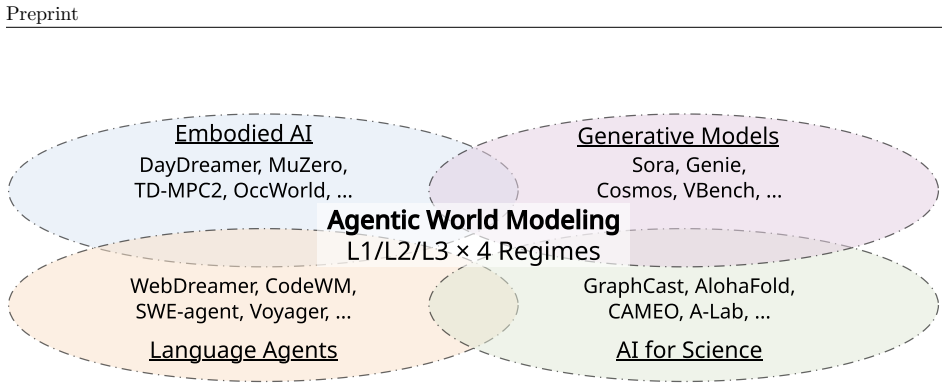
Three levels of world model — predict, simulate, evolve — unify fragmented AI research
A machine-rendered reading of the paper's core claim, the machinery that carries it, and where it could break.
Core claim
The paper's central contribution is the claim that the capability progression from one-step prediction (L1) to decision-usable multi-step simulation (L2) to evidence-driven model revision (L3) is a universal axis that cuts across all world-modeling domains, and that the boundary between each level can be specified by concrete, testable conditions rather than by modality or application area. The L1→L2 boundary is marked by three conditions: long-horizon coherence, intervention sensitivity, and constraint consistency. The L2→L3 boundary is marked by three further conditions: evidence-grounded diagnosis, persistent asset update, and governed validation. Paired with four governing-law regimes (d
What carries the argument
The POMDP-based unified graphical model (Figure 7) in which L1 is a single transition edge, L2 is a trajectory rollout under constraint c, and L3 is a model-stack revision M_t → M_{t+1} driven by distilled evidence d_t. The boundary conditions for each level transition serve as the operational test.
If this is right
- If L2 boundary conditions are adopted as evaluation standards, video generation systems like Sora would need to demonstrate intervention sensitivity and constraint consistency — not just visual fidelity — to qualify as world simulators, forcing a convergence between computer vision and reinforcement learning evaluation practices.
- The L3 definition provides a concrete target for autonomous science: systems like CAMEO and A-Lab already close the design–execute–observe–reflect loop, but the taxonomy predicts that L3 capability in digital, physical, and social domains will require building regression-gated update infrastructure that currently does not exist outside laboratory settings.
- The governing-law regime axis predicts that direct transfer of world-modeling techniques across domains will fail at the constraint-consistency layer: a model that works for digital-world state machines cannot simply be reskinned for social-world norm compliance, because the governing constraints are structurally different.
- The paper's Minimal Reproducible Evaluation Package (MREP) proposal, if adopted, would make L3 evaluation tractable by requiring version locking, trace logging, and failure taxonomy — infrastructure that would simultaneously serve as the gating mechanism for safe model self-revision.
Where Pith is reading between the lines
- If the L2 boundary conditions are necessary and sufficient for decision-usable simulation, then any system that cannot pass intervention-sensitivity tests — no matter how visually realistic — is operationally an L1 predictor with a good decoder, which would reclassify a large fraction of current video generation systems.
- The claim that L3 requires symbolic or semi-symbolic representations for genuine hypothesis-space expansion (Section 2.2) implies that purely latent neural world models may have a structural ceiling at L2, unable to perform the kind of invariance revision that scientific discovery requires — a testable prediction that could be checked by probing whether latent models can ever expand their hypothes
- The taxonomy's maturity assessment (scientific: established, digital: partial, physical: emerging, social: aspirational) suggests a research priority ordering: the social regime's L3 bottleneck is not computational but epistemological — the attribution problem for social prediction failures may require fundamentally different evidence infrastructure than the other three regimes.
- If harness engineering (open problem 10) is indeed a form of world modeling for software agents, then the L1→L2→L3 progression should apply to execution-environment design itself, predicting that future agent harnesses will evolve from fixed scaffolds (L1) to simulation-aware environments (L2) to self-revising harnesses that restructure their own tool and memory topology from deployment evidence (
Load-bearing premise
The taxonomy's diagnostic power depends on the assumption that three specific conditions — long-horizon coherence, intervention sensitivity, and constraint consistency — are jointly sufficient to distinguish decision-usable simulation (L2) from mere prediction (L1) across all four governing-law regimes. If these conditions fail to capture the critical failure modes in a particular domain — for example, social worlds where reflexive feedback loops may dominate — the taxonomy's
What would settle it
A domain-specific failure mode that satisfies all three L2 boundary conditions yet still produces systematically misleading rollouts for planning would show the boundary conditions are not sufficient to define decision-usable simulation.
Figures



read the original abstract
As AI systems move from generating text to accomplishing goals through sustained interaction, the ability to model environment dynamics becomes a central bottleneck. Agents that manipulate objects, navigate software, coordinate with others, or design experiments require predictive environment models, yet the term world model carries different meanings across research communities. We introduce a "levels x laws" taxonomy organized along two axes. The first defines three capability levels: L1 Predictor, which learns one-step local transition operators; L2 Simulator, which composes them into multi-step, action-conditioned rollouts that respect domain laws; and L3 Evolver, which autonomously revises its own model when predictions fail against new evidence. The second identifies four governing-law regimes: physical, digital, social, and scientific. These regimes determine what constraints a world model must satisfy and where it is most likely to fail. Using this framework, we synthesize over 400 works and summarize more than 100 representative systems spanning model-based reinforcement learning, video generation, web and GUI agents, multi-agent social simulation, and AI-driven scientific discovery. We analyze methods, failure modes, and evaluation practices across level-regime pairs, propose decision-centric evaluation principles and a minimal reproducible evaluation package, and outline architectural guidance, open problems, and governance challenges. The resulting roadmap connects previously isolated communities and charts a path from passive next-step prediction toward world models that can simulate, and ultimately reshape, the environments in which agents operate.
Editorial analysis
A structured set of objections, weighed in public.
Referee Report
Summary. This manuscript proposes a capability-based taxonomy for world modeling in agentic AI, organizing the field along two axes: three capability levels (L1 Predictor, L2 Simulator, L3 Evolver) and four governing-law regimes (physical, digital, social, scientific). The paper synthesizes over 400 works and classifies more than 100 representative systems within this framework. It introduces testable boundary conditions for each level transition, proposes decision-centric evaluation principles with a minimal reproducible evaluation package (MREP), and provides architectural guidance and open problems. The paper is positioned as a position-driven survey that argues for adopting the L1/L2/L3 hierarchy as a unifying language across previously isolated research communities. The conceptual framework is internally consistent and the literature coverage is broad. The central tension is whether the proposed boundary conditions, particularly at the L2→L3 transition, achieve clean separation when applied to concrete systems.
Significance. The paper addresses a genuine conceptual gap: the term 'world model' is used inconsistently across RL, vision, NLP, and AI-for-science communities, hindering cross-community comparison. The L1/L2/L3 hierarchy paired with governing-law regimes is a reasonable and potentially useful organizing principle. The proposal of decision-centric evaluation metrics (ASR, COD) and the MREP standard are constructive contributions. The L3 formalization, drawing on philosophy of science (Lakatos, Kuhn, Duhem-Quine), is conceptually interesting. The paper ships a public repository and homepage, which supports reproducibility of the taxonomy. However, the significance of the framework depends on whether its boundary conditions are actually testable and discriminating when applied to real systems, which is where the paper faces its most substantive challenges.
major comments (2)
- §5.2 and Table 5: The L2→L3 boundary conditions (active information expansion, autonomous execution, belief revision) are satisfiable by systems the paper itself classifies as L2. Plan2Explore (Sekar et al., 2020), classified as L2 in Table 5, actively selects actions to reduce model uncertainty (condition 1), executes them in the environment (condition 2), and updates its dynamics model based on resulting evidence (condition 3). The paper's own L3 definition explicitly includes parameter updates as a valid mode of L3 growth (§5.2, 'Modes of growth'). The attempted distinction—that L2 is 'fixed post-training' while L3 is 'adaptive post-deployment'—does not resolve this: Plan2Explore and DreamerV3 both update their models during interaction, and the training/deployment boundary is blurry in continual learning. The paper acknowledges this difficulty (§5.2, 'Distinction from L2') but does不是
- §2.4, L3 definition: The three L3 boundary conditions (evidence-grounded diagnosis, persistent asset update, governed validation) are stated abstractly but lack operational tests that would allow a reader to apply them consistently. For example, 'persistent asset update' requires that fixes be 'promoted as reusable assets (skills, rules, parsers, tests), not only ephemeral in-context patches'—but the threshold for what counts as 'persistent' versus 'ephemeral' is not specified. Table 8 marks some systems as having only partial loops (e.g., FunSearch has Design/Execute/Observe but not Reflect), yet CodeIt is marked as having all four. The criteria for these distinctions are not made explicit, making the classification difficult to reproduce or challenge.
minor comments (8)
- §4.1: The constraint term φ_c(τ) is introduced conceptually but its formal properties are underspecified. Is it a hard indicator, a soft penalty, or a learned potential? The text says 'the hard-indicator case 1[c(τ)] is a special case' but does not discuss when the soft vs. hard distinction matters for the L1→L2 boundary. A brief clarification would help readers.
- Table 5: Sora is marked as lacking intervention sensitivity (IS=✗), which is defensible, but the rationale is not provided. Given that Sora accepts text prompts as inputs, some readers may consider this a form of intervention. A footnote explaining the specific test or reasoning behind each ✗ marking for IS would strengthen the table's diagnostic value.
- Figure 8: The axes are described as 'schematic rather than metric,' but the placement of regimes on these axes implies ordinal relationships. For instance, the Social World is placed at low formalizability and low observability, while the Digital World is at high formalizability and high observability. Clarifying that these are illustrative positions rather than measured coordinates would prevent misinterpretation.
- §2.2: The argument that L3 revision requires a symbolic substrate is stated strongly ('the endpoint of L3, namely genuine revision of governing laws, requires a symbolic substrate') but is not substantiated by examples of failed latent-space revision. The claim is philosophically motivated but lacks empirical support currently.
- The paper cites several 2026-dated works (e.g., Mao et al., 2026a; Fan et al., 2026; Cao et al., 2026). Given the April 2026 submission date, these are plausible but the reviewer could not verify all of them. The authors should ensure all cited works are accessible and correctly attributed.
- §3.2.1: 'Thinking with Blueprints' (Ma et al., 2026) is discussed as relevant to L1 state inference, but its connection to the POMDP formalism is not made explicit. Clarifying whether this is a proposed integration or an analogy would help readers.
- Table 8: Several systems are marked with partial loop coverage (e.g., AdaptSim has Reflect=✗, FunSearch has Reflect=✗). The criteria for marking a system as having or lacking each loop stage should be briefly stated, either in the table caption or in a footnote, to support independent verification of the classification.
- §6.2: The benchmark landscape is extensive but the mapping from benchmarks to boundary conditions (Table 10) uses binary ✔/✗ markers without indicating degree of coverage. The capability coverage matrix in Appendix E apparently uses S/M/W/– labels, which are more informative; cross-referencing these in the main table or mentioning that more granular assessments exist would help.
Simulated Author's Rebuttal
We thank the referee for a careful and substantive reading. Both major comments identify genuine weaknesses in the L2→L3 boundary conditions as currently stated. We agree that the §5.2 conditions are too permissive as written and that the §2.4 conditions lack operational specificity. We will revise accordingly.
read point-by-point responses
-
Referee: §5.2 and Table 5: The L2→L3 boundary conditions (active information expansion, autonomous execution, belief revision) are satisfiable by systems the paper itself classifies as L2. Plan2Explore actively selects actions to reduce model uncertainty (condition 1), executes them (condition 2), and updates its dynamics model (condition 3). The paper's own L3 definition includes parameter updates as a valid mode of L3 growth. The fixed-post-training vs adaptive-post-deployment distinction does not resolve this.
Authors: The referee is substantially correct. As currently stated in §5.2, the three boundary conditions—active information expansion, autonomous execution, and belief revision—are indeed satisfied by Plan2Explore and, by similar logic, by DreamerV3 and other model-based RL systems that perform online model updates during interaction. We acknowledge this as a genuine gap between the paper's intent and its formalization. The distinction we attempted to draw (fixed post-training vs. adaptive post-deployment) is insufficient, because the training/deployment boundary is genuinely blurry in continual and online learning settings, and the paper itself lists parameter updates as a valid L3 growth mode. We will revise the manuscript to address this in three ways. First, we will tighten the §5.2 boundary conditions so that the L2→L3 transition is not triggered by online parameter updates alone. The key missing qualifier is that L3 revision must be triggered by systematic prediction failures that the current model class cannot absorb—not merely by routine uncertainty reduction within the existing model class. Plan2Explore reduces epistemic uncertainty within a fixed model class (its RSSM); it does not diagnose whether the model class itself is inadequate, nor does it expand the hypothesis space. Second, we will make the §2.4 conditions (evidence-grounded diagnosis, persistent asset update, governed validation) the primary L2→L3 criteria and explicitly state that the §5.2 conditions are necessary but not sufficient. Under the §2.4 criteria, Plan2Explore fails on persistent asset update (it updates network weights but does not produce reusable assets such as skills, rules, or regression tests) and on governed validation (it has no regression gates or rollback policies). Third, we will reex revision: no
Circularity Check
No circularity found: this is a survey/taxonomy paper with no fitted parameters, no derivation chain, and no self-citation load-bearing argument.
full rationale
This paper is a position-driven survey proposing a capability taxonomy (L1/L2/L3) and a governing-law regime framework. It contains no fitted parameters, no empirical predictions that reduce to inputs by construction, and no derivation chain where outputs are defined in terms of inputs. The L1/L2/L3 definitions (Section 2.4) are stated as formal boundary conditions (long-horizon coherence, intervention sensitivity, constraint consistency for L2; evidence-grounded diagnosis, persistent asset update, governed validation for L3) and are applied to classify existing external systems (Tables 5, 6, 8, 10). The skeptic's concern about L2/L3 boundary ambiguity (e.g., Plan2Explore satisfying L3 conditions) is a correctness/classification-consistency issue, not circularity: the paper's definitions are not defined in terms of the systems they classify, and the classification is applied against external benchmarks. Self-citations, if any, are to the authors' own prior work on specific systems (e.g., specific RL or vision papers), but the taxonomy itself does not depend on any self-cited uniqueness theorem or unverified prior result. The framework is self-contained and its claims are externally falsifiable: a system classified as L2 that demonstrably satisfies all three L3 boundary conditions would challenge the taxonomy's discriminative power, but this would be a correctness problem, not a circularity problem. No step in the paper reduces to its inputs by construction.
Axiom & Free-Parameter Ledger
axioms (3)
- domain assumption World modeling capability can be discretized into three hierarchical levels (L1, L2, L3) with testable boundary conditions.
- domain assumption Governing-law regimes (physical, digital, social, scientific) are representative, not exhaustive, and determine transition constraints.
- ad hoc to paper Decision-usable simulation (L2) requires long-horizon coherence, intervention sensitivity, and constraint consistency.
invented entities (1)
-
L3 Evolver
independent evidence
Forward citations
Cited by 6 Pith papers
-
Graph World Models: Concepts, Taxonomy, and Future Directions
The paper unifies emerging graph-based world models under a new paradigm and proposes a taxonomy organized by spatial, physical, and logical relational inductive biases.
-
Qwen-AgentWorld: Language World Models for General Agents
Qwen-AgentWorld are language world models that simulate multi-domain agent environments and boost general agent capabilities via decoupled RL simulation and unified foundation model training.
-
Not All Points Are Equal: Uncertainty-Aware 4D LiDAR Scene Synthesis
U4D introduces an uncertainty-guided two-stage diffusion framework for 4D LiDAR scene synthesis that prioritizes high-entropy regions for geometry and uses a spatio-temporal block for consistency, reporting SOTA resul...
-
SCOPE: Simulating Cross-game Operations in Playable Environments for FPS World Models
SCOPE adds per-pixel action conditioning to pretrained video diffusion models and releases the CrossFPS multi-game dataset to support cross-game FPS world model simulation with zero-shot transfer.
-
Self-Evolving World Models for LLM Agent Planning
WorldEvolver uses episodic memory, semantic memory, and selective foresight to self-evolve world models at test time, achieving top prediction accuracy and agent success on ALFWorld and ScienceWorld benchmarks.
-
Critique of Agent Model
Distinguishes agentic (externally scaffolded) from agentive (internally structured) AI systems and proposes the Goal-Identity-Configurator architecture for endogenous autonomy.
Reference graph
Works this paper leans on
-
[1]
J. Abramson, J. Adler, J. Dunger, R. Evans, T. Green, A. Pritzel, O. Ronneberger, L. Willmore, A. J. Ballard, J. Bambrick, S. W. Bodenstein, D. A. Evans, C.-C. Hung, M. O'Neill, D. Reiman, K. Tunyasuvunakool, Z. Wu, A. Z emguly \. t \. e , E. Arvaniti, C. Beattie, O. Bertolli, A. Bridgland, A. Cherepanov, M. Congreve, A. I. Cowen-Rivers, A. Cowie, M. Figu...
work page 2024
-
[2]
Cosmos World Foundation Model Platform for Physical AI
N. Agarwal, A. Ali, M. Bala, Y. Balaji, E. Barker, T. Cai, P. Chattopadhyay, Y. Chen, Y. Cui, Y. Ding, D. Dworakowski, J. Fan, M. Fenzi, F. Ferroni, S. Fidler, D. Fox, S. Ge, Y. Ge, J. Gu, S. Gururani, E. He, J. Huang, J. Huffman, P. Jannaty, J. Jin, S. W. Kim, G. Klár, G. Lam, S. Lan, L. Leal-Taixe, A. Li, Z. Li, C.-H. Lin, T.-Y. Lin, H. Ling, M.-Y. Liu,...
work page internal anchor Pith review Pith/arXiv arXiv 2025
-
[3]
R. Agarwal, M. Schwarzer, P. S. Castro, A. C. Courville, and M. G. Bellemare. Deep reinforcement learning at the edge of the statistical precipice. In Advances in Neural Information Processing Systems, volume 34, 2021
work page 2021
-
[4]
P. Agrawal, A. V. Nair, P. Abbeel, J. Malik, and S. Levine. Learning to poke by poking: Experiential learning of intuitive physics. In Advances in Neural Information Processing Systems, volume 29, pages 5092--5100, 2016
work page 2016
- [5]
- [6]
-
[7]
M. Andrychowicz, M. Denil, S. Gomez, M. W. Hoffman, D. Pfau, T. Schaul, B. Shillingford, and N. de Freitas. Learning to learn by gradient descent by gradient descent. In Advances in Neural Information Processing Systems, volume 29, pages 3988--3996, 2016
work page 2016
-
[8]
C. Angermueller, D. Belanger, A. Gane, Z. Mariet, D. Dohan, K. Murphy, L. Colwell, and D. Sculley. Population-based black-box optimization for biological sequence design. In International Conference on Machine Learning, pages 324--334. PMLR, 2020
work page 2020
-
[9]
Effective context engineering for AI agents
Anthropic . Effective context engineering for AI agents. Anthropic Engineering Blog, 2025. URL https://www.anthropic.com/engineering/effective-context-engineering-for-ai-agents
work page 2025
-
[10]
L. P. Argyle, E. C. Busby, N. Fulda, J. R. Gubler, C. Rytting, and D. Wingate. Out of one, many: Using language models to simulate human samples. Political Analysis, 31 0 (3): 0 337--351, 2023
work page 2023
-
[11]
V. Arunkumar, G. R. Gangadharan, and R. Buyya. Agentic artificial intelligence ( AI ): Architectures, taxonomies, and evaluation of large language model agents. arXiv preprint arXiv:2601.12560, 2026
-
[12]
A. F. Ashery, L. M. Aiello, and A. Baronchelli. Emergent social conventions and collective bias in LLM populations. Science Advances, 11, 2025
work page 2025
-
[13]
S. Ashkboos, A. Mohtashami, M. L. Croci, B. Li, P. Cameron, M. Jaggi, D. Alistarh, T. Hoefler, and J. Hensman. QuaRot : Outlier-free 4-bit inference in rotated LLMs . In Advances in Neural Information Processing Systems, volume 37, pages 100213--100240, 2024
work page 2024
- [14]
-
[15]
V-JEPA 2: Self-Supervised Video Models Enable Understanding, Prediction and Planning
M. Assran, A. Bardes, D. Fan, Q. Garrido, R. Howes, Mojtaba, Komeili, M. Muckley, A. Rizvi, C. Roberts, K. Sinha, A. Zholus, S. Arnaud, A. Gejji, A. Martin, F. R. Hogan, D. Dugas, P. Bojanowski, V. Khalidov, P. Labatut, F. Massa, M. Szafraniec, K. Krishnakumar, Y. Li, X. Ma, S. Chandar, F. Meier, Y. LeCun, M. Rabbat, and N. Ballas. V-JEPA 2 : Self-supervi...
work page internal anchor Pith review Pith/arXiv arXiv 2025
-
[16]
M. Babaeizadeh, C. Finn, D. Erhan, R. H. Campbell, and S. Levine. Stochastic variational video prediction. In International Conference on Learning Representations, 2018
work page 2018
-
[17]
M. Baek, F. DiMaio, I. Anishchenko, J. Dauparas, S. Ovchinnikov, G. R. Lee, J. Wang, Q. Cong, L. N. Kinch, R. D. Schaeffer, C. Mill \'a n, H. Park, C. Adams, C. R. Glassman, A. DeGiovanni, J. H. Pereira, A. V. Rodrigues, A. A. van Dijk, A. C. Ebrecht, D. J. Opperman, T. Sagmeister, C. Buhlheller, T. Pavkov-Keller, M. K. Rathinaswamy, U. Dalwadi, C. K. Yip...
work page 2021
-
[18]
A. P. Baker, M. J. Brookes, I. A. Rezek, S. M. Smith, T. Behrens, P. J. Probert Smith, and M. Woolrich. Fast transient networks in spontaneous human brain activity. eLife, 3: 0 e01867, 2014
work page 2014
-
[19]
B. Baker, I. Akkaya, P. Zhokhov, J. Huizinga, J. Tang, A. Ecoffet, B. Houghton, R. Sampedro, and J. Clune. Video P re T raining ( VPT ): Learning to act by watching unlabeled online videos. In Advances in Neural Information Processing Systems, volume 35, pages 24639--24654, 2022
work page 2022
- [20]
-
[21]
A. Bakhtin, N. Brown, E. Dinan, G. Farina, C. Flaherty, D. Fried, A. Goff, J. Gray, H. Hu, A. P. Jacob, M. Komeili, K. Konath, et al. Human-level play in the game of diplomacy by combining language models with strategic reasoning. Science, 378 0 (6624): 0 1067--1074, 2022
work page 2022
-
[22]
P. J. Ball, J. Bauer, F. Belletti, B. Brownfield, A. Ephrat, S. Fruchter, A. Gupta, K. Holsheimer, A. Holynski, J. Hron, C. Kaplanis, M. Limont, M. McGill, Y. Oliveira, J. Parker-Holder, F. Perbet, G. Scully, J. Shar, S. Spencer, O. Tov, R. Villegas, E. Wang, J. Yung, C. Baetu, J. Berbel, D. Bridson, J. Bruce, G. Buttimore, S. Chakera, B. Chandra, P. Coll...
work page 2025
-
[23]
O. Bar-Tal, H. Chefer, O. Tov, C. Herrmann, R. Paiss, S. Zada, A. Ephrat, J. Hur, G. Liu, A. Raj, Y. Li, M. Rubinstein, T. Michaeli, O. Wang, D. Sun, T. Dekel, and I. Mosseri. Lumiere: A space-time diffusion model for video generation. In SIGGRAPH Asia, pages 1--11, 2024
work page 2024
-
[24]
L. Barcellona, A. Zadaianchuk, D. Allegro, S. Papa, S. Ghidoni, and E. Gavves. Dream to manipulate: Compositional world models empowering robot imitation learning with imagination. arXiv preprint arXiv:2412.14957, 2024
-
[25]
Revisiting Feature Prediction for Learning Visual Representations from Video
A. Bardes, Q. Garrido, J. Ponce, X. Chen, M. G. Rabbat, Y. LeCun, M. Assran, and N. Ballas. Revisiting feature prediction for learning visual representations from video. arXiv preprint arXiv:2404.08471, 2024
work page internal anchor Pith review Pith/arXiv arXiv 2024
-
[26]
J. Behler and M. Parrinello. Generalized neural-network representation of high-dimensional potential-energy surfaces. Physical Review Letters, 98 0 (14): 0 146401, 2007
work page 2007
-
[27]
T. Beucler, P. Gentine, J. Yuval, A. Gupta, L. Peng, J. Lin, S. Yu, S. Rasp, F. Ahmed, P. A. O'Gorman, J. D. Neelin, N. J. Lutsko, and M. Pritchard. Climate-invariant machine learning. Science Advances, 10 0 (6): 0 eadj7250, 2024
work page 2024
-
[28]
K. Bi, L. Xie, H. Zhang, X. Chen, X. Gu, and Q. Tian. Accurate medium-range global weather forecasting with 3D neural networks. Nature, 619: 0 533--538, 2023
work page 2023
-
[29]
H. Bian, L. Kong, H. Xie, L. Pan, Y. Qiao, and Z. Liu. DynamicCity : Large-scale 4D occupancy generation from dynamic scenes. In International Conference on Learning Representations, 2025
work page 2025
-
[30]
F. Bianchi, P. J. Chia, M. Yuksekgonul, J. Tagliabue, D. Jurafsky, and J. Zou. How well can LLMs negotiate? negotiationarena platform and analysis. arXiv preprint arXiv:2402.05863, 2024
-
[31]
C. Bodnar, W. P. Bruinsma, A. Lucic, M. Stanley, A. Allen, J. Brandstetter, P. Garvan, M. Riechert, J. A. Weyn, H. Dong, J. K. Gupta, K. Thambiratnam, A. T. Archibald, C.-C. Wu, E. Heider, M. Welling, R. E. Turner, and P. Perdikaris. A foundation model for the earth system. Nature, 641 0 (8065): 0 1180--1187, 2025
work page 2025
-
[32]
G. Boella and L. van der Torre. A game-theoretic approach to normative multi-agent systems. In Normative Multi-agent Systems. Schloss Dagstuhl, 2007
work page 2007
-
[33]
N. M. Boffi, M. S. Albergo, and E. Vanden-Eijnden. Flow map matching with stochastic interpolants: A mathematical framework for consistency models. Transactions on Machine Learning Research, 2025
work page 2025
-
[34]
D. A. Boiko, R. MacKnight, B. Kline, and G. Gomes. Autonomous chemical research with large language models. Nature, 624: 0 570--578, 2023
work page 2023
-
[35]
D. Bolya and J. Hoffman. Token merging for fast stable diffusion. In IEEE/CVF Conference on Computer Vision and Pattern Recognition Workshops, pages 4599--4603, 2023
work page 2023
-
[36]
D. Bolya, C.-Y. Fu, X. Dai, P. Zhang, C. Feichtenhofer, and J. Hoffman. Token merging: Your vit but faster. In International Conference on Learning Representations, 2023
work page 2023
-
[37]
A. M. Bran, S. Cox, O. Schilter, C. Baldassari, A. D. White, and P. Schwaller. Augmenting large language models with chemistry tools. Nature Machine Intelligence, 6 0 (5): 0 525--535, 2024
work page 2024
-
[38]
T. Brooks, B. Peebles, C. Holmes, W. DePue, Y. Guo, L. Jing, D. Schnurr, J. Taylor, T. Luhman, E. Luhman, C. Ng, R. Wang, and A. Ramesh. Video generation models as world simulators. Technical report, OpenAI, 2024. URL https://openai.com/research/video-generation-models-as-world-simulators
work page 2024
-
[39]
T. B. Brown, B. Mann, N. Ryder, M. Subbiah, J. D. Kaplan, P. Dhariwal, A. Neelakantan, P. Shyam, G. Sastry, A. Askell, S. Agarwal, A. Herbert-Voss, G. Krueger, T. Henighan, R. Child, A. Ramesh, D. M. Ziegler, J. Wu, C. Winter, C. Hesse, M. Chen, E. Sigler, M. Litwin, S. Gray, B. Chess, J. Clark, C. Berner, S. McCandlish, A. Radford, I. Sutskever, and D. A...
work page 1901
-
[40]
J. Bruce, M. Dennis, A. Edwards, J. Parker-Holder, Y. Shi, E. Hughes, M. Lai, A. Mavalankar, R. Steigerwald, C. Apps, Y. Aytar, S. Bechtle, F. Behbahani, S. Chan, N. Heess, L. Gonzalez, S. Osindero, S. Ozair, S. Reed, J. Zhang, K. Zolna, J. Clune, N. de Freitas, S. Singh, and T. Rockt \"a schel. Genie: Generative interactive environments. In International...
work page 2024
-
[41]
N. Butt, B. Manczak, A. Wiggers, C. Rainone, D. W. Zhang, M. Defferrard, and T. Cohen. CodeIt : Self-improving language models with prioritized hindsight replay. In International Conference on Machine Learning, pages 5013--5034. PMLR, 2024
work page 2024
- [42]
- [43]
- [44]
- [45]
-
[46]
H. Chae, N. Kim, K. T.-i. Ong, M. Gwak, G. Song, J. Kim, S. Kim, D. Lee, and J. Yeo. Web agents with world models: Learning and leveraging environment dynamics in web navigation. In International Conference on Learning Representations, 2025
work page 2025
-
[47]
Y. Chai, L. Deng, R. Shao, J. Zhang, K. Lv, L. Xing, X. Li, H. Zhang, and Y. Liu. Gaf: Gaussian action field as a 4d representation for dynamic world modeling in robotic manipulation. arXiv preprint arXiv:2506.14135, 2025
work page internal anchor Pith review Pith/arXiv arXiv 2025
-
[48]
C. Chen, Y.-F. Wu, J. Yoon, and S. Ahn. TransDreamer : Reinforcement learning with transformer world models. arXiv preprint arXiv:2202.09481, 2022
- [49]
-
[50]
L. Chen, Y. Meng, C. Tang, X. Ma, J. Jiang, X. Wang, Z. Wang, and W. Zhu. Q-DiT : Accurate post-training quantization for diffusion transformers. In IEEE/CVF Conference on Computer Vision and Pattern Recognition, pages 28306--28315, 2025 b
work page 2025
-
[51]
R. Chen, W. Jiang, C. Qin, and C. Tan. Theory of mind in large language models: Assessment and enhancement. In Annual Meeting of the Association for Computational Linguistics, pages 31539--31558, 2025 c
work page 2025
-
[52]
T. Chen, S. Kornblith, M. Norouzi, and G. Hinton. A simple framework for contrastive learning of visual representations. In International Conference on Machine Learning, pages 1597--1607. PMLR, 2020
work page 2020
-
[53]
X. Chen, Y. Chen, Y. Fu, N. Gao, J. Jia, W. Jin, H. Li, Y. Mu, J. Pang, Y. Qiao, Y. Tian, B. Wang, B. Wang, F. Wang, H. Wang, T. Wang, Z. Wang, X. Wei, C. Wu, S. Yang, J. Ye, J. Yu, J. Zeng, J. Zhang, J. Zhang, S. Zhang, F. Zheng, B. Zhou, and Y. Zhu. InternVLA-M1 : A spatially guided vision-language-action framework for generalist robot policy. arXiv pre...
work page internal anchor Pith review Pith/arXiv arXiv 2025
- [54]
- [55]
- [56]
-
[57]
S. R. Chitturi, A. Ramdas, Y. Wu, B. Rohr, S. Ermon, J. Dionne, F. H. d. Jornada, M. Dunne, C. Tassone, W. Neiswanger, and D. Ratner. Targeted materials discovery using bayesian algorithm execution. NPJ Computational Materials, 10 0 (1): 0 156, 2024
work page 2024
-
[58]
K. Chua, R. Calandra, R. McAllister, and S. Levine. Deep reinforcement learning in a handful of trials using probabilistic dynamics models. In Advances in Neural Information Processing Systems, volume 31, pages 4759--4770, 2018
work page 2018
- [59]
-
[60]
A. Clark. Surfing Uncertainty: Prediction, Action, and the Embodied Mind. Oxford University Press, 2015
work page 2015
-
[61]
StarVLA: A Lego-like Codebase for Vision-Language-Action Model Developing
S. Community. Starvla: A lego-like codebase for vision-language-action model developing. arXiv preprint arXiv:2604.05014, 2026
work page internal anchor Pith review Pith/arXiv arXiv 2026
-
[62]
J. Copet, Q. Carbonneaux, G. Cohen, J. Gehring, J. Kahn, J. Kossen, F. Kreuk, E. McMilin, M. Meyer, Y. Wei, D. Zhang, K. Zheng, J. Armengol-Estap \'e , P. Bashiri, M. Beck, et al. CWM : An open-weights LLM for research on code generation with world models. arXiv preprint arXiv:2510.02387, 2025
-
[63]
A. Coutant, K. Roper, D. Trejo-Banos, D. Bouthinon, M. Carpenter, J. Grzebyta, G. Santini, H. Soldano, M. Elati, J. Ramon, C. Rouveirol, L. N. Soldatova, and R. D. King. Closed-loop cycles of experiment design, execution, and learning accelerate systems biology model development in yeast. Proceedings of the National Academy of Sciences, 116 0 (36): 0 1814...
work page 2019
-
[64]
K. J. W. Craik. The Nature of Explanation. Cambridge University Press, 1943
work page 1943
- [65]
- [66]
-
[67]
N. Dainese, M. Merler, M. Alakuijala, and P. Marttinen. Generating code world models with large language models guided by Monte Carlo tree search. In Advances in Neural Information Processing Systems, volume 37, pages 60429--60474, 2024
work page 2024
-
[68]
A. C. Dama, K. S. Kim, D. M. Leyva, A. P. Lunkes, N. S. Schmid, K. Jijakli, and P. A. Jensen. BacterAI maps microbial metabolism without prior knowledge. Nature Microbiology, 8: 0 1018--1025, 2023
work page 2023
-
[69]
Decart, J. Quevedo, Q. McIntyre, S. Campbell, X. Chen, and R. Wachen. Oasis: A universe in a transformer. Blog post, 2024. URL https://oasis-model.github.io
work page 2024
-
[70]
J. Degen. The rational speech act framework. Annual Review of Linguistics, 9 0 (1): 0 519--540, 2023
work page 2023
-
[71]
M. P. Deisenroth and C. E. Rasmussen. PILCO : A model-based and data-efficient approach to policy search. In International Conference on Machine Learning, pages 465--472, 2011
work page 2011
-
[72]
F. Deng, I. Jang, and S. Ahn. DreamerPro : Reconstruction-free model-based reinforcement learning with prototypical representations. In International Conference on Machine Learning, pages 4956--4975. PMLR, 2022
work page 2022
-
[73]
X. Deng, Y. Gu, B. Zheng, S. Chen, S. Stevens, B. Wang, H. Sun, and Y. Su. Mind2Web : Towards a generalist agent for the web. In Advances in Neural Information Processing Systems, volume 36, pages 28091--28114, 2023
work page 2023
-
[74]
T. Dettmers, M. Lewis, Y. Belkada, and L. Zettlemoyer. LLM.int8() : 8-bit matrix multiplication for transformers at scale. In Advances in Neural Information Processing Systems, volume 35, pages 30318--30332, 2022
work page 2022
-
[75]
V. Dignum and F. Dignum. Agentifying agentic AI . arXiv preprint arXiv:2511.17332, 2025
-
[76]
J. Ding, Y. Zhang, Y. Shang, J. Feng, Y. Zhang, Z. Zong, Y. Yuan, H. Su, N. Li, J. Piao, Y. Deng, N. Sukiennik, C. Gao, F. Xu, and Y. Li. Understanding world or predicting future? A comprehensive survey of world models. ACM Computing Surveys, 2025 a
work page 2025
-
[77]
X. Ding, G. Ding, Y. Guo, and J. Han. Centripetal sgd for pruning very deep convolutional networks with complicated structure. In IEEE/CVF Conference on Computer Vision and Pattern Recognition, pages 4943--4953, 2019
work page 2019
-
[78]
Z. Ding, C. Jin, D. Liu, H. Zheng, K. K. Singh, Q. Zhang, Y. Kang, Z. Lin, and Y. Liu. Dollar: Few-step video generation via distillation and latent reward optimization. In IEEE/CVF International Conference on Computer Vision, pages 17961--17971, 2025 b
work page 2025
-
[79]
T. Dockhorn, A. Vahdat, and K. Kreis. Genie: Higher-order denoising diffusion solvers. In Advances in Neural Information Processing Systems, volume 35, pages 30150--30166, 2022
work page 2022
-
[80]
X. Dong, S. Chen, and S. Pan. Learning to prune deep neural networks via layer-wise optimal brain surgeon. Advances in Neural Information Processing Systems, 30: 0 4860--4874, 2017
work page 2017
discussion (0)
Sign in with ORCID, Apple, or X to comment. Anyone can read and Pith papers without signing in.