BDF2-type integrator for Landau-Lifshitz-Gilbert equation in micromagnetics: a-priori error estimates
Pith reviewed 2026-07-01 07:39 UTC · model grok-4.3
The pith
BDF2 time integrator with linear finite elements proves optimal-order convergence for the Landau-Lifshitz-Gilbert equation.
A machine-rendered reading of the paper's core claim, the machinery that carries it, and where it could break.
Core claim
The fully discrete scheme that combines linear finite elements in space with the BDF2 time integrator converges with optimal rates to the exact solution of the Landau-Lifshitz-Gilbert equation when the solution and external field are sufficiently regular; the method requires only one linear solve per time step and does not enforce the pointwise constraint |m|=1.
What carries the argument
The BDF2-type integrator, a second-order backward differentiation formula in time paired with first-order finite elements in space, that produces a single linear system per step.
If this is right
- The scheme converges optimally to both weak and strong solutions when the regularity conditions hold.
- Only one linear solve per time step is required, independent of the unit-length constraint.
- First-order spatial accuracy and second-order temporal accuracy are attained simultaneously.
- The approach extends prior weak-convergence results to optimal rates under added smoothness.
Where Pith is reading between the lines
- The linear structure may allow straightforward extension to adaptive time-stepping strategies for long-time micromagnetic simulations.
- The absence of an explicit constraint enforcement step could simplify coupling to other physical models such as temperature or current-driven effects.
- Testing the scheme on problems with reduced regularity would clarify the practical range of the error bounds.
Load-bearing premise
The exact solution and external field must satisfy sufficient regularity assumptions.
What would settle it
Numerical experiments with smooth solutions and fields that produce convergence rates below first order in space or second order in time would disprove the claimed a-priori estimates.
Figures



read the original abstract
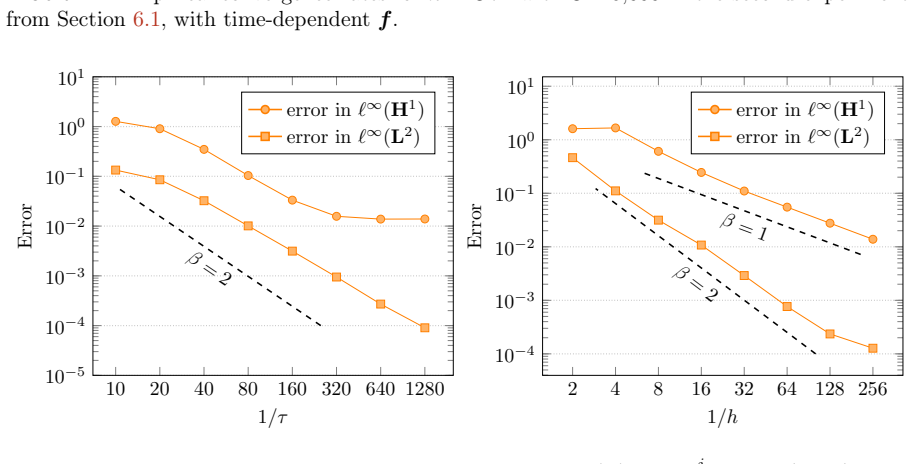
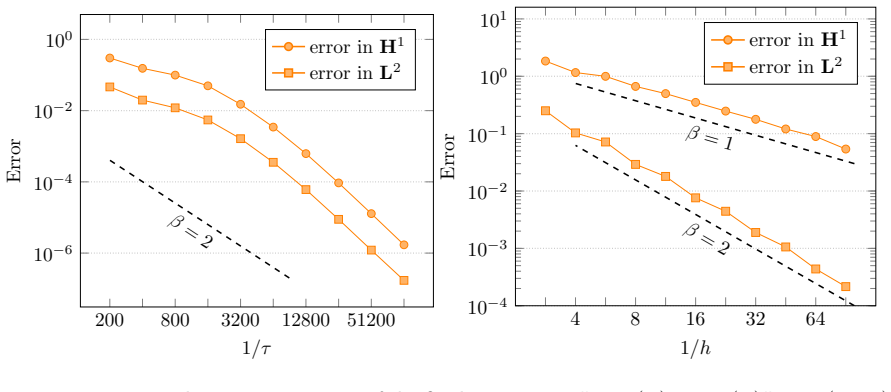
We consider the Landau-Lifshitz-Gilbert equation (LLG), which models time-dependent micromagnetic phenomena. We analyze a fully discrete scheme that combines first-order finite elements in space with a BDF2 method in time. The method requires the solution of only one linear system of equations per time step and does not enforce the pointwise unit-length constraint of the magnetization. While unconditional weak convergence has been analyzed in an earlier work, we now prove optimal-order convergence rates under sufficient regularity assumptions on the exact solution and the external field. In combination with our previous work, this establishes the first higher-order-in-time and linear integrator that converges both to weak and strong solutions of LLG. Numerical experiments confirm first-order convergence in space and second-order convergence in time.
Editorial analysis
A structured set of objections, weighed in public.
Referee Report
Summary. The paper analyzes a fully discrete numerical scheme for the Landau-Lifshitz-Gilbert equation that combines linear finite elements in space with a BDF2 time integrator. The scheme solves a single linear system per time step and does not enforce the pointwise unit-length constraint. Building on prior unconditional weak-convergence analysis, the authors prove optimal-order a-priori error estimates under sufficient regularity assumptions on the exact solution and external field. Numerical experiments are presented to confirm first-order spatial and second-order temporal convergence.
Significance. If the error estimates are valid, the work supplies the first higher-order-in-time linear integrator with rigorous convergence guarantees to both weak and strong solutions of the LLG equation. This is a meaningful contribution to the numerical analysis of micromagnetics, where efficient, unconditionally stable higher-order methods with proven rates are needed.
minor comments (2)
- [Abstract] The abstract and introduction should explicitly restate the precise Sobolev regularity indices (e.g., H^2 in space and W^{2,∞} in time) required for the optimal rates, rather than referring only to “sufficient regularity.”
- [Numerical experiments] In the numerical experiments section, the tables or figures reporting convergence rates should include the observed orders computed from successive refinements so that the claimed first- and second-order behavior can be directly verified.
Simulated Author's Rebuttal
We thank the referee for the positive evaluation of our manuscript and the recommendation of minor revision. The referee's summary correctly reflects the paper's contributions: optimal-order a-priori error estimates for the linear BDF2 finite-element scheme applied to the LLG equation, building on prior weak-convergence results to establish convergence to both weak and strong solutions. No major comments were provided in the report.
Circularity Check
No significant circularity; prior work cited for weak convergence only
full rationale
The manuscript explicitly separates the new a-priori error estimates (under regularity) from the unconditional weak-convergence result of the earlier paper. The central claim is a combination of two independent analyses rather than a reduction of one to the other by definition or fitting. No self-definitional steps, fitted inputs renamed as predictions, or ansatz smuggling appear in the derivation chain. The self-citation is acknowledged and non-load-bearing for the novel strong-solution rates.
Axiom & Free-Parameter Ledger
axioms (1)
- domain assumption Sufficient regularity assumptions on the exact solution and the external field
Reference graph
Works this paper leans on
-
[1]
[AFKL21] G. Akrivis, M. Feischl, B. Kovács, and C. Lubich. Higher-order linearly implicit full discretization of the Landau-Lifshitz-Gilbert equation.Math. Comp., 90(329):995– 1038, 2021.doi:10.1090/mcom/3597. [AFP26a] M. Aldé, M. Feischl, and D. Praetorius. BDF2-type integrator for Landau-Lifshitz- Gilbert equation in micromagnetics: implicit-explicit ti...
-
[2]
[AHP+14] C. Abert, G. Hrkac, M. Page, D. Praetorius, M. Ruggeri, and D. Suess. Spin- polarized transport in ferromagnetic multilayers: an unconditionally convergent FEM integrator.Comput. Math. Appl., 68(6):639–654, 2014.doi:10 . 1016 / j . camwa.2014.07.010. [AJ06] F. Alouges and P. Jaisson. Convergence of a finite element discretization for the Landau-L...
-
[3]
doi:10.1016/j.camwa.2017.11.028. [Alo08] F. Alouges. A new finite element scheme for Landau-Lifchitz equations.Discrete Contin. Dyn. Syst. Ser. S, 1(2):187–196, 2008.doi:10.3934/dcdss.2008.1.187. [ALS25] R. An, Y. Li, and W. Sun. Optimal error analysis of the normalized tangent plane FEMforLandau-Lifshitz-Gilbertequation.IMA J. Numer. Anal.,45(5):3109–313...
-
[4]
doi:10.1137/050631070. [BPP15] L. Baňas, M. Page, and D. Praetorius. A convergent linear finite element scheme for the Maxwell-Landau-Lifshitz-Gilbert equations.Electron. Trans. Numer. Anal., 44:250–270,
-
[5]
Baňas, M
[BPPR14] L. Baňas, M. Page, D. Praetorius, and J. Rochat. A decoupled and unconditionally convergent linear FEM integrator for the Landau-Lifshitz-Gilbert equation with magnetostriction.IMA J. Numer. Anal., 34(4):1361–1385, 2014.doi:10 . 1093 / imanum/drt050. [Bro62] W. F. Brown.Magnetostatic principles in ferromagnetism. North-Holland Publish- ing Compan...
2014
-
[6]
[BS06] Ľ. Baňas and M. Slodička. Error estimates for Landau-Lifshitz-Gilbert equation with magnetostriction.Appl. Numer. Math., 56(8):1019–1039, 2006.doi:10.1016/ j.apnum.2005.09.003. [BS08] S. C. Brenner and L. R. Scott.The mathematical theory of finite element methods. Springer, New York, third edition, 2008.doi:10.1007/978-0-387-75934-0. [BSF+14] F. Br...
-
[7]
doi:10.1142/S0218202514500328. [CCWX22] Y. Cai, J. Chen, C. Wang, and C. Xie. A second-order numerical method for Landau-Lifshitz-Gilbertequationwithlargedampingparameters.J. Comput. Phys., 451:Paper No. 110831, 12, 2022.doi:10.1016/j.jcp.2021.110831. 34 [CCWX23] Y. Cai, J. Chen, C. Wang, and C. Xie. Error analysis of a linear numerical scheme for the Lan...
-
[8]
[Cia02] P. G. Ciarlet.The finite element method for elliptic problems. Society for Industrial and Applied Mathematics, 2002.doi:10.1137/1.9780898719208. [Cim05] I. Cimrák. Error estimates for a semi-implicit numerical scheme solving the Landau- Lifshitz equation with an exchange field.IMA J. Numer. Anal., 25(3):611–634, 2005.doi:10.1093/imanum/dri011. [Ci...
-
[9]
doi:10.1007/BF01932018. [DDPR22] E. Davoli, G. Di Fratta, D. Praetorius, and M. Ruggeri. Micromagnetics of thin films in the presence of Dzyaloshinskii-Moriya interaction.Math. Models Methods Appl. Sci., 32(5):911–939, 2022.doi:10.1142/S0218202522500208. [DIP20] G. Di Fratta, M. Innerberger, and D. Praetorius. Weak-strong uniqueness for the Landau-Lifshit...
-
[10]
35 [HPP+19] G. Hrkac, C.-M. Pfeiler, D. Praetorius, M. Ruggeri, A. Segatti, and B. Stiftner. Convergenttangentplaneintegratorsforthesimulationofchiralmagneticskyrmion dynamics.Adv. Comput. Math., 45(3):1329–1368, 2019.doi:10 . 1007 / s10444 - 019-09667-z. [HS98] A. Hubert and R. Schäfer.Magnetic Domains: The Analysis of Magnetic Mi- crostructures.Springer...
-
[11]
[HW10] E. Hairer and G. Wanner.Solving ordinary differential equations. II. Springer, Berlin, revised edition, 2010.doi:10.1007/978-3-642-05221-7. [LHH23] M. Liu, P. Huang, and Y. He. A linearized Crank-Nicolson/leapfrog scheme for the Landau-Lifshitz equation.Rocky Mountain J. Math., 53(3):821–837, 2023.doi: 10.1216/rmj.2023.53.821. [LL35] L. D. Landau a...
-
[12]
arXiv:2602.07571 [math.NA]. [NO81] O.NevanlinnaandF.Odeh.Multipliertechniquesforlinearmultistepmethods.Nu- mer. Funct. Anal. Optim., 3(4):377–423, 1981.doi:10.1080/01630568108816097. [Pro01] A.Prohl.Computational micromagnetism.Teubner,Stuttgart,2001.doi:10.1007/ 978-3-663-09498-2. [PRS18] D. Praetorius, M. Ruggeri, and B. Stiftner. Convergence of an impl...
work page internal anchor Pith review Pith/arXiv arXiv doi:10.1080/01630568108816097 1981
- [13]
-
[14]
arXiv:2510.25172 [math.NA]. Email address:Michele.Alde@asc.tuwien.ac.at(corresponding author) Email address:Michael.Feischl@asc.tuwien.ac.at Email address:Dirk.Praetorius@asc.tuwien.ac.at TU Wien, Institute of Analysis and Scientific Computing, Wiedner Hauptstraße 8–10, 1040 Wien, Austria 36
discussion (0)
Sign in with ORCID, Apple, or X to comment. Anyone can read and Pith papers without signing in.