A Lumped-Element Electrical Model of the Human Head for Brain-Oriented Applications
Pith reviewed 2026-06-28 23:47 UTC · model grok-4.3
The pith
A three-shell lumped RC circuit accurately models the human head for electro-quasi-static brain applications.
A machine-rendered reading of the paper's core claim, the machinery that carries it, and where it could break.
Core claim
The authors establish that a lumped-element model consisting of three concentric spherical shells, each implemented with independent radial and tangential RC branches derived from frequency-dependent tissue properties, serves as a valid surrogate for full electro-quasi-static head modeling, as confirmed by agreement with the semi-analytical spherical-harmonics solution.
What carries the argument
The three-shell geometry with radial and tangential RC pathways for each layer, where frequency-dependent conductivity and permittivity are mapped to dispersive resistive and capacitive elements.
If this is right
- The model demonstrates good agreement with the spherical-harmonics reference over multiple geometrical configurations and operating frequencies.
- Neglecting dispersion and capacitive pathways leads to an overestimation of scalp potentials over the considered frequency range.
- The need for dispersive RC circuit modeling is highlighted for accurate predictions.
Where Pith is reading between the lines
- This approach could allow faster simulations in applications like transcranial stimulation planning compared to full numerical methods.
- Extensions to non-spherical head shapes or additional tissue layers could build on the same mapping principle.
- Similar lumped models might apply to other bioelectromagnetic problems involving layered tissues.
Load-bearing premise
The human head can be adequately represented for electro-quasi-static purposes by three concentric spherical shells whose layers are each replaced by independent radial and tangential RC branches whose values are obtained by direct mapping of frequency-dependent conductivity and permittivity.
What would settle it
A comparison showing significant deviation between the lumped model's predicted scalp potentials and those computed by the spherical-harmonics reference at tested frequencies and configurations would falsify the claim of good agreement.
Figures



read the original abstract
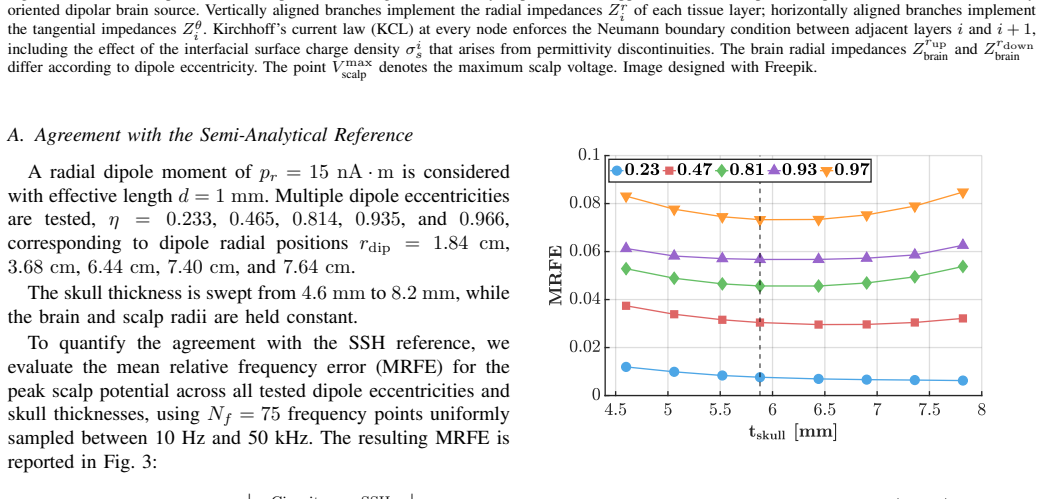
In this work, we present a compact surrogate circuit for electro-quasi-static (EQS) head modeling. A three-shell geometry (brain, skull, scalp) is considered, and each layer is modeled through radial and tangential pathways, implemented as RC branches. Frequency-dependent tissue conductivity and permittivity are mapped into dispersive resistive and capacitive elements. The model is validated against a semi-analytical spherical-harmonics reference solution over multiple geometrical configurations and operating frequencies, demonstrating good agreement. Neglecting dispersion and capacitive pathways can lead to an overestimation of scalp potentials over the considered frequency range, highlighting the need for dispersive RC circuit modeling.
Editorial analysis
A structured set of objections, weighed in public.
Referee Report
Summary. The manuscript presents a lumped-element surrogate circuit model for electro-quasi-static (EQS) modeling of the human head. It uses a three-shell spherical geometry (brain, skull, scalp), with each layer modeled by independent radial and tangential RC branches whose parameters are obtained by direct mapping from frequency-dependent tissue conductivity and permittivity spectra. The model is validated against a semi-analytical spherical-harmonics reference solution for multiple geometries and frequencies, with the claim of good agreement, and it is shown that neglecting dispersion and capacitive pathways leads to overestimation of scalp potentials.
Significance. Should the lumped model prove accurate, it would offer a fast, low-dimensional surrogate for EQS head simulations, beneficial for brain stimulation and sensing applications where computational efficiency is important. The incorporation of dispersive RC elements and the use of an independent semi-analytical reference for validation are positive aspects. However, the current presentation lacks the quantitative details needed to fully assess its performance.
major comments (2)
- [Abstract] The assertion of 'good agreement' with the semi-analytical reference lacks any quantitative support such as maximum relative error, RMS error, or specific values for the frequency range and geometrical parameters tested. This is central to the validation claim and prevents verification of the model's accuracy.
- [Model construction] The direct mapping of local σ(ω) and ε(ω) into radial and tangential RC branches does not explicitly account for the spherical geometry factors, e.g., the radial resistance being proportional to ∫_{r1}^{r2} dr/(σ 4π r²) while tangential paths have different scaling. Without a derivation or proof that this mapping reproduces the boundary-value EQS solution, the agreement may not hold generally beyond the specific test cases.
minor comments (2)
- The abstract would benefit from including at least one quantitative error metric or the frequency range considered to support the 'good agreement' statement.
- Clarify whether the RC branches are derived per shell or if there is coupling between radial and tangential paths through the circuit topology.
Simulated Author's Rebuttal
We are grateful to the referee for their insightful comments, which have helped us identify areas for improvement in the manuscript. We provide point-by-point responses to the major comments and outline the revisions we intend to make.
read point-by-point responses
-
Referee: [Abstract] The assertion of 'good agreement' with the semi-analytical reference lacks any quantitative support such as maximum relative error, RMS error, or specific values for the frequency range and geometrical parameters tested. This is central to the validation claim and prevents verification of the model's accuracy.
Authors: We concur that the abstract would be strengthened by the inclusion of quantitative error metrics. In the revised manuscript, we will update the abstract to report specific values for the maximum relative error and RMS error between the lumped model and the semi-analytical solution for the frequency range and geometrical parameters tested. These metrics will be based on the validation results presented in the manuscript. revision: yes
-
Referee: [Model construction] The direct mapping of local σ(ω) and ε(ω) into radial and tangential RC branches does not explicitly account for the spherical geometry factors, e.g., the radial resistance being proportional to ∫_{r1}^{r2} dr/(σ 4π r²) while tangential paths have different scaling. Without a derivation or proof that this mapping reproduces the boundary-value EQS solution, the agreement may not hold generally beyond the specific test cases.
Authors: The construction of the RC branches incorporates the spherical geometry through effective parameters derived from the shell dimensions and the local tissue properties. We will add an explicit derivation in the revised manuscript showing how the radial and tangential admittances account for the geometric factors in the spherical coordinate system. The close agreement with the semi-analytical solution across multiple geometries and frequencies provides evidence that the mapping reproduces the essential features of the EQS solution. revision: yes
Circularity Check
No circularity; derivation uses external validation and direct mapping without self-referential reduction
full rationale
The paper constructs a lumped RC model by mapping frequency-dependent conductivity and permittivity directly into circuit elements for a three-shell geometry, then validates the resulting potentials against an independent semi-analytical spherical-harmonics reference solution. No step reduces a claimed prediction or first-principles result to a fitted parameter or self-citation by construction. The central claim rests on agreement with an external benchmark rather than internal re-derivation of the same quantities. This matches the default expectation of a non-circular engineering model paper.
Axiom & Free-Parameter Ledger
free parameters (1)
- Tissue conductivity and permittivity spectra
axioms (2)
- domain assumption Head geometry can be represented by three concentric spherical shells with uniform isotropic properties per layer.
- domain assumption Electro-quasi-static approximation is valid over the frequencies of interest.
Reference graph
Works this paper leans on
-
[1]
Considerations of quasi-stationarity in electrophysiological systems,
R. Plonsey and D. B. Heppner, “Considerations of quasi-stationarity in electrophysiological systems,”The Bulletin of mathematical biophysics, vol. 29, no. 4, pp. 657–664, 1967
1967
-
[2]
Review on solving the forward problem in eeg source analysis,
H. Hallezet al., “Review on solving the forward problem in eeg source analysis,”Journal of NeuroEngineering and Rehabilitation, vol. 4, p. 46, 2007
2007
-
[3]
Review on solving the inverse problem in eeg source analysis,
R. Grech, T. Cassar, J. Muscat, K. P. Camilleri, S. G. Fabri, M. Zervakis, P. Xanthopoulos, V . Sakkalis, and B. Vanrumste, “Review on solving the inverse problem in eeg source analysis,”Journal of neuroengineering and rehabilitation, vol. 5, no. 1, p. 25, 2008
2008
-
[4]
High frequency deep brain stimulation attenuates subthalamic and cortical rhythms in parkinson’s disease,
D. Whitmer, C. De Solages, B. Hill, H. Yu, J. M. Henderson, and H. Bronte-Stewart, “High frequency deep brain stimulation attenuates subthalamic and cortical rhythms in parkinson’s disease,”Frontiers in human neuroscience, vol. 6, p. 155, 2012
2012
-
[5]
P. 089 ultra-high frequency deep brain stimulation at 10,000 hz improves motor function,
I. Harmsen, D. Lee, R. Dallapiazza, P. De Vloo, R. Chen, A. Fasano, S. Kalia, M. Hodaie, and A. Lozano, “P. 089 ultra-high frequency deep brain stimulation at 10,000 hz improves motor function,”Canadian Journal of Neurological Sciences, vol. 46, no. s1, pp. S37–S37, 2019
2019
-
[6]
Jin,Theory and computation of electromagnetic fields
J.-M. Jin,Theory and computation of electromagnetic fields. John Wiley & Sons, 2015
2015
-
[7]
Solution of poisson’s equation in a volume conductor using resistor mesh models: application to event related potential imaging,
X. Franceries, B. Doyon, N. Chauveau, B. Rigaud, P. Celsis, and J. Morucci, “Solution of poisson’s equation in a volume conductor using resistor mesh models: application to event related potential imaging,” Journal of applied physics, vol. 93, no. 6, pp. 3578–3588, 2003
2003
-
[8]
Quasi-static approximation error of electric field analysis for transcranial current stimulation,
G. Gaugainet al., “Quasi-static approximation error of electric field analysis for transcranial current stimulation,”Journal of Neural Engi- neering, vol. 20, no. 1, p. 016027, 2023
2023
-
[9]
Eeg electrode sensitivity-an application of reciprocity,
S. Rush and D. A. Driscoll, “Eeg electrode sensitivity-an application of reciprocity,”IEEE transactions on biomedical engineering, no. 1, pp. 15–22, 2008
2008
-
[10]
Effect of inhomogeneities on the apparent location and magnitude of a cardiac current dipole source,
R. M. Arthur and D. B. Geselowitz, “Effect of inhomogeneities on the apparent location and magnitude of a cardiac current dipole source,” IEEE Transactions on Biomedical Engineering, no. 2, pp. 141–146, 1970
1970
-
[11]
Impact of brain tissue filtering on neurostimulation fields: A modeling study,
T. Wagneret al., “Impact of brain tissue filtering on neurostimulation fields: A modeling study,”NeuroImage, vol. 85, pp. 1048–1057, 2014
2014
discussion (0)
Sign in with ORCID, Apple, or X to comment. Anyone can read and Pith papers without signing in.