Operant Conditioning in Indian Free-Ranging Dogs: Effects of Positive and Threatening Cues on Sociability
Pith reviewed 2026-07-03 01:43 UTC · model grok-4.3
The pith
Operant conditioning shapes free-ranging dogs' sociability toward humans with asymmetric generalization of positive and threatening experiences.
A machine-rendered reading of the paper's core claim, the machinery that carries it, and where it could break.
Core claim
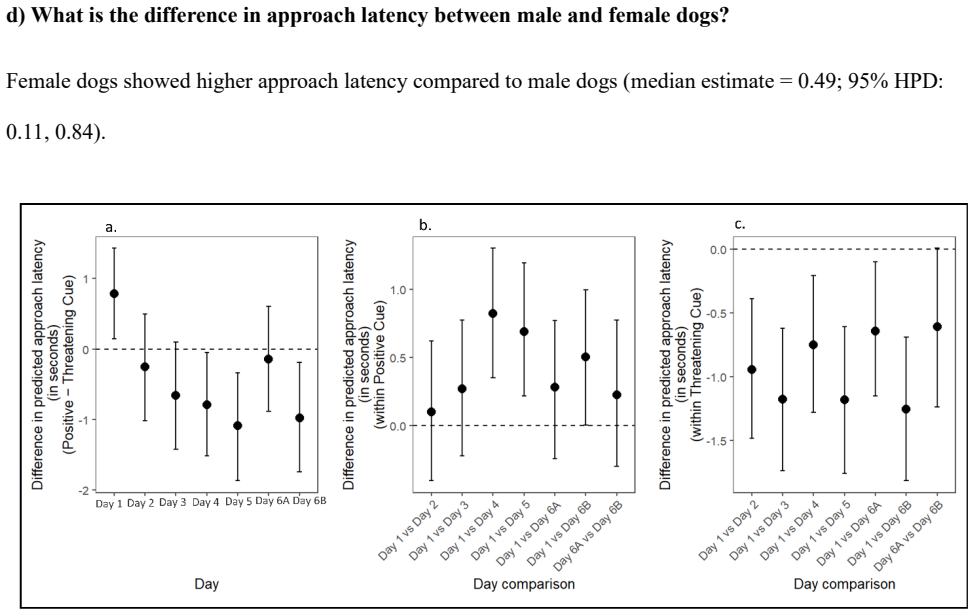
Dogs exposed to positive cues over five days increased their approach proportion, shortened approach latency, and showed more affiliative demeanor toward the familiar experimenter; these changes partially generalized to an unfamiliar individual with added hesitation. In contrast, dogs exposed to threatening cues decreased approach proportion, lengthened latency, and shifted to neutral or less affiliative responses, yet did not reduce approaches to the unfamiliar individual and only showed greater caution via longer latency. The results indicate that operant conditioning drives these changes in sociability and that generalization occurs asymmetrically between positive and threatening experien
What carries the argument
Repeated daily exposure to assigned positive or threatening cues, tracked through approach proportion, approach latency, and demeanor scores in familiar then unfamiliar experimenters.
If this is right
- Positive cue exposure reliably increases approach behavior and reduces latency across repeated interactions with the same person.
- Threatening cue exposure reliably decreases approach behavior, increases latency, and reduces affiliative demeanor across repeated interactions.
- Positive conditioning effects transfer partially to an unfamiliar person, increasing approach but with hesitation.
- Threatening conditioning does not transfer as reduced approach to an unfamiliar person but produces increased approach latency instead.
Where Pith is reading between the lines
- Management programs that use consistent positive interactions could increase dogs' willingness to approach caretakers or resource sites.
- The asymmetry suggests that once a dog learns caution from threats, it may still investigate new people but more slowly, which could affect bite-risk models.
- Future work could test whether the same cue effects appear in other free-ranging populations or with different cue intensities.
Load-bearing premise
The measured shifts in dog behavior over the five days are produced by the specific positive or threatening cues rather than by other factors such as individual dog histories or group dynamics.
What would settle it
A replication that measures the same dogs' baseline approach rates to both experimenters before any cue exposure and finds no differential change between positive and threatening groups after five days would falsify the claim that the cues drive the observed conditioning.
Figures



read the original abstract
Sociability toward humans is a key adaptive trait in free-ranging dogs, enabling them to access resources while navigating risks associated with human interactions. In this study, we investigated whether operant conditioning shapes sociability in Indian free-ranging dogs and whether learned responses generalize to unfamiliar individuals. We experimentally exposed 58 dog groups to either positive or a threatening cue over five consecutive days and assessed their behaviour using approach proportion, approach latency, and demeanor across repeated interactions with a familiar experimenter, followed by a test with an unfamiliar individual. Using Bayesian generalized linear mixed models, we found that cue type and repeated exposure significantly influenced sociability. Dogs exposed to a positive cue showed increased approach behaviour and reduced approach latency over time, along with increased affiliative demeanor. In contrast, dogs exposed to threatening cues exhibited reduced approach behaviour, increased approach latency, and a shift toward neutral and less affiliative responses across days. Importantly, positive cues partially generalized across individuals, as dogs showed increased approach toward an unfamiliar experimenter, although this was accompanied by hesitation to approach. In contrast, threatening cues did not generalize in the same way; dogs did not reduce their approach toward unfamiliar individuals but displayed increased approach latency, indicating heightened caution. Our findings demonstrate that operant conditioning plays a crucial role in shaping dog-human interactions, with asymmetric generalization of positive and threatening experiences.
Editorial analysis
A structured set of objections, weighed in public.
Referee Report
Summary. The manuscript reports an experiment exposing 58 groups of Indian free-ranging dogs to either positive or threatening human cues over five consecutive days. Using Bayesian GLMMs, it claims that positive cues increase approach proportion, reduce latency, and increase affiliative demeanor with partial generalization to an unfamiliar experimenter, while threatening cues produce the opposite pattern without equivalent generalization, concluding that operant conditioning shapes dog-human sociability with asymmetric effects.
Significance. If the cue-specific effects can be isolated from environmental confounds, the work would add field evidence on learned behavioral plasticity in free-ranging canids and the limits of generalization between familiar and unfamiliar humans. The repeated-measures design with a generalization test is a strength, but the current reporting leaves the causal attribution open.
major comments (3)
- [Abstract / Methods] Abstract and Methods (experimental design): The five-day repeated-exposure protocol on the same groups does not describe randomization of cue assignment, yoked controls, daily environmental logs, or covariates for human density, food availability, or intra-group dynamics. Without these, the reported cue-type × day interactions on approach proportion, latency, and demeanor cannot be unambiguously attributed to the assigned cues rather than correlated free-ranging variables.
- [Abstract] Abstract: The Bayesian GLMM results are summarized only as 'significant effects' with no model equations, prior specifications, convergence diagnostics, posterior predictive checks, or effect-size tables. This prevents evaluation of whether the reported trajectories are robust or sensitive to modeling choices.
- [Abstract] Abstract (generalization test): The shift from familiar to unfamiliar experimenter occurs after five days of conditioning, yet no details are given on counterbalancing of experimenter identity, order effects, or individual dog histories. This weakens the claim of asymmetric generalization, as the observed hesitation in the positive-cue group could reflect cumulative exposure rather than cue valence.
minor comments (2)
- [Abstract] Define 'demeanor' categories (affiliative, neutral, etc.) and inter-observer reliability metrics explicitly.
- [Abstract] Clarify whether 'dog groups' refers to stable packs or temporary aggregations and report the total number of individual dogs observed.
Simulated Author's Rebuttal
We thank the referee for their constructive comments on our manuscript. We address each major point below, providing the strongest honest defense and indicating where revisions will be made to improve clarity and transparency without overstating the original design or results.
read point-by-point responses
-
Referee: [Abstract / Methods] Abstract and Methods (experimental design): The five-day repeated-exposure protocol on the same groups does not describe randomization of cue assignment, yoked controls, daily environmental logs, or covariates for human density, food availability, or intra-group dynamics. Without these, the reported cue-type × day interactions on approach proportion, latency, and demeanor cannot be unambiguously attributed to the assigned cues rather than correlated free-ranging variables.
Authors: We agree that greater detail on assignment and potential confounds is needed. In the revision we will specify that groups were assigned to cue conditions by spatial location to avoid cross-group interference (a practical constraint of working with free-ranging animals), and we will add a limitations paragraph discussing unmeasured variables such as daily human density and food availability. Systematic daily environmental logs were not collected; we will therefore note this as a limitation rather than claim controls that were absent. Yoked controls are not feasible in this field setting without disrupting natural ranging, so we will explain why they were omitted and discuss how the repeated-measures design within groups still allows within-subject inference on cue effects. revision: partial
-
Referee: [Abstract] Abstract: The Bayesian GLMM results are summarized only as 'significant effects' with no model equations, prior specifications, convergence diagnostics, posterior predictive checks, or effect-size tables. This prevents evaluation of whether the reported trajectories are robust or sensitive to modeling choices.
Authors: We accept this criticism. Although the Methods section contains the model family and random-effects structure, we will expand the revision to include the explicit model equations, prior choices (weakly informative defaults), convergence diagnostics (R-hat and effective sample sizes), posterior predictive checks, and a table of posterior means with 95% credible intervals for key interactions. These additions will appear in the main text or a dedicated supplementary section. revision: yes
-
Referee: [Abstract] Abstract (generalization test): The shift from familiar to unfamiliar experimenter occurs after five days of conditioning, yet no details are given on counterbalancing of experimenter identity, order effects, or individual dog histories. This weakens the claim of asymmetric generalization, as the observed hesitation in the positive-cue group could reflect cumulative exposure rather than cue valence.
Authors: We will revise the Methods to state that the unfamiliar experimenter was always a new individual with no prior contact with the tested groups and that testing order was fixed (familiar then unfamiliar) because the same experimenter conducted the five conditioning days. Counterbalancing of identities was not performed. Individual histories could not be obtained in a free-ranging population. In the revised Discussion we will explicitly acknowledge that cumulative exposure or order effects could contribute to the hesitation observed in the positive-cue generalization trial, while noting that the differential pattern across cue types (generalization with hesitation after positive cues versus increased latency without reduced approach after threatening cues) remains consistent with asymmetric valence effects. We will temper the strength of the generalization claim accordingly. revision: partial
Circularity Check
No circularity; empirical results grounded in independent experimental observations
full rationale
This is an empirical behavioral study reporting outcomes from controlled cue exposure in free-ranging dogs, analyzed via Bayesian GLMMs on measured variables (approach proportion, latency, demeanor). No mathematical derivation chain, fitted parameters renamed as predictions, self-definitional constructs, or load-bearing self-citations appear in the abstract or described methods. The design (repeated measures, familiar/unfamiliar contrast) supplies independent data grounding for the reported cue-type effects and asymmetric generalization; claims do not reduce to inputs by construction.
Axiom & Free-Parameter Ledger
axioms (1)
- domain assumption Dogs can form associations between human cues and outcomes via operant conditioning in natural settings
Reference graph
Works this paper leans on
-
[1]
F., Bratslavsky, E., Finkenauer, C., & V ohs, K
Baumeister, R. F., Bratslavsky, E., Finkenauer, C., & V ohs, K. D. (2001). Bad is stronger than good. Review of general psychology, 5(4), 323-370. Berman, M., & Dunbar, I. (1983). The social behaviour of free-ranging suburban dogs. Applied Animal Ethology, 10(1-2), 5-17. Bhattacharjee, D., & Bhadra, A. (2020). Humans dominate the social interaction networ...
2001
-
[2]
Bhattacharjee, D., Sarkar, R., Sau, S., & Bhadra, A. (2021). Sociability of Indian free-ranging dogs (Canis lupus familiaris) varies with human movement in urban areas. Journal of comparative psychology, 135(1),
2021
-
[3]
Advanced Bayesian Multilevel Modeling with the R Package brms
Bhattacharjee, D., Sau, S., Das, J., & Bhadra, A. (2017). Free-ranging dogs prefer petting over food in repeated interactions with unfamiliar humans. Journal of Experimental Biology, 220(24), 4654-4660. Boitani, L., & Ciucci, P. (1995). Comparative social ecology of feral dogs and wolves. Ethology ecology & evolution, 7(1), 49-72. Boitani, L., Francesco, ...
-
[4]
Acknowledgements The authors gratefully acknowledge the Indian Institute of Science Education and Research Kolkata for providing infrastructural support
Journal of the Experimental Analysis of Behavior, 7(3), 263-266. Acknowledgements The authors gratefully acknowledge the Indian Institute of Science Education and Research Kolkata for providing infrastructural support. They also thank Arpan Bhattacharyya for creating the experimental illustration and Imran Mondal for assistance with the fieldwork. Funding...
2020
discussion (0)
Sign in with ORCID, Apple, or X to comment. Anyone can read and Pith papers without signing in.