Antenna System for Simultaneous Wireless Power and Information Transfer to Brain Implants
Pith reviewed 2026-07-03 07:58 UTC · model grok-4.3
The pith
A dual-function antenna delivers wireless power to brain implants while supporting 32 Mbps data rates without batteries.
A machine-rendered reading of the paper's core claim, the machinery that carries it, and where it could break.
Core claim
The central claim is that a single dual-function antenna system, combining inductive coupling for wireless power transfer and a backscatter antenna for uplink, can power an implant ASIC sufficiently for continuous operation and simultaneously achieve battery-free wireless connectivity at rates up to 32 Mbps.
What carries the argument
Dual-function antenna system: inductive coupling for power delivery and backscatter modulation for data return.
If this is right
- Continuous, battery-free BCI operation becomes feasible for extended sessions.
- Wired connections and repeated surgical battery changes are eliminated.
- High-rate neural data can be streamed in real time for closed-loop control tasks.
- Energy efficiency is preserved because the same antenna structure serves both functions.
Where Pith is reading between the lines
- The same antenna architecture could be adapted for other low-power implants such as cochlear devices or peripheral nerve stimulators.
- Integration with existing external BCI hardware would require only antenna redesign rather than full system overhaul.
- In-vivo tests in animal models would directly test whether tissue absorption limits the claimed power margin.
Load-bearing premise
The inductive link can supply adequate power through tissue while the backscatter link maintains its data rate and accuracy without mutual interference or extra power draw.
What would settle it
Direct measurement inside tissue showing received power at the ASIC below the level required for stimulation and readout, or measured uplink throughput falling short of 32 Mbps under realistic conditions.
Figures

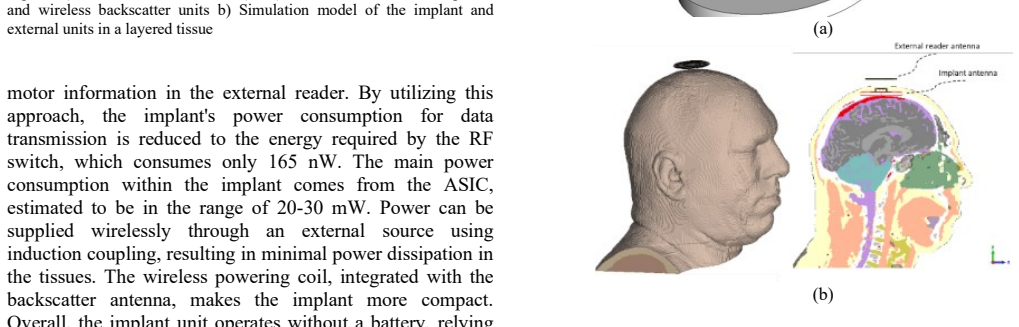


read the original abstract
Brain-Computer Interfaces (BCIs) have revolutionized neuroscience applications, from motor rehabilitation to neuroergonomics. Traditional implantable BCIs with invasive microelectrode arrays pose challenges, notably the need for wired connections and inherent implantation risks. This paper introduces a battery-free wireless BCI system, consolidating an implant and its external supporting system. Our design centers on a dual-function antenna system: firstly, an inductive coupling mechanism enables wireless power transfer, sufficiently powering the implant's Application-Specific Integrated Circuit (ASIC) for stimulation and readout without an implant battery. Secondly, a backscatter antenna in the implant facilitates battery-free, high-data-rate wireless connectivity (up to 32 Mbps). This system not only enhances the BCI experience by eliminating wires but also retains data fidelity and energy efficiency, promising a safer, more efficient interface for tasks like robotic arm control.
Editorial analysis
A structured set of objections, weighed in public.
Referee Report
Summary. The manuscript proposes a battery-free wireless brain-computer interface (BCI) system that uses a dual-function antenna: inductive coupling for wireless power transfer to sufficiently power an implant ASIC for stimulation and readout, and a backscatter antenna for battery-free high-data-rate connectivity up to 32 Mbps, eliminating wires and batteries while maintaining data fidelity.
Significance. If the power delivery and data-rate claims were demonstrated with quantitative link budgets, efficiency calculations, and measurements in tissue or phantoms compared against ASIC consumption, the work could advance safe, wireless BCIs for applications like robotic control. The manuscript provides no such supporting analysis, simulations, or data, so significance cannot be assessed.
major comments (1)
- [Abstract] Abstract: The central claims that inductive coupling 'sufficiently' powers the ASIC without a battery and that backscatter enables 'up to 32 Mbps' are stated without any link budget, received-power calculation, efficiency estimate, comparison to ASIC consumption, or error analysis in a biological environment; this renders the performance assertions unevaluable.
Simulated Author's Rebuttal
We thank the referee for the detailed review and constructive feedback. We agree that the performance claims require quantitative support to be properly evaluable and will revise the manuscript to incorporate the requested analyses.
read point-by-point responses
-
Referee: [Abstract] Abstract: The central claims that inductive coupling 'sufficiently' powers the ASIC without a battery and that backscatter enables 'up to 32 Mbps' are stated without any link budget, received-power calculation, efficiency estimate, comparison to ASIC consumption, or error analysis in a biological environment; this renders the performance assertions unevaluable.
Authors: We agree with the referee that the abstract states the claims without supporting quantitative details. In the revised manuscript we will expand the abstract to reference key results (e.g., estimated received power, link efficiency, and data-rate validation) and will add a new subsection in the main text that presents the inductive link budget, received-power calculations, efficiency estimates, direct comparison against measured ASIC consumption, and error analysis based on tissue-phantom measurements. These additions will make the assertions evaluable while preserving the original design narrative. revision: yes
Circularity Check
No significant circularity; design description lacks load-bearing derivations or self-referential predictions
full rationale
The manuscript presents an antenna system design for simultaneous WPT and backscatter data transfer. No equations, fitted parameters, or derivation chains appear in the abstract or described full text. Claims rest on engineering description and (presumably) simulation/measurement results rather than any prediction that reduces by construction to its own inputs or to a self-citation chain. Self-citations, if present, are not load-bearing for any uniqueness theorem or ansatz. This is the normal non-finding for a hardware-design paper without closed-form predictive modeling.
Axiom & Free-Parameter Ledger
Reference graph
Works this paper leans on
-
[1]
https://blackrockneurotech.com/products/utah-array/ (accessed
Blackrock. https://blackrockneurotech.com/products/utah-array/ (accessed
-
[2]
https://www.neuronexus.com/products/electrode-arrays/ (accessed
Neuronexus. https://www.neuronexus.com/products/electrode-arrays/ (accessed
-
[3]
A Power -Efficient Brain -Machine Interface System With a Sub-mw Feature Extraction and Decoding ASIC Demonstrated in Nonhuman Primates,
H. An et al. , "A Power -Efficient Brain -Machine Interface System With a Sub-mw Feature Extraction and Decoding ASIC Demonstrated in Nonhuman Primates," IEEE Transactions on Biomedical Circuits and Systems, vol. 16, no. 3, pp. 395-408, 2022
2022
-
[4]
The dielectric properties of biological tissues: II. Measurements in the frequency range 10 Hz to 20 GHz,
S. Gabriel, R. Lau, and C. Gabriel, "The dielectric properties of biological tissues: II. Measurements in the frequency range 10 Hz to 20 GHz," Physics in medicine & biology, vol. 41, no. 11, p. 2251, 1996
1996
-
[5]
"IEEE Standard for Safety Levels with Respect to Human Exposure to Radio Frequen cy Electromagnetic Fields, 3 kHz to 300 GHz," IEEE Std C95.1-2005 (Revision of IEEE Std C95.1 -1991), pp. 1-238, doi: 10.1109/IEEESTD.2006.99501
-
[6]
Advancing Brain-Machine Interfaces: High Data Rate Battery-Free Implants,
A. Hasanvand, A. Khaleghi, C. Beguet, P. Wanda, and I. Balasingham, "Advancing Brain-Machine Interfaces: High Data Rate Battery-Free Implants," presented at the IMBioC 2023 KU Leuven, Belgium, 2023
2023
discussion (0)
Sign in with ORCID, Apple, or X to comment. Anyone can read and Pith papers without signing in.