Beyond Laplace: Closed-form wrapped Gaussian posterior approximations on statistical manifolds
Pith reviewed 2026-07-03 08:10 UTC · model grok-4.3
The pith
Contrast functions yield closed-form approximations to logarithmic and exponential maps, enabling fast wrapped Gaussian posteriors on statistical manifolds.
A machine-rendered reading of the paper's core claim, the machinery that carries it, and where it could break.
Core claim
By invoking the theory of contrast functions, tractable closed-form approximations to the logarithmic and exponential maps are obtained on statistical manifolds. These approximations replace the need to solve geodesic equations or evaluate geometric quantities such as inverse matrices, Christoffel symbols, and curvature tensors, thereby furnishing a computationally efficient wrapped Gaussian posterior that retains the flexibility of the full Riemannian construction.
What carries the argument
Contrast-function approximations to the logarithmic and exponential maps on statistical manifolds with the Fisher-Rao metric.
If this is right
- Posterior sampling and density evaluation become orders of magnitude faster than existing wrapped-Gaussian procedures that rely on differential-equation solvers.
- Bayesian models can now use posterior shapes that include skewness and heavy tails without incurring the computational overhead previously associated with Riemannian geometry.
- The method applies to a range of statistical models while avoiding explicit calculation of curvature tensors or Jacobi fields.
- Density evaluation no longer requires repeated inversion of metric tensors or integration along geodesics.
Where Pith is reading between the lines
- The same contrast-function route could be tested on manifolds equipped with metrics other than Fisher-Rao, provided suitable contrast functions exist.
- Because the approximations are closed-form, they may be inserted directly into existing Markov-chain or variational routines that currently use Laplace or simple Gaussian proposals.
- In settings where posterior geometry changes with data size, the speed-up could allow repeated re-approximation during sequential updating without prohibitive cost.
Load-bearing premise
The contrast-function approximations to the logarithmic and exponential maps stay accurate enough on the manifolds of interest that they preserve a valid wrapped-Gaussian representation of the posterior.
What would settle it
On a low-dimensional statistical manifold where numerical geodesic integration is feasible, compute the exact wrapped-Gaussian density or samples and compare them directly to the contrast-function version; systematic large discrepancies would show the approximations fail to capture the intended posterior geometry.
Figures




read the original abstract
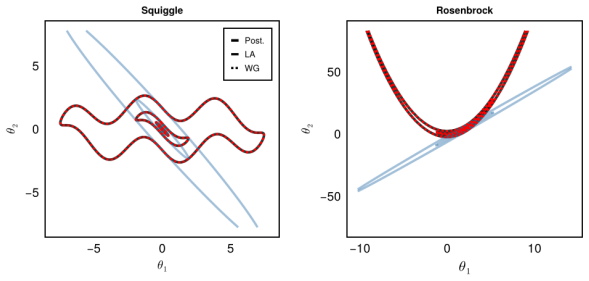
In Bayesian statistics, the Laplace approximation provides a computationally efficient approximation to posterior distributions. However, its Gaussian form restricts it to elliptical shapes, limiting its ability to capture important posterior features such as skewness, heavy tails, and narrow high-probability regions. Recent work has addressed this limitation by exploiting Riemannian geometry to push forward Gaussian distributions from the tangent space to the manifold, referred to wrapped Gaussians. While offering greater flexibility, they introduce substantial computational challenges. Sampling requires solving geodesic equations through the exponential map and density evaluation additionally depends on the logarithmic map and Jacobi fields, involving costly differential equation solvers and geometric quantities such as inverse matrices, Christoffel symbols and curvature tensors. To overcome these limitations, we employ the theory of contrast functions to derive tractable approximations of the logarithmic and exponential maps on statistical manifolds endowed with the Fisher--Rao metric and the prior distribution geometry. The resulting methodology bypass the need to compute these geometric quantities and numerical solvers thereby removing the principal computational bottlenecks of existing wrapped Gaussian approaches. Empirical results across a range of models demonstrate that the proposed approximation captures complex posterior geometries while remaining orders of magnitude faster than current state-of-the-art approximation.
Editorial analysis
A structured set of objections, weighed in public.
Referee Report
Summary. The paper claims that contrast-function theory yields closed-form approximations to the logarithmic and exponential maps on Fisher-Rao statistical manifolds (incorporating prior geometry), thereby producing tractable wrapped-Gaussian posterior approximations that capture skewness and heavy tails while avoiding geodesic solvers, Christoffel symbols, curvature tensors, and Jacobi fields required by existing Riemannian methods; empirical results are said to show orders-of-magnitude speed-ups with comparable accuracy across several models.
Significance. If the approximations are provably accurate, the work would remove the principal computational barrier to wrapped-Gaussian posteriors and supply a practical, geometry-aware alternative to the Laplace approximation for non-elliptical posteriors. The use of established contrast-function theory is a methodological strength that could generalize beyond the models tested.
major comments (2)
- [§3] §3 (derivation of the contrast-function surrogates): the central claim that the approximations 'bypass the need to compute these geometric quantities' requires quantitative error bounds on the surrogate exp/log maps in terms of sectional curvature, injectivity radius, or distance from the mode; without such bounds it is unclear whether the resulting density remains normalized or faithfully represents the target posterior geometry.
- [§4] §4 (empirical validation): the reported speed and accuracy comparisons do not include a diagnostic that the approximated wrapped-Gaussian density integrates to one (or a Monte-Carlo estimate of the normalization constant) on manifolds where the contrast-function error is largest; this check is load-bearing for the claim that the method 'captures complex posterior geometries'.
minor comments (2)
- [§2] Notation for the contrast function and its induced divergence should be introduced once with a clear reference to the prior literature (e.g., the specific contrast function chosen).
- [Figures 2-4] Figure captions should state the manifold dimension and sample size used for each timing experiment.
Simulated Author's Rebuttal
We thank the referee for the constructive comments, which highlight important aspects of the theoretical and empirical support for the proposed approximations. We agree that strengthening the analysis with error bounds and normalization diagnostics will improve the manuscript and plan to incorporate these revisions.
read point-by-point responses
-
Referee: [§3] §3 (derivation of the contrast-function surrogates): the central claim that the approximations 'bypass the need to compute these geometric quantities' requires quantitative error bounds on the surrogate exp/log maps in terms of sectional curvature, injectivity radius, or distance from the mode; without such bounds it is unclear whether the resulting density remains normalized or faithfully represents the target posterior geometry.
Authors: We acknowledge that explicit quantitative error bounds would provide stronger theoretical grounding. The current derivation relies on the established properties of contrast functions to obtain closed-form surrogates, but does not include curvature-based bounds. In the revision we will add a subsection to §3 deriving approximation-error bounds in terms of the contrast function's divergence properties and local manifold geometry (including injectivity radius considerations), and we will discuss the implications for normalization of the resulting wrapped-Gaussian density. revision: yes
-
Referee: [§4] §4 (empirical validation): the reported speed and accuracy comparisons do not include a diagnostic that the approximated wrapped-Gaussian density integrates to one (or a Monte-Carlo estimate of the normalization constant) on manifolds where the contrast-function error is largest; this check is load-bearing for the claim that the method 'captures complex posterior geometries'.
Authors: We agree that a direct check on normalization is necessary to substantiate the claim. The existing experiments focus on speed and posterior-shape fidelity but omit explicit normalization diagnostics. In the revised §4 we will add Monte-Carlo estimates of the normalization constant for the approximated densities, with particular attention to model instances where the contrast-function approximation error is expected to be largest, and report these alongside the current accuracy metrics. revision: yes
Circularity Check
No circularity: derivation applies external contrast-function theory to Fisher-Rao manifolds
full rationale
The abstract states that the approximations to logarithmic and exponential maps are derived from 'the theory of contrast functions' applied to statistical manifolds with the Fisher-Rao metric. No equations or steps in the provided text reduce a claimed prediction or result to a fitted parameter, self-definition, or load-bearing self-citation chain. The central methodology is presented as bypassing geometric computations via established external theory, with empirical results offered as separate validation. This matches the default expectation of a self-contained derivation against external benchmarks; no specific reduction (e.g., Eq. X = Eq. Y by construction) is exhibited.
Axiom & Free-Parameter Ledger
axioms (1)
- domain assumption Statistical manifolds are endowed with the Fisher-Rao metric and prior distribution geometry.
Reference graph
Works this paper leans on
-
[1]
1812 , publisher =
Laplace, Pierre-Simon , title =. 1812 , publisher =
-
[2]
, title =
Stigler, Stephen M. , title =. 1986 , publisher =
1986
-
[3]
International Conference on Artificial Intelligence and Statistics (AISTATS) , year =
Georgios Arvanitidis and S. International Conference on Artificial Intelligence and Statistics (AISTATS) , year =
-
[4]
International Conference on Artificial Intelligence and Statistics (AISTATS) , year =
Georgios Arvanitidis and Miguel González-Duque and Alison Pouplin and Dimitris Kalatzis and S. International Conference on Artificial Intelligence and Statistics (AISTATS) , year =
-
[5]
Machine Learning , volume=
R. Machine Learning , volume=
-
[6]
Approximate
Rue, H. Approximate. Journal of the Royal Statistical Society: Series B (Statistical Methodology) , year=
-
[7]
and Tierney, Luke and Kadane, Joseph B
Kass, Robert E. and Tierney, Luke and Kadane, Joseph B. , journal=. The Validity of Posterior Expansions Based on. 1989 , publisher=
1989
-
[8]
and Tierney, Luke and Kadane, Joseph B
Kass, Robert E. and Tierney, Luke and Kadane, Joseph B. , journal=. The Asymptotic Error in
-
[9]
Journal of the American Statistical Association , year=
Accurate approximations for posterior moments and marginal densities , author=. Journal of the American Statistical Association , year=
-
[10]
Journal of the American Statistical Association , volume=
Bayes Factors , author=. Journal of the American Statistical Association , volume=
-
[11]
Riemannian
Federico Bergamin and Pablo Moreno-Muñoz and Søren Hauberg, Georgios Arvanitidis , booktitle =. Riemannian
-
[12]
Neal , booktitle=
Radford M. Neal , booktitle=. Bayesian learning for neural networks , year=
-
[13]
A characterization of second order efficiency in a curved exponential family , year =
Shinto Eguchi , journal =. A characterization of second order efficiency in a curved exponential family , year =
-
[14]
Second Order Efficiency of Minimum Contrast Estimators in a Curved Exponential Family , year =
Shinto Eguchi , journal =. Second Order Efficiency of Minimum Contrast Estimators in a Curved Exponential Family , year =
-
[15]
Augusto Armando de Castro Júnior , title =
-
[16]
Hiroshima Mathematical Journal , publisher =
Shinto Eguchi , title =. Hiroshima Mathematical Journal , publisher =
-
[17]
Hiroshima mathematical journal , year=
A differential geometric approach to statistical inference on the basis of contrast functionals , author=. Hiroshima mathematical journal , year=
- [18]
-
[19]
Hiroshima Mathematical Journal , publisher =
Takao Matumoto , title =. Hiroshima Mathematical Journal , publisher =
-
[20]
An introduction to optimization on smooth manifolds , author =
-
[21]
Methods of Information Geometry , year =
Amari, Shun. Methods of Information Geometry , year =
-
[22]
1992 , series =
Riemannian Geometry , author =. 1992 , series =
1992
-
[23]
Approximate B ayesian inference in multivariate Gaussian process regression and applications to species distribution models
Marcelo Hartmann. Approximate B ayesian inference in multivariate Gaussian process regression and applications to species distribution models. 2019
2019
-
[24]
Approximate natural gradient in
Marcelo Hartmann , booktitle=. Approximate natural gradient in
-
[25]
Warped geometric information on the optimisation of
Hartmann, Marcelo and Williams, Bernardo and Yu, Hanlin and Girolami, Mark and Barp, Alessandro and Klami, Arto , year =. Warped geometric information on the optimisation of
-
[26]
Lagrangian manifold
Hartmann, Marcelo and Girolami, Mark and Klami, Arto , booktitle =. Lagrangian manifold
-
[27]
Statistics and Computing , year =
Hartmann, Marcelo and Vanhatalo, Jarno , title =. Statistics and Computing , year =
-
[28]
Geometric Modeling in Probability and Statistics , author =
-
[29]
1997 , series =
Geometrical Foundations of Asymptotic Inference , author =. 1997 , series =
1997
-
[30]
Riemannian
Yu, Hanlin and Hartmann, Marcelo and Williams Moreno Sanchez, Bernardo and Girolami, Mark and Klami, Arto , booktitle =. Riemannian
-
[31]
Proceedings of the IEEE Conference on Computer Vision and Pattern Recognition (CVPR) , year =
Mallasto, Anton and Feragen, Aasa , title =. Proceedings of the IEEE Conference on Computer Vision and Pattern Recognition (CVPR) , year =
-
[32]
Thibault de Surrel and Fabien Lotte and Sylvain Chevallier and Florian Yger , year=. Wrapped
-
[33]
SIAM Journal on Mathematics of Data Science , year =
Chevallier, Emmanuel and Li, Didong and Lu, Yulong and Dunson, David , title =. SIAM Journal on Mathematics of Data Science , year =
-
[34]
The Annals of Statistics , publisher =
Xavier Pennec , title =. The Annals of Statistics , publisher =
-
[35]
2020 , publisher =
Pennec, Xavier and Sommer, Stefan and Fletcher, Tom , title =. 2020 , publisher =
2020
-
[36]
Journal of Mathematical Imaging and Vision , year =
Xavier Pennec , title =. Journal of Mathematical Imaging and Vision , year =
-
[37]
2021 , Journal =
Salem Said , title =. 2021 , Journal =
2021
-
[38]
Probability Density Estimation on the Hyperbolic Space Applied to Radar Processing
Chevallier, Emmanuel and Barbaresco, Fr \'e d \'e ric and Angulo, Jes \'u s. Probability Density Estimation on the Hyperbolic Space Applied to Radar Processing. Geometric Science of Information. 2015
2015
-
[39]
A Geometric Approach to Differential Forms , author =
-
[40]
2014 , edition =
Table of Integrals, Series, and Products , author =. 2014 , edition =
2014
-
[41]
Journal of the Royal Statistical Society: Series B (Statistical Methodology) , author =
Riemann manifold. Journal of the Royal Statistical Society: Series B (Statistical Methodology) , author =
-
[42]
The Annals of Statistics , year =
The Geometry of Exponential Families , author =. The Annals of Statistics , year =
-
[43]
Markov Chain
Lan, Shiwei and Stathopoulos, Vasileios and Shahbaba, Babak and Girolami, Mark , publisher =. Markov Chain. Journal of Computational and Graphical Statistics , year =
-
[44]
Information and the accuracy attainable in the estimation of statistical parameters
Rao, Radhakrishna C. Information and the accuracy attainable in the estimation of statistical parameters. Bulletin of Calcutta mathematical society. 1945
1945
-
[45]
Kullback and R
S. Kullback and R. A. Leibler , title =. The Annals of Mathematical Statistics , publisher =
-
[46]
and Vajda, I
Liese, F. and Vajda, I. , journal=. On Divergences and Informations in Statistics and Information Theory , year=
-
[47]
The Advanced Theory of
Anthony O'Hagan , publisher =. The Advanced Theory of
-
[48]
2003 , publisher=
Theory of Point Estimation , author=. 2003 , publisher=
2003
-
[49]
Theory of Statistics
Schervish, Mark J. Theory of Statistics
-
[50]
Pfanzagl , title =
J. Pfanzagl , title =. The Annals of Statistics , publisher =
-
[51]
1982 , series =
Statistical Decision Rules and Optimal Inference , author =. 1982 , series =
1982
-
[52]
Bregman , title =
L.M. Bregman , title =. USSR Computational Mathematics and Mathematical Physics , volume =
-
[53]
Journal of Machine Learning Research , year =
Automatic Differentiation in Machine Learning: a Survey , author =. Journal of Machine Learning Research , year =
-
[54]
The American Statistician , year =
Arnold Zellner , title =. The American Statistician , year =
-
[55]
Philip Dawid and Steffen Lauritzen , journal =
Matthew Parry and A. Philip Dawid and Steffen Lauritzen , journal =. Proper local scoring rules , year =
-
[56]
and Holmes, Chris , TITLE =
Jewson, Jack and Smith, Jim Q. and Holmes, Chris , TITLE =. Entropy , YEAR =
-
[57]
and Mameli, V
Giummolè, F. and Mameli, V. and Ruli, E. and Ventura, L. , journal =. Objective
-
[58]
Harris and Nils L
Ayanendranath Basu and Ian R. Harris and Nils L. Hjort and M. C. Jones , journal =. Robust and Efficient Estimation by Minimising a Density Power Divergence , year =
-
[59]
Ghosh, Abhik; Basu, Ayanendranath , publisher =. Robust. Annals of the Institute of Statistical Mathematics , year =
-
[60]
1989 , edition =
Generalized Linear Models , author =. 1989 , edition =
1989
-
[61]
2022 , publisher =
Exponential Families in Theory and Practice , author =. 2022 , publisher =
2022
-
[62]
and Jupp, Peter E
Mardia, Kanti V. and Jupp, Peter E. , title =
-
[63]
Probabilistic
Mallasto, Anton and Hauberg, S. Probabilistic. International Conference on Artificial Intelligence and Statistics , year =
-
[64]
Geometric Science of Information , series =
Mallasto, Anton and Haije, Tom Dela and Feragen, Aasa , title =. Geometric Science of Information , series =. 2019 , publisher =
2019
-
[65]
Rousseeuw and Geert Molenberghs , journal =
Peter J. Rousseeuw and Geert Molenberghs , journal =. The Shape of Correlation Matrices , volume =
-
[66]
and Browning, Alexander P
Sharp, Jesse A. and Browning, Alexander P. and Burrage, Kevin and Simpson, Matthew J. , title =. Journal of The Royal Society Interface , year =
-
[67]
and Ghosh, Joydeep , journal =
Banerjee, Arindam and Merugu, Srujana and Dhillon, Inderjit S. and Ghosh, Joydeep , journal =. Clustering with
-
[68]
Curve Fitting and Optimal Design for Prediction , year =
Anthony O'Hagan , journal =. Curve Fitting and Optimal Design for Prediction , year =
-
[69]
2006 , publisher=
Gaussian Processes for Machine Learning , author=. 2006 , publisher=
2006
-
[70]
, title =
Barndorff-Nielsen, O. , title =
-
[71]
Advanced
Xu, Kai and Ge, Hong and Tebbutt, Will and Tarek, Mohamed and Trapp, Martin and Ghahramani, Zoubin , booktitle=. Advanced
-
[72]
Hoffman and Andrew Gelman , title =
Matthew D. Hoffman and Andrew Gelman , title =. Journal of Machine Learning Research , year =
-
[73]
Jones and Xiao-Li Meng , journal=
Neal, Radford and Steve Brooks and Andrew Gelman and Galin L. Jones and Xiao-Li Meng , journal=
-
[74]
The Annals of Statistics , publisher =
Alain Durmus and. The Annals of Statistics , publisher =
-
[75]
Journal of Machine Learning Research , volume =
Nickisch, Hannes and Rasmussen, Carl Edward , title =. Journal of Machine Learning Research , volume =. 2008 , month =
2008
-
[76]
, title =
Kuss, Malte and Rasmussen, Carl E. , title =. Journal of Machine Learning Research , year =
-
[77]
, title =
MacKay, David J.C. , title =. Machine Learning , year =
-
[78]
Entropy , YEAR =
Li, Mingming and Sun, Huafei and Li, Didong , TITLE =. Entropy , YEAR =
-
[79]
Waller, L. A. and Zelterman, D. , title =. Biometrics , year =
-
[80]
W. O. Kermack and A. G. McKendrick , journal =. A Contribution to the Mathematical Theory of Epidemics , volume =
discussion (0)
Sign in with ORCID, Apple, or X to comment. Anyone can read and Pith papers without signing in.