The slope of the friction law of hertzian-asperity--based metainterfaces has a finite positive lower bound
Pith reviewed 2026-07-03 02:04 UTC · model grok-4.3
The pith
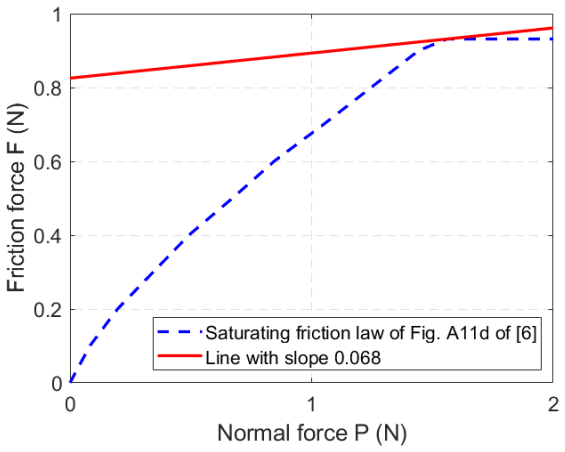
Friction laws from independent Hertzian asperity metainterfaces have a finite positive lower bound on slope.
A machine-rendered reading of the paper's core claim, the machinery that carries it, and where it could break.
Core claim
The slope of the friction law of hertzian-asperity-based metainterfaces has a finite positive lower bound. This is established by showing that any attempt to match a target friction law through free choice of asperity radii and heights under independent Hertzian contact still produces a slope that stays above a positive minimum value.
What carries the argument
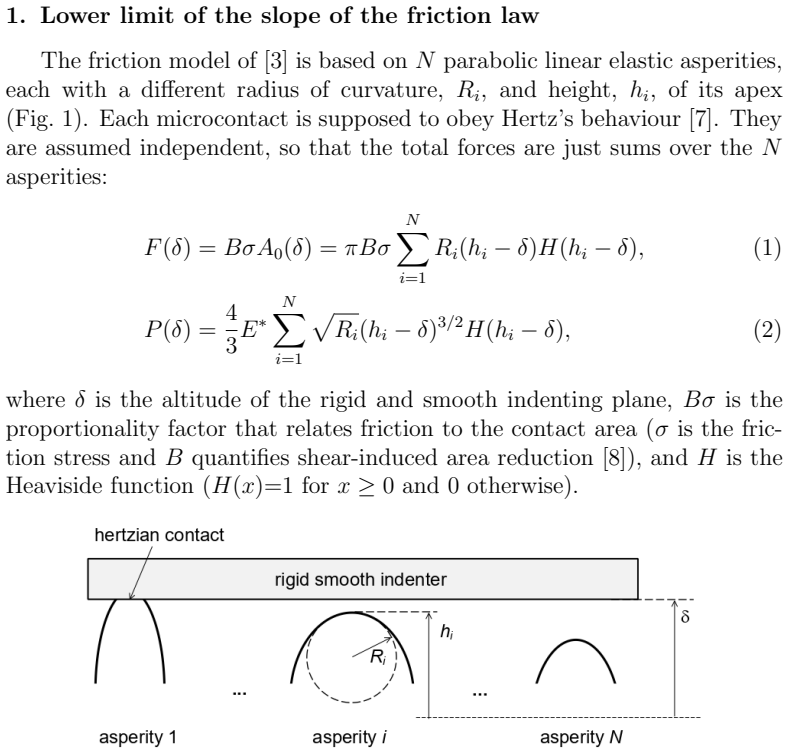
The population of independent Hertzian asperities whose radii and heights are selected to reproduce a desired friction law; the proof derives the positive lower bound on the resulting slope from the properties of Hertzian contact.
If this is right
- Friction laws whose slope falls below the bound cannot be realized with this metainterface construction.
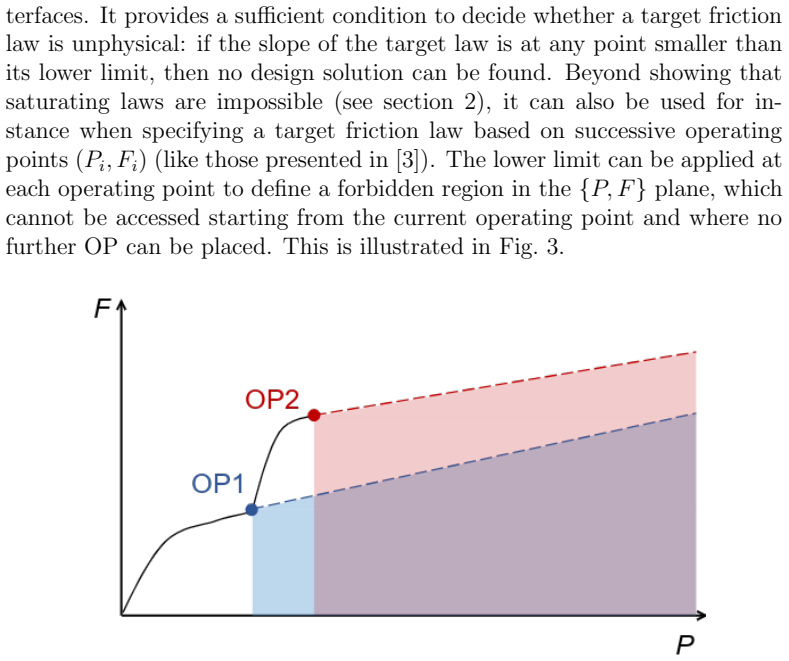
- The bound supplies a quick test to decide whether a proposed friction law is accessible.
- Designs that aim for very shallow positive slopes are ruled out even with optimal choice of asperity sizes.
- Earlier suggestions that arbitrarily small positive slopes might be attainable are contradicted.
Where Pith is reading between the lines
- The bound could shift if interactions between asperities are permitted or if a different contact model replaces Hertzian mechanics.
- Comparable limits may appear in metainterfaces built from other surface features or materials.
- Direct measurement of the shallowest achievable slope in a physical sample would test the predicted value.
Load-bearing premise
The asperities remain completely independent with no interactions and each obeys Hertzian contact mechanics.
What would settle it
An experimental metainterface fabricated from independent Hertzian asperities that achieves a friction law whose slope lies below the derived lower bound would falsify the claim.
Figures
read the original abstract
Metainterfaces can realize specified evolutions of their friction force as a function of the confining normal force (friction law), thanks to the design of the individual radii and heights of a population of independent hertzian asperities. However, not all friction laws are achievable. Here I show that, contrary to a suggestion from the literature, the slope of the friction law has a finite positive lower bound. This result is useful to identify friction laws that are not accessible to metainterfaces.
Editorial analysis
A structured set of objections, weighed in public.
Referee Report
Summary. The manuscript claims that metainterfaces built from independent Hertzian asperities with freely chosen radii and heights cannot realize friction laws whose slope dF_friction/dN is arbitrarily small. Through analysis of the contact-mechanics relations and the sequential engagement ordering of the asperity population, the author derives a finite positive lower bound on the achievable slope that is independent of the particular design parameters.
Significance. If the derivation holds, the result supplies a concrete, model-internal limit on the design space of realizable friction laws for this class of metainterfaces. It directly addresses and refutes an earlier suggestion that arbitrarily shallow positive slopes are attainable, thereby furnishing a practical criterion for identifying inaccessible target laws. The bound emerges from the Hertzian force-displacement relations and the ordering constraint without additional fitted parameters, which strengthens its utility for tribological metamaterial design.
minor comments (1)
- The abstract states the existence of the bound but does not quote its explicit numerical value or functional form; adding this would improve immediate readability.
Simulated Author's Rebuttal
We thank the referee for the positive assessment of the manuscript and the recommendation to accept. The report accurately captures the central result concerning the lower bound on the slope of realizable friction laws.
Circularity Check
No significant circularity
full rationale
The central result is a mathematical lower bound on achievable friction-law slope, derived directly from the stated model assumptions of independent Hertzian asperities with freely chosen radii and heights. The skeptic assessment confirms the bound follows from contact-mechanics relations and asperity-engagement ordering without reduction to fitted parameters, self-citation chains, or definitional equivalence. No load-bearing step matches any enumerated circularity pattern; the derivation is self-contained against the explicit model.
Axiom & Free-Parameter Ledger
Reference graph
Works this paper leans on
-
[1]
J. A. Greenwood, J. B. P. Williamson, Contact of nominally flat surfaces, Proceedings of the Royal Society of London A: Mathematical, Physical and Engineering Sciences 295 (1966) 300–319
1966
-
[2]
A. I. Vakis, V. A. Yastrebov, J. Scheibert, L. Nicola, D. Dini, C. Minfray, A. Almqvist, M. Paggi, S. Lee, G. Limbert, J. F. Molinari, G. Anciaux, R. Aghababaei, S. E. Restrepo, A. Papangelo, A. Cammarata, P. Nicolini, C. Putignano, G. Carbone, S. Stupkiewicz, J. Lengiewicz, G. Costagliola, F. Bosia, R. Guarino, N. M. Pugno, M. H. M¨ user, M. Ciavarella, ...
2018
-
[3]
Aymard, E
A. Aymard, E. Delplanque, D. Dalmas, J. Scheibert, Designing metain- terfaces with specified friction laws, Science 383 (6679) (2024) 200–204
2024
-
[4]
D. Zeka, N. Blal, F.-E. Fekak, A. Duval, A. Gravouil, J. Scheibert, Nor- mal contact of metainterfaces: The roles of finite size and microcontact interactions, Journal of the Mechanics and Physics of Solids 214 (2026) 106646
2026
-
[5]
L. Fu, D. G. Kashala, D. Dalmas, J. Scheibert, Automated Discovery of Metainterfaces with Tailored Friction Laws, eprint: 2605.19555 (2026)
work page internal anchor Pith review Pith/arXiv arXiv 2026
-
[6]
Mouton, A
V. Mouton, A. M´ elot, Friction on demand: A generative framework for the inverse design of metainterfaces, Tribology International 218 (2026) 111724
2026
-
[7]
J. R. Barber, Contact Mechanics, Springer, Cham, 2018
2018
-
[8]
Sahli, G
R. Sahli, G. Pallares, C. Ducottet, I. E. Ben Ali, S. Al Akhrass, M. Guib- ert, J. Scheibert, Evolution of real contact area under shear and the value of static friction of soft materials, Proceedings of the National Academy of Sciences of the USA 115 (2018) 471–176. 6
2018
discussion (0)
Sign in with ORCID, Apple, or X to comment. Anyone can read and Pith papers without signing in.