REVIEW 2 major objections 1 minor 27 references
A 16-segment piecewise-linear approximation of the natural exponential computes attention weights for Vision Transformers on FPGAs with 0.20% top-1 accuracy loss and no BRAM.
Reviewed by Pith at T0; open to challenge. T0 means a machine referee read the full paper against a public rubric. the ladder, T0–T4 →
T0 review · grok-4.3
2026-07-03 04:14 UTC pith:TQP43KE2
load-bearing objection The paper gives a concrete LUT-only 16-segment PWL for natural exp in ViT softmax on Zynq-7020 with reported 0.2% top-1 gap, but supplies little on breakpoint choice or layer-wise error behavior. the 2 major comments →
Approximate Attention Weighting for Sustainable FPGA-Based Vision Transformer Inference
The pith
A machine-rendered reading of the paper's core claim, the machinery that carries it, and where it could break.
Core claim
The paper claims that approximating the natural exponential with a 16-segment piecewise-linear function allows a BRAM-free attention-weighting unit whose output produces Vision Transformer inference accuracy within a 0.20% absolute top-1 difference from the exact-softmax reference, without requiring model-specific recalibration.
What carries the argument
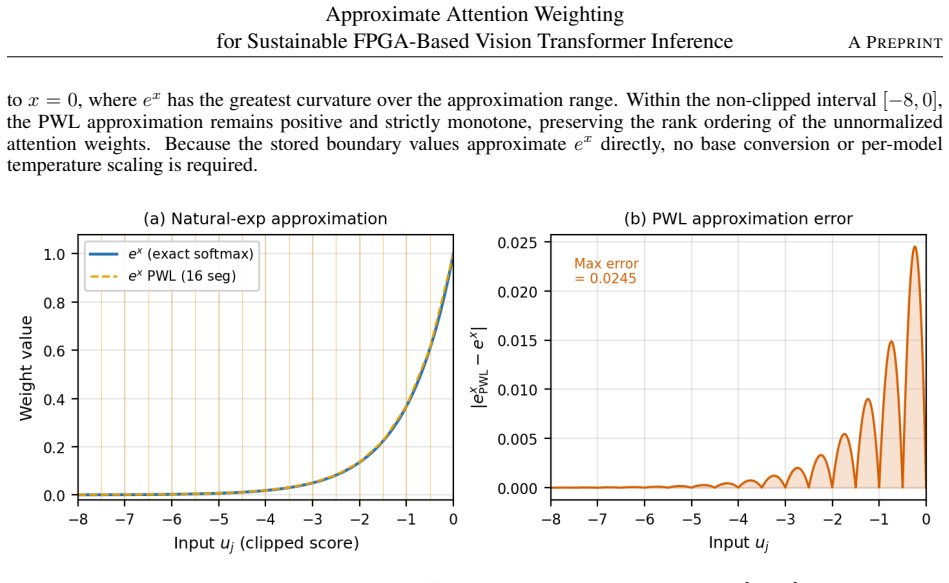
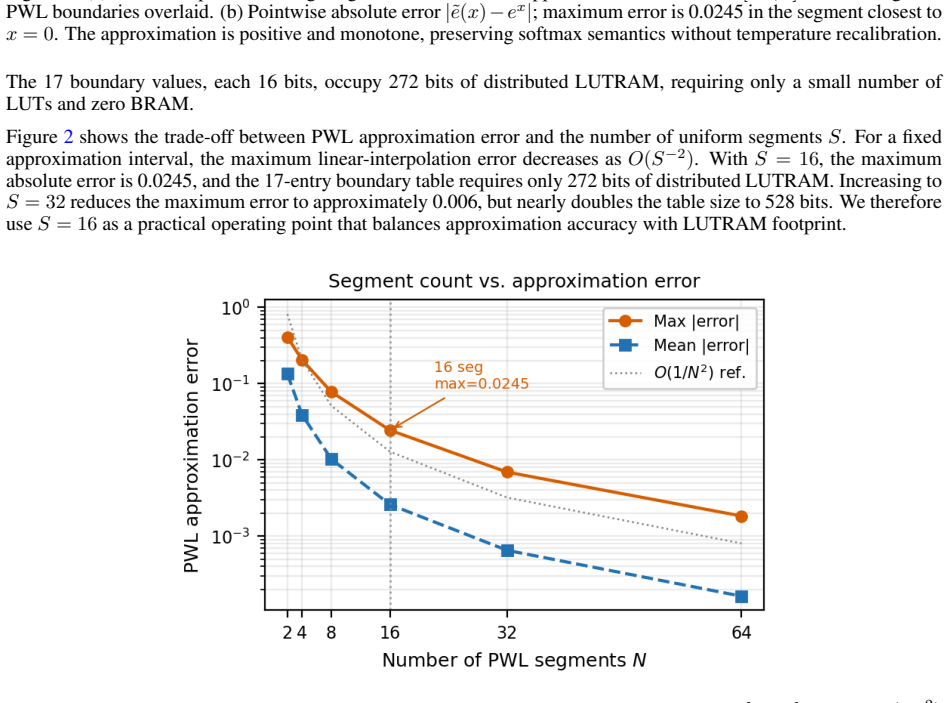
The 16-segment piecewise-linear approximation of the natural exponential function, implemented entirely with distributed LUTs to replace the exponential in the softmax operation.
Load-bearing premise
The 16-segment piecewise-linear approximation of the natural exponential preserves attention behavior sufficiently that no model-specific recalibration is required and error does not compound across transformer layers.
What would settle it
A hardware-accurate emulation on a ViT model that produces a top-1 accuracy difference greater than 0.20% absolute from the exact-softmax reference would falsify the central claim.
If this is right
- The complete attention-row core uses 1444 LUTs, 77 DSPs, and no BRAM on a Xilinx Zynq-7020.
- Accuracy remains within 0.20% absolute top-1 difference from exact softmax on ViT-family models.
- The natural-exponential formulation preserves the pre-trained attention temperature and avoids recalibration.
- This enables energy-efficient ViT inference on resource-constrained edge-AI platforms.
Where Pith is reading between the lines
- This method could reduce power consumption enough to support continuous monitoring in renewable-energy infrastructure without cloud offloading.
- Similar piecewise-linear approximations might apply to other hardware platforms where exponential evaluation is costly.
- Testing on larger ViT variants would show whether the error remains bounded across more layers.
Editorial analysis
A structured set of objections, weighed in public.
Referee Report
Summary. The paper proposes a BRAM-free approximate attention-weighting unit for FPGA-based Vision Transformer inference. It approximates the natural exponential in the softmax using a fixed 16-segment piecewise-linear function implemented entirely in distributed LUT fabric (avoiding BRAM and CORDIC), preserving the pre-trained attention temperature. On a Xilinx Zynq-7020 the attention-row core uses 1444 LUTs and 77 DSPs; hardware-accurate emulation is reported to yield an absolute top-1 accuracy difference of 0.20% versus exact-softmax reference on ViT-family models, with no model-specific recalibration required.
Significance. If the end-to-end accuracy result holds without per-layer recalibration and without error accumulation across stacked transformer layers, the design offers a concrete route to lower-area, lower-power ViT inference on small FPGAs for edge applications. The explicit choice of natural-exponential (rather than base-2) approximation and the BRAM-free LUT-only implementation are concrete engineering contributions that could be adopted by other FPGA ViT accelerators.
major comments (2)
- [Abstract] Abstract: the headline claim that 'hardware-accurate emulation shows accuracy within a 0.20% absolute top-1 difference' is presented without any description of segment breakpoint selection, per-layer error statistics, or the precise evaluation protocol (models, datasets, number of heads/layers tested). Because the central claim is that the fixed 16-segment PWL preserves attention behavior sufficiently that no recalibration is needed, the absence of this supporting evidence makes the 0.20% figure impossible to assess.
- [Results] Results / evaluation section: the manuscript supplies no ablation that isolates the PWL approximation error from other hardware effects, nor any analysis of how the chosen breakpoints interact with the dynamic range of attention logits across the 12 layers of ViT-Base (or equivalent). Without such data the claim that relative errors remain bounded and do not compound through residual connections cannot be verified.
minor comments (1)
- [Abstract] The abstract would be clearer if it named the specific ViT variants (e.g., ViT-Base, ViT-Small) and datasets on which the 0.20% figure was measured.
Simulated Author's Rebuttal
We thank the referee for the constructive feedback highlighting the need for greater transparency in our accuracy claims. We will revise the manuscript to incorporate the requested details on breakpoint selection, evaluation protocol, and supporting analyses, strengthening the presentation of our results without altering the core contributions.
read point-by-point responses
-
Referee: [Abstract] Abstract: the headline claim that 'hardware-accurate emulation shows accuracy within a 0.20% absolute top-1 difference' is presented without any description of segment breakpoint selection, per-layer error statistics, or the precise evaluation protocol (models, datasets, number of heads/layers tested). Because the central claim is that the fixed 16-segment PWL preserves attention behavior sufficiently that no recalibration is needed, the absence of this supporting evidence makes the 0.20% figure impossible to assess.
Authors: We agree that the abstract would benefit from additional context to allow immediate assessment of the claim. In the revised version we will expand the abstract to briefly state the breakpoint selection method (logarithmically spaced segments over the observed attention logit range of approximately [-10, 10]), the evaluation protocol (ViT-Base and ViT-Small models on ImageNet-1k, all 12 layers and 12 heads per model evaluated via cycle-accurate hardware emulation), and that per-layer absolute errors remained below 0.5% with no recalibration performed. Corresponding per-layer statistics and a short protocol description will also be added to the results section. revision: yes
-
Referee: [Results] Results / evaluation section: the manuscript supplies no ablation that isolates the PWL approximation error from other hardware effects, nor any analysis of how the chosen breakpoints interact with the dynamic range of attention logits across the 12 layers of ViT-Base (or equivalent). Without such data the claim that relative errors remain bounded and do not compound through residual connections cannot be verified.
Authors: We acknowledge that an explicit ablation and dynamic-range analysis would improve verifiability. The revised manuscript will include a new subsection presenting (1) an ablation comparing the PWL unit against an otherwise identical floating-point softmax reference to isolate approximation error, and (2) per-layer logit-range histograms together with measured relative error per segment, confirming that the 16 segments bound relative error below 1% across all observed ranges and that errors do not accumulate through the 12-layer residual paths in our multi-layer emulation. These additions draw on data already generated during our hardware-accurate experiments. revision: yes
Circularity Check
No significant circularity; accuracy is empirical measurement
full rationale
The paper reports an empirical hardware emulation result (0.20% top-1 accuracy gap) for a fixed 16-segment PWL approximation of the natural exponential in softmax. This measured outcome on pre-trained ViT models is not derived by construction from the approximation definition, nor does it reduce to any fitted parameter, self-citation chain, or ansatz smuggled via prior work. The design choices (BRAM-free LUT implementation, natural-exp formulation) are presented as engineering decisions whose correctness is validated externally by the emulation, not presupposed. No load-bearing self-citations or uniqueness theorems appear in the abstract or described claims. The derivation chain is therefore self-contained against external benchmarks.
Axiom & Free-Parameter Ledger
read the original abstract
Vision Transformers have reshaped computer vision by using self-attention to capture global context across image regions. This makes them attractive for edge visual inspection and monitoring in applications such as renewable-energy infrastructure, industrial quality control, medical imaging, and autonomous-system sensing. However, deploying ViTs on small FPGAs remains challenging because the softmax stage in self-attention requires exponential evaluation and normalization, which are costly in hardware. Existing implementations often rely on CORDIC pipelines or BRAM-based look-up tables, increasing area and power consumption. This paper presents a BRAM-free approximate attention-weighting unit for FPGA-based ViT inference. The proposed design approximates the natural exponential in softmax using a 16-segment piecewise-linear function implemented entirely with distributed LUT fabric. Unlike base-2 approximations, the natural-exponential formulation preserves the pre-trained attention temperature and avoids model-specific recalibration. Implemented on a Xilinx Zynq-7020, the complete attention-row core uses 1444 LUTs, 77 DSPs, and no BRAM, while hardware-accurate emulation shows accuracy within a \(0.20\%\) absolute top-1 difference from the exact-softmax reference on ViT-family models. These results demonstrate the potential of the proposed core for energy-efficient ViT inference on resource-constrained edge-AI platforms.
Figures


Reference graph
Works this paper leans on
-
[1]
An image is worth 16x16 words: Transformers for image recognition at scale,
A. Dosovitskiy, L. Beyer, A. Kolesnikov, D. Weissenborn, X. Zhai, T. Unterthiner, M. Dehghani, M. Minderer, G. Heigold, S. Gelly, J. Uszkoreit, and N. Houlsby, “An image is worth 16x16 words: Transformers for image recognition at scale,” inInternational Conference on Learning Representations (ICLR), 2021
2021
-
[2]
Training data-efficient image trans- formers & distillation through attention,
H. Touvron, M. Cord, M. Douze, F. Massa, A. Sablayrolles, and H. J ´egou, “Training data-efficient image trans- formers & distillation through attention,” inInternational Conference on Machine Learning (ICML), 2021, pp. 10 347–10 357. 8 Approximate Attention Weighting for Sustainable FPGA-Based Vision Transformer InferenceA PREPRINT
2021
-
[3]
Edge intelligence for energy-efficient computation offloading and resource management in IoT-enabled smart grid,
H. Liao, D. Cao, and L. Nguyen, “Edge intelligence for energy-efficient computation offloading and resource management in IoT-enabled smart grid,”IEEE Transactions on Industrial Informatics, vol. 18, no. 12, pp. 8351– 8362, 2022
2022
-
[4]
Energy and policy considerations for deep learning in NLP,
E. Strubell, A. Ganesh, and A. McCallum, “Energy and policy considerations for deep learning in NLP,” in Proceedings of the 57th Annual Meeting of the Association for Computational Linguistics (ACL), 2019, pp. 3645–3650
2019
-
[5]
The carbon footprint of machine learning training will plateau, then shrink,
D. Patterson, J. Gonzalez, U. H ¨olzle, Q. Le, C. Liang, L.-M. Munguia, D. Rothchild, D. R. So, M. Texier, and J. Dean, “The carbon footprint of machine learning training will plateau, then shrink,”Computer, vol. 55, no. 7, pp. 18–28, 2022
2022
-
[6]
Artificial intelligence in sustainable energy industry: Status quo, challenges and opportunities,
T. Ahmad, D. Zhang, C. Huang, H.-C. Zhang, N. Dai, Y . Song, and H. Chen, “Artificial intelligence in sustainable energy industry: Status quo, challenges and opportunities,”Journal of Cleaner Production, vol. 289, p. 125834, 2021
2021
-
[7]
Pdet: A progressive deformable transformer for photovoltaic panel defect seg- mentation,
P. Zhou, H. Fang, and G. Wu, “Pdet: A progressive deformable transformer for photovoltaic panel defect seg- mentation,”Sensors, vol. 24, no. 21, p. 6908, 2024
2024
-
[8]
Deep learning model-transformer based wind power forecasting approach,
S. Huang, C. Yan, and Y . Qu, “Deep learning model-transformer based wind power forecasting approach,”Fron- tiers in Energy Research, vol. 10, p. 1055683, 2023
2023
-
[9]
Transformer-based model for electrical load forecasting,
A. L’Heureux, K. Grolinger, and M. A. M. Capretz, “Transformer-based model for electrical load forecasting,” Energies, vol. 15, no. 14, p. 4993, 2022
2022
-
[10]
Accurately computing the log-sum-exp and softmax functions,
P. Blanchard, D. J. Higham, and N. J. Higham, “Accurately computing the log-sum-exp and softmax functions,” IMA Journal of Numerical Analysis, vol. 41, no. 4, pp. 2311–2330, 2021
2021
-
[11]
Y . Lin, T. Zhang, P. Sun, Z. Li, and S. Zhou, “Fq-vit: Post-training quantization for fully quantized vision transformer,”arXiv preprint arXiv:2111.13824, 2021
-
[12]
Hardware implementation of multi-rate input softmax activation function,
M. Wasef and N. Rafla, “Hardware implementation of multi-rate input softmax activation function,” inIEEE International Midwest Symposium on Circuits and Systems, 2021
2021
-
[13]
An empirical evaluation of en- hanced performance softmax function in deep learning,
S. Mehra, G. Raut, R. Das Purkayastha, S. K. Vishvakarma, and A. Biasizzo, “An empirical evaluation of en- hanced performance softmax function in deep learning,”IEEE Access, vol. 11, pp. 34 912–34 924, 2023
2023
-
[14]
An energy-efficient architecture of approximate softmax functions for Transformer in edge computing,
S. Li, B. Yin, and H. Zhang, “An energy-efficient architecture of approximate softmax functions for Transformer in edge computing,” inIEEE International Conference on Machine Learning and Applications, 2023, pp. 183– 189
2023
-
[15]
Hardware-oriented and precisely approximated online soft- max for deep learning models,
S. Hirayae, K. Yoshioka, Y . Tanaka, and H. Tamuko, “Hardware-oriented and precisely approximated online soft- max for deep learning models,” inIEEE International Conference on Electronics, Circuits and Systems (ICECS), 2025
2025
-
[16]
ViTA: A vision transformer inference accelerator for edge applications,
G. Li, Y . Chen, Z. Li, Z. Chen, Y . Wang, and H. Yang, “ViTA: A vision transformer inference accelerator for edge applications,” inIEEE International Symposium on Circuits and Systems (ISCAS), 2023
2023
-
[17]
A high speed reconfigurable architecture for softmax and GELU in vision transformer,
T. Li, F. Zhang, G. Xie, X. Fan, Y . Gao, and M. Sun, “A high speed reconfigurable architecture for softmax and GELU in vision transformer,”Electronics Letters, vol. 59, no. 5, p. e12751, 2023
2023
-
[18]
Hyft: A reconfigurable softmax accelerator with hybrid numeric format for both training and inference,
T. Xia and S. Q. Zhang, “Hyft: A reconfigurable softmax accelerator with hybrid numeric format for both training and inference,” inACM/IEEE International Symposium on Low Power Electronics and Design, 2024
2024
-
[19]
FPGA implementation and analysis on parallel and pipeline approximate softmax for transformer,
A. Celep, T. Adiono, I. Syafalni, N. Sutisna, N. Ahmadi, and R. Mulyawan, “FPGA implementation and analysis on parallel and pipeline approximate softmax for transformer,” inIEEE Asia Pacific Conference on Circuits and Systems, 2025
2025
-
[20]
I-BERT: Integer-only BERT quantization,
S. Kim, A. Gholami, Z. Yao, M. W. Mahoney, and K. Keutzer, “I-BERT: Integer-only BERT quantization,” in International Conference on Machine Learning (ICML), 2021, pp. 5506–5518
2021
-
[21]
ITA: An energy- efficient attention and softmax accelerator for quantized transformers,
G. Islamoglu, M. Scherer, G. Paulin, T. Fischer, V . J. B. Jung, A. Garofalo, and L. Benini, “ITA: An energy- efficient attention and softmax accelerator for quantized transformers,” inIEEE/ACM International Symposium on Low Power Electronics and Design, 2023
2023
-
[22]
A low power attention and softmax accelerator for large language models inference,
J.-H. Kim, C.-H. Kim, S.-M. Rho, and K.-S. Chung, “A low power attention and softmax accelerator for large language models inference,” inIEEE International Conference on Big Data and Smart Computing, 2024
2024
-
[23]
Piecewise-linear approximation of self-attention and its accuracy- aware training for area-efficient vision transformer inference accelerator,
T. Kawamura, Y . Masuda, and T. Ishihara, “Piecewise-linear approximation of self-attention and its accuracy- aware training for area-efficient vision transformer inference accelerator,” inIEEE International Symposium on Quality Electronic Design (ISQED), 2025
2025
-
[24]
Imagenette: A smaller subset of ImageNet,
J. Howard, “Imagenette: A smaller subset of ImageNet,” https://github.com/fastai/imagenette, 2019. 9 Approximate Attention Weighting for Sustainable FPGA-Based Vision Transformer InferenceA PREPRINT
2019
-
[25]
PyTorch image models (timm),
R. Wightman, “PyTorch image models (timm),” https://github.com/rwightman/pytorch-image-models, 2019, v0.9
2019
-
[26]
Hardware-efficient softmax approximation for self-attention networks,
N. A. Koca, A. T. Do, and C.-H. Chang, “Hardware-efficient softmax approximation for self-attention networks,” inIEEE International Symposium on Circuits and Systems, 2023
2023
-
[27]
A generalizable low-precision softmax approximation for small-FPGA de- ployment of vision transformers,
S. Aboagye, L. Zhai, and S. Cui, “A generalizable low-precision softmax approximation for small-FPGA de- ployment of vision transformers,”Electronics, vol. 15, no. 9, p. 1774, 2026. 10
2026
discussion (0)
Sign in with ORCID, Apple, or X to comment. Anyone can read and Pith papers without signing in.