Algebraic conditions for second-moment stability boundaries of linear, time-invariant stochastic delay-differential equations
Pith reviewed 2026-07-03 18:27 UTC · model grok-4.3
The pith
Algebraic equality conditions identify second-moment stability boundaries for stochastic delay equations without discretization.
A machine-rendered reading of the paper's core claim, the machinery that carries it, and where it could break.
Core claim
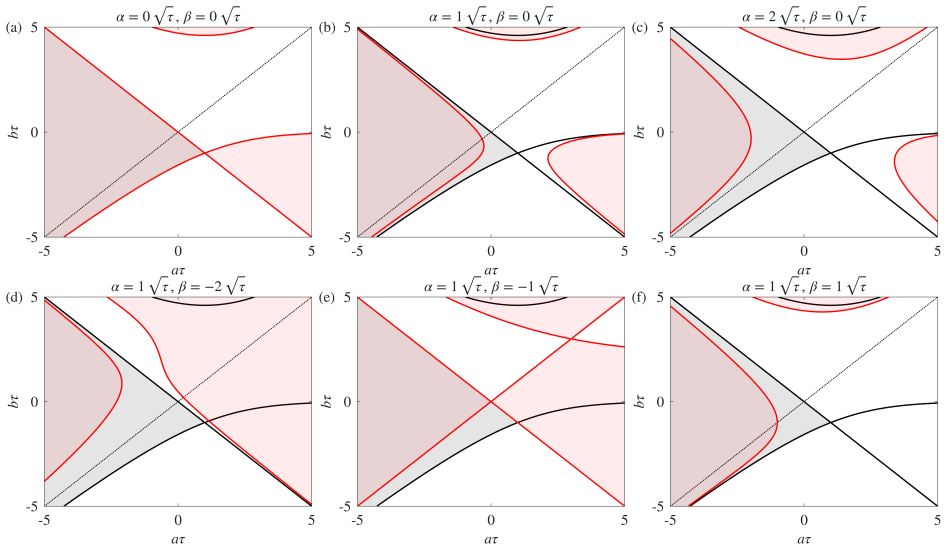
For linear time-invariant stochastic delay-differential equations with a single constant delay and both multiplicative and additive noise, second-moment stability boundaries are identified with the loss of uniqueness of stationary solutions to a reduced delay-differential boundary-value problem for a two-variable correlation function. This identification is motivated by the observation that stability is lost when a real eigenvalue of the discretization of the corresponding infinitesimal generator passes through the origin. The reduction begins with an advection-type boundary-value problem with non-local boundary conditions for a three-variable correlation function. The resulting algebraic eq
What carries the argument
The reduced delay-differential boundary-value problem for the two-variable correlation function, whose stationary solutions lose uniqueness exactly at the second-moment stability boundaries.
If this is right
- Second-moment stability boundaries become computable by applying parameter continuation directly to the discretization-free algebraic equality conditions.
- Computational effort scales only with the square of the system dimension rather than with a chosen discretization resolution.
- In the one-dimensional case the stability condition reduces to an explicit expression in elementary functions.
- The algebraic conditions can be used to test and clarify limitations of previously published stability criteria for the same class of equations.
Where Pith is reading between the lines
- The same reduction strategy could be examined for systems with multiple distinct delays if analogous correlation equations can be derived.
- The algebraic conditions supply a practical test that could be embedded inside optimization routines seeking parameter values that keep second moments stable.
- Higher-dimensional numerical implementations of the equality conditions could be benchmarked against existing discretization codes to quantify the scaling advantage beyond the low-dimensional examples already checked.
Load-bearing premise
Second-moment stability is lost precisely when a real eigenvalue of the discretized infinitesimal generator passes through the origin, which corresponds to non-uniqueness of stationary solutions to the reduced correlation boundary-value problem.
What would settle it
A Monte Carlo simulation of a concrete low-dimensional stochastic delay equation in which the algebraic condition predicts a stability boundary but the simulated second moments either remain bounded or diverge on the opposite side of the predicted curve.
Figures




read the original abstract
For linear, time-invariant stochastic delay-differential equations with a single constant delay and both multiplicative and additive noise, this paper derives optimal semi-analytic algebraic equality conditions that can be used to identify second-moment stability boundaries without the use of problem discretization. Successful validation against Monte Carlo simulations and published results for several low-dimensional models clarifies limitations of stability conditions proposed in the literature and demonstrates considerable savings in computational effort relative to discretization-based approaches. In particular, using the theory derived in this paper, second-moment stability boundaries are shown to be computable using parameter continuation techniques applied to discretization-free equality conditions that scale only with the square of the problem dimension. For the case of one-dimensional stochastic delay-differential equations, in particular, the analysis is entirely closed form with a stability condition expressed entirely in terms of elementary functions. These results are enabled by the derivation of an advection-type boundary-value problem with non-local boundary conditions for a three-variable correlation function followed by a reduction to a delay-differential boundary-value problem for a two-variable correlation function. For the former problem, observations regarding the spectral abscissa of the discretization of the corresponding infinitesimal generator, particularly that second-moment stability is lost when a real eigenvalue passes through the origin, motivate identification of second-moment stability boundaries with a loss of uniqueness of stationary solutions to the latter problem.
Editorial analysis
A structured set of objections, weighed in public.
Referee Report
Summary. The manuscript derives semi-analytic algebraic equality conditions for second-moment stability boundaries of linear time-invariant stochastic delay-differential equations with constant delay and both multiplicative and additive noise. It proceeds by deriving an advection-type BVP for a three-variable correlation function, reducing it to a delay-differential BVP for a two-variable correlation function, and identifying stability boundaries with parameter values at which the reduced BVP loses uniqueness of stationary solutions; this identification is motivated by the observation that, on a discretized infinitesimal generator, stability is lost precisely when a real eigenvalue crosses the origin. The resulting conditions are validated against Monte Carlo simulations and published results for low-dimensional models, with closed-form expressions available for the scalar case, and are shown to enable discretization-free parameter continuation that scales with the square of the system dimension.
Significance. If the central identification between stability loss and loss of uniqueness in the reduced BVP can be placed on a rigorous footing, the work supplies a scalable, discretization-free route to stability boundaries that improves computational cost relative to existing methods and clarifies limitations of prior algebraic conditions in the literature.
major comments (2)
- [Abstract] Abstract: the equivalence between second-moment stability boundaries and loss of uniqueness of stationary solutions to the reduced two-variable delay-differential BVP is motivated solely by the numerical observation that a real eigenvalue of the discretized infinitesimal generator crosses the origin; no direct spectral analysis of the continuous (infinite-dimensional) operator is supplied to show that other crossings (complex eigenvalues, essential spectrum) cannot produce instability without a real zero eigenvalue, nor is a rigorous passage-to-the-limit argument given that the discretized crossing implies the continuous one.
- [Abstract] Abstract: because the algebraic conditions are obtained exactly by imposing the non-uniqueness condition on the reduced BVP, the absence of a continuous-operator justification for the identification directly undermines the claim that the resulting equalities locate the true stability boundaries.
Simulated Author's Rebuttal
We thank the referee for the careful reading and for highlighting the need for greater rigor in the central identification of our work. We respond to the major comments point by point below.
read point-by-point responses
-
Referee: [Abstract] Abstract: the equivalence between second-moment stability boundaries and loss of uniqueness of stationary solutions to the reduced two-variable delay-differential BVP is motivated solely by the numerical observation that a real eigenvalue of the discretized infinitesimal generator crosses the origin; no direct spectral analysis of the continuous (infinite-dimensional) operator is supplied to show that other crossings (complex eigenvalues, essential spectrum) cannot produce instability without a real zero eigenvalue, nor is a rigorous passage-to-the-limit argument given that the discretized crossing implies the continuous one.
Authors: We agree that the identification is motivated by the observed crossing of a real eigenvalue through the origin in the discretized generator and that no direct spectral analysis of the continuous operator (addressing complex eigenvalues or essential spectrum) or passage-to-the-limit argument is provided. In the revised manuscript we have added explicit language in the abstract and introduction stating that the algebraic conditions rest on this numerically motivated identification, and we have inserted a brief discussion of why other crossings are not expected on the basis of the structure of the correlation equations. A complete operator-theoretic proof lies beyond the present scope. revision: partial
-
Referee: [Abstract] Abstract: because the algebraic conditions are obtained exactly by imposing the non-uniqueness condition on the reduced BVP, the absence of a continuous-operator justification for the identification directly undermines the claim that the resulting equalities locate the true stability boundaries.
Authors: The referee is correct that, without a rigorous continuous-operator justification, the derived equalities locate the stability boundaries only under the stated identification. We have revised the abstract to describe the conditions as those obtained by imposing non-uniqueness on the reduced BVP under the identification supported by discretization evidence and low-dimensional validation, rather than asserting an unconditional equivalence. The computational advantages and empirical agreement with Monte Carlo simulations remain as reported. revision: partial
- A rigorous spectral analysis of the continuous infinite-dimensional operator establishing that stability loss occurs precisely when a real eigenvalue crosses the origin, together with a passage-to-the-limit argument from the discretized to the continuous setting.
Circularity Check
No circularity; algebraic conditions derived directly from BVP non-uniqueness without reduction to inputs by construction
full rationale
The paper reduces the three-variable correlation-function BVP to a two-variable delay-differential BVP and obtains the algebraic equality conditions by imposing the non-uniqueness condition on stationary solutions of the reduced problem. This derivation step is independent of the target stability data and is not shown to be tautological or statistically forced. The identification of stability boundaries with loss of uniqueness is motivated by a discretization observation, but that motivation is external to the algebraic derivation itself and does not create a self-definitional or fitted-input loop. No load-bearing self-citation, uniqueness theorem imported from the authors, or ansatz smuggled via citation is indicated. The chain from BVP to algebraic conditions is therefore self-contained.
Axiom & Free-Parameter Ledger
Reference graph
Works this paper leans on
-
[1]
Traffic jams: dynamics and control, 2010
Gábor Orosz, R Eddie Wilson, and Gábor Stépán. Traffic jams: dynamics and control, 2010
work page 2010
-
[2]
Chatter suppression techniques in metal cutting.CIRP annals, 65(2):785–808, 2016
Jokin Munoa, Xavier Beudaert, Z Dombovari, Yusuf Altintas, Erhan Budak, Christian Brecher, and Ga- bor Stepan. Chatter suppression techniques in metal cutting.CIRP annals, 65(2):785–808, 2016
work page 2016
-
[3]
David S Glass, Xiaofan Jin, and Ingmar H Riedel- Kruse. Nonlinear delay differential equations and 21 their application to modeling biological network motifs.Nature communications, 12(1):1788, 2021
work page 2021
-
[4]
Wim Michiels, Tomáš Vyhlídal, and Pavel Zítek. Control design for time-delay systems based on quasi-direct pole placement.Journal of Process Control, 20(3):337–343, 2010
work page 2010
-
[5]
Henrik T Sykora, Mehdi Sadeghpour, Jin I Ge, Dániel Bachrathy, and Gábor Orosz. On the mo- ment dynamics of stochastically delayed linear con- trol systems.International Journal of Robust and Nonlinear Control, 30(18):8074–8097, 2020
work page 2020
-
[6]
Gerg ˝o Fodor, Henrik T Sykora, and Daniel Bachrathy. Stochastic modeling of the cutting force in turning processes.The International Journal of Advanced Manufacturing Technology, 111(1):213– 226, 2020
work page 2020
-
[7]
Oluwatosin Babasola, Evans Otieno Omondi, Kay- ode Oshinubi, and Nancy Matendechere Imbusi. Stochastic delay differential equations: a compre- hensive approach for understanding biosystems with application to disease modelling.AppliedMath, 3(4):702–721, 2023
work page 2023
-
[8]
Yong-Ge Yang, Li-Li He, Yuan-Hui Zeng, Ya-Hui Sun, and Wei Xu. Stochastic analysis of a time- delayed viscoelastic energy harvester subjected to narrow-band noise.International Journal of Non- Linear Mechanics, 147:104230, 2022
work page 2022
-
[9]
TD Frank and PJ Beek. Stationary solutions of lin- ear stochastic delay differential equations: Appli- cations to biological systems.Physical Review E, 64(2):021917, 2001
work page 2001
-
[10]
Henrik T Sykora, Daniel Bachrathy, and Gabor Stepan. Stochastic semi-discretization for linear stochastic delay differential equations.Interna- tional Journal for Numerical Methods in Engineer- ing, 119(9):879–898, 2019
work page 2019
-
[11]
Gerg ˝o Fodor, Henrik T Sykora, and Dániel Bachrathy. Collocation method for stochastic de- lay differential equations.Probabilistic Engineering Mechanics, 74:103515, 2023
work page 2023
-
[12]
Alexandre René and André Longtin. Mean, co- variance, and effective dimension of stochastic dis- tributed delay dynamics.Chaos: An Interdisci- plinary Journal of Nonlinear Science, 27(11), 2017
work page 2017
-
[13]
Zhen Wang, Xiong Li, and Jinzhi Lei. Moment boundedness of linear stochastic delay differen- tial equations with distributed delay.Stochastic Processes and their Applications, 124(1):586–612, 2014
work page 2014
-
[14]
R Kuske. Competition of noise sources in systems with delay: the role of multiple time scales.Journal of Vibration and Control, 16(7-8):983–1003, 2010
work page 2010
-
[15]
Delayed stochastic systems.Physical Review E, 61(2):1247, 2000
Toru Ohira and Toshiyuki Yamane. Delayed stochastic systems.Physical Review E, 61(2):1247, 2000
work page 2000
-
[16]
Christopher Rackauckas and Qing Nie. Differ- entialequations. jl–a performant and feature-rich ecosystem for solving differential equations in julia. 2017
work page 2017
-
[17]
Desmond J Higham. An algorithmic introduction to numerical simulation of stochastic differential equa- tions.SIAM review, 43(3):525–546, 2001
work page 2001
-
[18]
Stochastic differential equations
Bernt Øksendal. Stochastic differential equations. InStochastic differential equations: an introduction with applications, pages 38–50. Springer, 2003
work page 2003
-
[19]
Jian-Qiao Sun.Stochastic dynamics and control, volume 4. Elsevier, 2006
work page 2006
-
[20]
Shahab Torkamani, Ehsan Samiei, Oleg Bobrenkov, and Eric A Butcher. Numerical stability analysis of linear stochastic delay differential equations us- ing chebyshev spectral continuous time approxima- tion.International Journal of Dynamics and Con- trol, 2(2):210–220, 2014
work page 2014
-
[21]
Xuerong Mao. Robustness of stability of nonlinear systems with stochastic delay perturbations.Systems &control letters, 19(5):391–400, 1992
work page 1992
-
[22]
Osman Tunç and Cemil Tunç. On the asymptotic stability of solutions of stochastic differential delay equations of second order.Journal of Taibah Uni- versity for Science, 13(1):875–882, 2019. 22
work page 2019
-
[23]
Leonid Shaikhet. About one method of stability in- vestigation for nonlinear stochastic delay differential equations.International Journal of Robust and Non- linear Control, 31(8):2946–2959, 2021
work page 2021
-
[24]
Ehsan Samiei, Shahab Torkamani, and Eric A Butcher. On lyapunov stability of scalar stochas- tic time-delayed systems.International Journal of Dynamics and Control, 1(1):64–80, 2013
work page 2013
-
[25]
Asymptotic and exponential decay in mean square for delay geometric brownian motion
Jan Haškovec. Asymptotic and exponential decay in mean square for delay geometric brownian motion. Applications of Mathematics, 67(4):471–483, 2022
work page 2022
-
[26]
John Appleby, Xuerong Mao, and Markus Riedle. Geometric brownian motion with delay: Mean square characterisation.Proceedings of the Amer- ican Mathematical Society, 137(1):339–348, 2009
work page 2009
-
[27]
Xuerong Mao.Stochastic differential equations and applications. Elsevier, 2007
work page 2007
-
[28]
Springer Sci- ence & Business Media, 2011
Tamás Insperger and Gábor Stépán.Semi- discretization for time-delay systems: stability and engineering applications, volume 178. Springer Sci- ence & Business Media, 2011
work page 2011
-
[29]
Dimitri Breda, Stefano Maset, and Rossana Ver- miglio.Stability of linear delay differential equations: A numerical approach with MATLAB. Springer, 2014
work page 2014
-
[30]
V Novi ˇcenko and K Pyragas. Phase reduction of weakly perturbed limit cycle oscillations in time- delay systems.Physica D: Nonlinear Phenomena, 241(12):1090–1098, 2012
work page 2012
-
[31]
Springer Science & Business Media, 2013
Jack K Hale and Sjoerd M Verduyn Lunel.Introduc- tion to functional differential equations, volume 99. Springer Science & Business Media, 2013
work page 2013
-
[32]
N.D. Hayes. Roots of the transcendental equa- tion associated with a certain difference-differential equation.Journal of the London Mathematical So- ciety, 1(3):226–232, 1950
work page 1950
-
[33]
Charles R Doering. Modeling complex systems: stochastic processes, stochastic differential equa- tions, and fokker-planck equations. In1990 Lectures in Complex Systems, pages 3–52. CRC Press, 2018
work page 2018
-
[34]
Michael C Mackey and Irina G Nechaeva. Solu- tion moment stability in stochastic differential delay equations.Physical Review E, 52(4):3366, 1995
work page 1995
-
[35]
Evelyn Buckwar and Girolama Notarangelo. A note on the analysis of asymptotic mean-square stability properties for systems of linear stochastic delay dif- ferential equations.Discrete&Continuous Dynam- ical Systems-Series B, 18(6), 2013
work page 2013
-
[36]
John Milton and Toru Ohira.Mathematics as a lab- oratory tool. Springer, 2021
work page 2021
- [37]
-
[38]
Positive operators and an inertia theorem
Hans Schneider. Positive operators and an inertia theorem. 7:11–17., 1965
work page 1965
-
[39]
Sai Pushpak Nandanoori, Amit Diwadkar, and Umesh Vaidya. Mean square stability analysis of stochastic continuous-time linear networked sys- tems.IEEE Transactions on Automatic Control, 63(12):4323–4330, 2018
work page 2018
-
[40]
Roger G Ghanem and Pol D Spanos.Stochastic fi- nite elements: a spectral approach. Courier Corpo- ration, 2003
work page 2003
-
[41]
Christopher KI Williams and Carl Edward Ras- mussen.Gaussian processes for machine learning, volume 2. MIT press Cambridge, MA, 2006
work page 2006
-
[42]
Peter H Baxendale and Sergey V Lototsky.Stochas- tic differential equations: theory and applications, volume 2. World Scientific, 2007
work page 2007
-
[43]
Desmond J Higham. Mean-square and asymptotic stability of the stochastic theta method.SIAM jour- nal on numerical analysis, 38(3):753–769, 2000
work page 2000
-
[44]
A cucker–smale model with noise and delay.SIAM Journal on Applied Mathematics, 76(4):1535–1557, 2016
Radek Erban, Jan Haskovec, and Yongzheng Sun. A cucker–smale model with noise and delay.SIAM Journal on Applied Mathematics, 76(4):1535–1557, 2016
work page 2016
-
[45]
Harry Dankowicz and Frank Schilder.Recipes for continuation. SIAM, 2013. 23
work page 2013
-
[46]
Harry Dankowicz, Yuqing Wang, Frank Schilder, and Michael E Henderson. Multidimensional mani- fold continuation for adaptive boundary-value prob- lems.Journal of Computational and Nonlinear Dy- namics, 15(5):051002, 2020
work page 2020
-
[47]
Gerg ˝o Fodor and Dániel Bachrathy. Efficient ap- proximation of stochastic turning process based on power spectral density.The International Journal of Advanced Manufacturing Technology, 133(11):5673–5681, 2024. Appendix A. Discretization of the correlation boundary-value problem We considered in Sec. 2.5 the discretization of the co- variance boundary-v...
work page 2024
discussion (0)
Sign in with ORCID, Apple, or X to comment. Anyone can read and Pith papers without signing in.