REVIEW 3 minor 28 references
A Nyström discretization with FFT-evaluated modal Green's functions solves acoustic scattering by many quasi-axisymmetric objects.
Reviewed by Pith at T0; open to challenge. T0 means a machine referee read the full paper against a public rubric. the ladder, T0–T4 →
T0 review · grok-4.3
2026-07-01 04:41 UTC pith:VYK6BIWH
load-bearing objection A targeted Nyström-FFT method for scattering from many quasi-axisymmetric bodies that looks workable and scales to 1000 objects.
A Spectral Solver for Acoustic Scattering by Multiple Quasi-Axisymmetric Structures
The pith
A machine-rendered reading of the paper's core claim, the machinery that carries it, and where it could break.
Core claim
We develop a fast and highly accurate algorithm for acoustic scattering by multiple quasi-axisymmetric objects, whose axis of rotation is an arbitrary curve. The method is based on a Nyström discretization that combines Gauss-Legendre quadrature with the trapezoidal rule. To treat the singular integrals that occur when target points are close to or coincide with source points, we reformulate them as evaluations of the modal Green's function and its derivatives, which are computed efficiently using the fast Fourier transform and convolution. The multiple scattering solver is then constructed by coupling the single scatterer discretizations through inter-body boundary integral interactions. We
What carries the argument
Nyström discretization of boundary integral equations combined with modal Green's functions computed via fast Fourier transform and convolution.
Load-bearing premise
The geometries are smooth and quasi-axisymmetric so that singular integrals reduce to modal Green's functions computable by FFT.
What would settle it
A numerical experiment on a single smooth sphere with a known exact analytical scattering solution; if the computed error does not decrease at the expected rate as the number of quadrature points increases, the accuracy and convergence claims would fail.
If this is right
- The solver efficiently handles multiple scattering problems involving up to 1000 quasi-axisymmetric structures.
- High accuracy is achieved through spectral convergence of the quadrature rules when the surfaces are smooth.
- Inter-body boundary integral interactions are incorporated by direct coupling of the single-scatterer discretizations.
- The method applies to acoustic problems arising in medical imaging, geophysical exploration, and acoustic metamaterials.
Where Pith is reading between the lines
- The modal reduction via FFT could be adapted to electromagnetic scattering or other linear wave problems that share the same axisymmetry.
- For collections of objects that are not perfectly quasi-axisymmetric, the same framework might still provide a good preconditioner or initial approximation.
- The convolution structure suggests that the method could be combined with fast multipole or tree-based accelerators for even larger numbers of scatterers.
- Extending the solver to broadband or time-domain problems would require repeating the frequency-domain solve at multiple frequencies while reusing the modal Green's function infrastructure.
Editorial analysis
A structured set of objections, weighed in public.
Referee Report
Summary. The manuscript develops a Nyström discretization for acoustic scattering by multiple quasi-axisymmetric objects (axis of rotation an arbitrary curve), combining Gauss-Legendre quadrature with the trapezoidal rule. Singular integrals are reformulated as modal Green's functions and derivatives, computed via FFT and convolution. Single-body discretizations are coupled through inter-body boundary integral interactions to solve the multiple-scattering system. A convergence analysis is presented for smooth geometries, and numerical examples demonstrate efficiency and accuracy for problems with up to 1000 such structures.
Significance. If the convergence analysis and numerical results hold, the approach offers a computationally efficient spectral method for a practically relevant class of multiple-scattering problems in acoustics. The FFT reduction of singular integrals exploiting quasi-axisymmetry and the direct coupling strategy are strengths that could enable scaling to large numbers of bodies, with potential impact in applications such as medical imaging and acoustic metamaterials. The explicit convergence statement and large-scale tests add value.
minor comments (3)
- The description of the modal Green's function computation via FFT and convolution (mentioned in the abstract and method) would benefit from an explicit statement of the convolution theorem application and any aliasing controls, to make the implementation fully reproducible from the text.
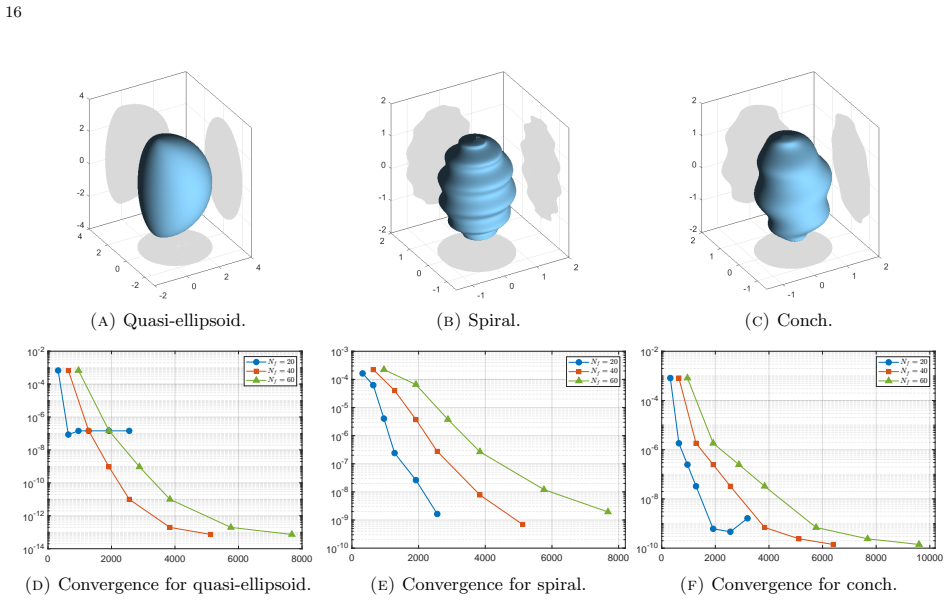
- In the numerical examples section, convergence plots or tables should report observed rates alongside the theoretical predictions from the analysis, with explicit mention of the smoothness assumptions used in each test case.
- Notation for the inter-body interaction operators and the overall system matrix should be introduced with a clear diagram or equation block early in the multiple-scattering section to aid readability.
Simulated Author's Rebuttal
We thank the referee for their positive evaluation of the manuscript, accurate summary of the method, and recommendation of minor revision. The significance assessment correctly identifies the strengths of the FFT-based modal Green's function approach and the scaling to 1000 bodies. No major comments were provided in the report.
Circularity Check
No significant circularity
full rationale
The paper presents a Nyström discretization combining Gauss-Legendre quadrature and the trapezoidal rule for quasi-axisymmetric scatterers, reformulates singular integrals as modal Green's functions evaluated via FFT and convolution, then couples the resulting single-body systems through inter-body boundary integrals. Convergence analysis is stated only for smooth geometries, with numerical validation on up to 1000 bodies. No derivation step reduces a claimed prediction or uniqueness result to a fitted parameter, self-citation, or ansatz imported from the authors' prior work; the central algorithm is a direct discretization and coupling construction whose correctness is checked externally by the supplied numerical examples.
Axiom & Free-Parameter Ledger
axioms (1)
- domain assumption Geometries are smooth
read the original abstract
Acoustic scattering arises in a wide range of applications, including medical imaging, geophysical exploration, acoustic metamaterials, etc. In this paper, we develop a fast and highly accurate algorithm for acoustic scattering by multiple quasi-axisymmetric objects, whose axis of rotation is an arbitrary curve. The method is based on a Nystr\"om discretization that combines Gauss-Legendre quadrature with the trapezoidal rule. To treat the singular integrals that occur when target points are close to or coincide with source points, we reformulate them as evaluations of the modal Green's function and its derivatives, which are computed efficiently using the fast Fourier transform and convolution. The multiple scattering solver is then constructed by coupling the single scatterer discretizations through inter-body boundary integral interactions. We also present a convergence analysis for scattering problems with smooth geometries. Numerical examples demonstrate the efficiency and accuracy of the proposed method for solving multiple scattering problems involving up to 1000 quasi-axisymmetric structures.
Figures




Reference graph
Works this paper leans on
-
[1]
National Bureau of Standards, Washington, DC (1964)
Abramowitz, M., Stegun, I.A.: Handbook of Mathematical Functions with Formulas, Graphs, and Mathematical Tables. National Bureau of Standards, Washington, DC (1964)
1964
-
[2]
Bremer, J., Gimbutas, Z.: A Nystr¨ om method for weakly singular integral operators on surfaces. J. Comput. Phys. 231(14), 4885–4903 (2012)
2012
-
[3]
Bremer, J., Gimbutas, Z., Rokhlin, V.: A nonlinear optimization procedure for generalized Gaussian quadratures. SIAM J. Sci. Comput. 32(4), 1761–1788 (2010)
2010
-
[4]
ESAIM Math
Chernov, A., von Petersdorff, T., Schwab, C.: Exponential convergence of hp quadrature for integral operators with Gevrey kernels. ESAIM Math. Model. Numer. Anal. 45(3), 387–422 (2011)
2011
-
[5]
and Kress, R.: Integral Equation Method in Scattering Theory
Colton, D. and Kress, R.: Integral Equation Method in Scattering Theory. Wiley-Interscience, New York (1983)
1983
-
[6]
(eds.): Acoustic Metamaterials: Negative Refraction, Imaging, Lensing and Cloaking
Craster, R.V., Guenneau, S. (eds.): Acoustic Metamaterials: Negative Refraction, Imaging, Lensing and Cloaking. Springer, Dordrecht (2013)
2013
-
[7]
Fleming, J.L., Wood, A.W., Wood, W.D.: Locally corrected Nystr¨ om method for EM scattering by bodies of revolution. J. Comput. Phys. 196(1), 41–52 (2004)
2004
-
[8]
Ganesh, M., Hawkins, S.C.: A high-order algorithm for multiple electromagnetic scattering in three dimensions. Numer. Algorithms 50(4), 469–510 (2009)
2009
-
[9]
Garritano, J., Kluger, Y., Rokhlin, V., Serkh, K.: On the efficient evaluation of the azimuthal Fourier components of the Green’s function for Helmholtz’s equation in cylindrical coordinates. J. Comput. Phys. 471, 11585 (2022)
2022
-
[10]
Gimbutas, Z., Greengard, L.: Fast multi-particle scattering: a hybrid solver for the Maxwell equations in mi- crostructured materials. J. Comput. Phys. 232, 22–32 (2013)
2013
-
[11]
V.: A fast algorithm for particle simulations
Greengard, L., Rokhlin. V.: A fast algorithm for particle simulations. J. Comput. Phys. 73(2), 325-348, (1987)
1987
-
[12]
Helsing, J., Karlsson, A.: An explicit kernel-split panel-based Nystr¨ om scheme for integral equations on axially symmetric surfaces. J. Comput. Phys. 272, 686–703 (2014)
2014
-
[13]
SIAM Rev
Kleinman, R.E., Roach, G.F.: Boundary integral equations for the three-dimensional Helmholtz equation. SIAM Rev. 16(2), 214–236 (1974)
1974
-
[14]
Springer, New York (2014)
Kress, R.: Linear Integral Equations, 3rd edn. Springer, New York (2014)
2014
-
[15]
J., Dong, H.: A fast solver for elastic scattering from axisymmetric objects by boundary integral equations
Lai. J., Dong, H.: A fast solver for elastic scattering from axisymmetric objects by boundary integral equations. Adv. Comput. Math. 48(20), (2022)
2022
-
[16]
Lai, J., Kobayashi, M., Barnett, A.: A fast and robust solver for the scattering from a layered periodic structure containing multi-particle inclusions. J. Comput. Phys. 298, 194–208 (2015)
2015
-
[17]
Lai, J., Kobayashi, M., Greengard, L.: A fast solver for multi-particle scattering in a layered medium. Opt. Express 22(17), 20481–20499 (2014)
2014
-
[18]
Lai, J., O’Neil, M.: An FFT-accelerated direct solver for electromagnetic scattering from penetrable axisymmetric objects. J. Comput. Phys. 390, 152–174 (2019)
2019
-
[19]
Inverse Probl
Lai, J., Zhang, J.: Fast inverse elastic scattering of multiple particles in three dimensions. Inverse Probl. 38(10), 104002 (2022)
2022
-
[20]
Liu, Y., Barnett, A.H.: Efficient numerical solution of acoustic scattering from doubly-periodic arrays of axisym- metric objects. J. Comput. Phys. 324, 226–245 (2016)
2016
-
[21]
Malhotra D, Barnett A.H.: Efficient convergent boundary integral methods for slender bodies. J. Comput. Phys. 503, 112855 (2024)
2024
-
[22]
Cambridge University Press, Cambridge (2006)
Martin, P.A.: Multiple Scattering: Interaction of Time-Harmonic Waves with N Obstacles. Cambridge University Press, Cambridge (2006)
2006
-
[23]
IEEE Trans
Medgyesi-Mitschang, L., Putnam, J.: Electromagnetic scattering from axially inhomogeneous bodies of revolution. IEEE Trans. Antennas Propag. 32(8), 797–806 (1984) 23
1984
-
[24]
IEEE Trans
Morgan, M., Mei, K.: Finite-element computation of scattering by inhomogeneous penetrable bodies of revolution. IEEE Trans. Antennas Propag. 27(2), 202–214 (1979)
1979
-
[25]
Soenarko, B.: A boundary element formulation for radiation of acoustic waves from axisymmetric bodies with arbitrary boundary conditions. J. Acoust. Soc. Am. 93(2), 631–639 (1993)
1993
-
[26]
50(1), 67–87 (2008)
Trefethen, L.N.: Is Gauss quadrature better than Clenshaw–Curtis? SIAM Rev. 50(1), 67–87 (2008)
2008
-
[27]
Young, P., Hao, S., Martinsson, P.G.: A high-order Nystr¨ om discretization scheme for boundary integral equations defined on rotationally symmetric surfaces. J. Comput. Phys. 231(11), 4142–4159 (2012)
2012
-
[28]
Zhang, S., Xia, C., Fang, N.: Broadband acoustic cloak for ultrasound waves. Phys. Rev. Lett. 106(2), 024301 (2011) School of Mathematical Sciences, Zhejiang University, Hangzhou, Zhejiang 310027, China, and Cen- ter for Interdisciplinary Applied Mathematics, Zhejiang University, Hangzhou, Zhejiang 310027, China Email address:laijun6@zju.edu.cn School of ...
2011
discussion (0)
Sign in with ORCID, Apple, or X to comment. Anyone can read and Pith papers without signing in.