Paper Fortune Tellers in Julia sets of Generalized McMullen maps II: Sidecars and Zippers
Pith reviewed 2026-06-30 00:27 UTC · model grok-4.3
The pith
Generalized McMullen maps admit hyperbolic Julia sets containing homeomorphic copies of rabbit, aeroplane, or Kokopelli quadratic Julia sets.
A machine-rendered reading of the paper's core claim, the machinery that carries it, and where it could break.
Core claim
The combinatorial model and ray-landing identifications developed for the basilica case extend directly to rabbit, aeroplane, and Kokopelli cases, yielding hyperbolic Julia sets of Generalized McMullen maps that contain infinitely many homeomorphic copies of these quadratic Julia sets, with the c-value taken from any bulb attached to the main cardioid of the Mandelbrot set or from the main cardioid of any principal baby Mandelbrot set.
What carries the argument
The combinatorial model of Julia sets containing infinitely many homeomorphic copies of a chosen quadratic Julia set, realized by an algorithm that changes a finite number of pairs of external ray landing point identifications starting from the basilica or its generalizations.
If this is right
- Hyperbolic components exist in parameter space for each such baby quadratic type.
- The Julia sets contain the additional sidecar and zipper structures described by the same finite-modification algorithm.
- Infinitely many distinct homeomorphic copies appear for each admissible c-value without further restrictions.
- The classification covers all principal baby Mandelbrot sets attached to the main cardioid.
Where Pith is reading between the lines
- The same extension technique may apply to still other quadratic Julia sets not covered in this catalog.
- The pattern suggests a uniform description of all hyperbolic components whose baby sets arise from principal Mandelbrot copies.
- Explicit parameter bounds or pictures of the new components could be computed directly from the ray identifications.
Load-bearing premise
The combinatorial model and ray-landing identifications developed for the basilica case extend directly to rabbit, aeroplane, and Kokopelli cases without requiring new conditions or renormalizations.
What would settle it
A concrete parameter pair (a, b) for which the baby Julia set is a rabbit but the predicted ray-landing pattern fails to produce the expected homeomorphic copies inside the Generalized McMullen Julia set.
Figures

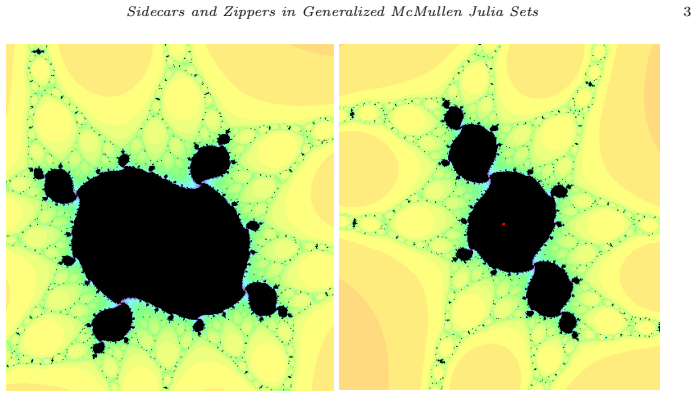


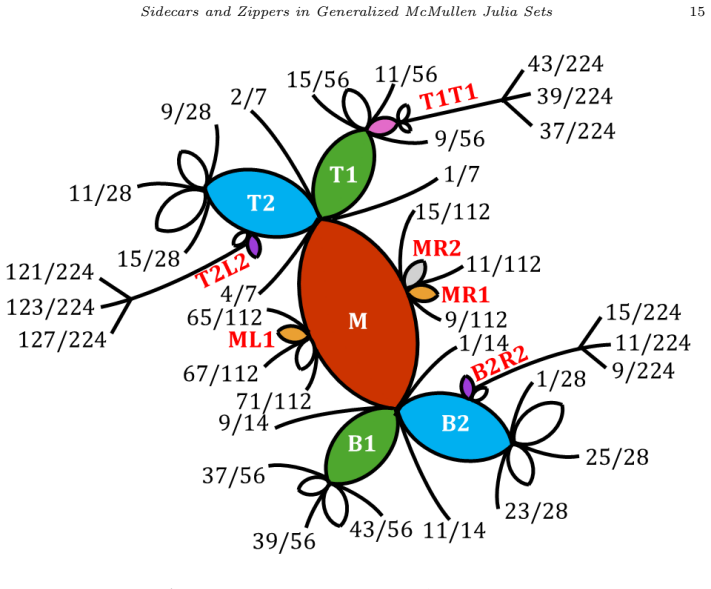


read the original abstract
We study the family of complex rational functions known as Generalized McMullen maps, F(z) = z^n + a/z^n+b, for integer n at least 3 fixed, and complex parameters a, b with a nonzero. In prior work by the same authors, we provided a combinatorial model for a large class of maps whose Julia sets contain both infinitely many homeomorphic copies of quadratic Julia sets conjugate to the ``basilica'', and infinitely many subsets homeomorphic to a set which is obtained by starting with the basilica, then changing a finite number of pairs of external ray landing point identifications, following an algorithm we described. In this article, we generalize beyond the basilica, and provide a catalog of additional types of hyperbolic Julia sets of Generalized McMullen maps, where the ``baby'' Julia set can be any rabbit, aeroplane, or Kokopelli quadratic Julia set; that is, where the c-value can be taken from any bulb attached to the main cardioid of the Mandelbrot set, or from the main cardioid of any principal baby Mandelbrot set (no renormalizations).
Editorial analysis
A structured set of objections, weighed in public.
Referee Report
Summary. The paper extends prior combinatorial models for Julia sets of the family F(z) = z^n + a/z^n + b (n ≥ 3) from the basilica case to hyperbolic components whose 'baby' Julia sets are rabbits, aeroplanes, or Kokopelli quadratics (c-values from bulbs off the main cardioid or principal baby Mandelbrot sets, without renormalizations). It catalogs additional types via sidecar and zipper constructions that modify external-ray landing identifications according to an algorithm.
Significance. If the direct extension of the ray-landing model holds, the work supplies a broader catalog of hyperbolic Julia-set types for Generalized McMullen maps, linking them to a range of quadratic combinatorial models beyond the basilica. This strengthens the combinatorial approach to these rational maps by showing that the sidecar/zipper framework transfers to different periodic-cycle structures.
major comments (2)
- [Introduction / combinatorial model section] The central claim that the basilica ray-landing identifications and sidecar/zipper constructions extend verbatim to rabbit (period-3), aeroplane, and Kokopelli cases requires explicit verification that the new periodic points do not alter landing pairings or impose additional combinatorial constraints; the abstract and prior-work reference provide no such check.
- [Section describing rabbit/aeroplane/Kokopelli extensions] The assumption of 'no renormalizations' for c-values from principal baby Mandelbrot sets needs a concrete argument that the external-ray pairings remain compatible with the higher-period cycles without introducing new periodic-cycle conditions.
minor comments (2)
- Clarify the precise statement of the algorithm for changing ray-landing identifications when moving from basilica to the new cases.
- Add a table or diagram summarizing which quadratic types are covered and which are excluded.
Simulated Author's Rebuttal
We thank the referee for the careful reading and the recommendation for major revision. We address each major comment below, indicating the revisions we will make to clarify the combinatorial extensions.
read point-by-point responses
-
Referee: [Introduction / combinatorial model section] The central claim that the basilica ray-landing identifications and sidecar/zipper constructions extend verbatim to rabbit (period-3), aeroplane, and Kokopelli cases requires explicit verification that the new periodic points do not alter landing pairings or impose additional combinatorial constraints; the abstract and prior-work reference provide no such check.
Authors: The full manuscript verifies the extension in the sections on rabbit, aeroplane, and Kokopelli cases by showing that the sidecar and zipper algorithms operate on the local external-ray landing data of the chosen quadratic model and are independent of the specific period of the attracting cycle. The new periodic points are incorporated directly via the choice of the quadratic Julia set (rabbit, aeroplane, or Kokopelli) without altering the global pairing rules. We agree, however, that the introduction would benefit from an explicit statement of this independence, and we will add a short paragraph outlining the verification. revision: partial
-
Referee: [Section describing rabbit/aeroplane/Kokopelli extensions] The assumption of 'no renormalizations' for c-values from principal baby Mandelbrot sets needs a concrete argument that the external-ray pairings remain compatible with the higher-period cycles without introducing new periodic-cycle conditions.
Authors: The no-renormalization condition is used to ensure that the baby Julia sets are obtained directly from the quadratic parameter without iterated renormalization, so that the external-ray identifications follow the quadratic combinatorics exactly. We will strengthen the relevant section by adding an explicit argument that the higher-period cycles do not impose additional constraints: the ray pairings are fixed by the internal address of the hyperbolic component, and the sidecar/zipper modifications act only on a finite set of rays that remain compatible under the higher-period dynamics. revision: yes
Circularity Check
Minor self-citation to basilica model; generalization to rabbit/aeroplane/Kokopelli cases remains independent
full rationale
The paper cites its own prior work for the basilica combinatorial model and ray-landing identifications, then states that these extend directly to other quadratic Julia sets (rabbit, aeroplane, Kokopelli) with c-values from Mandelbrot bulbs or principal baby Mandelbrot sets, without renormalizations. This is a standard self-citation for background but is not load-bearing: the present article claims to provide the catalog of additional types and the generalization itself. No equations or steps reduce by construction to fitted parameters, self-definitions, or a chain of unverified self-citations. The derivation builds on external standard combinatorial descriptions of quadratic Julia sets rather than renaming or smuggling its own inputs. Score remains low (2) as one minor self-citation that does not force the central claim.
Axiom & Free-Parameter Ledger
Reference graph
Works this paper leans on
-
[1]
Suzanne Boyd and Kelsey Brouwer. Paper fortune tellers in the combinatorial dynamics of some generalized mcmullen maps with both critical orbits bounded. https://arxiv.org/abs/2501.07545, February 2025
-
[2]
Exploring baby julia sets in parameter space slices for generalized mcmullen maps
Suzanne Boyd, Kelsey Brouwer, and Matthew Hoeppner. Exploring baby julia sets in parameter space slices for generalized mcmullen maps. https://arxiv.org/abs/2512.06992, January 2026
-
[3]
Devaney, Antonio Garijo, and Elizabeth D
Paul Blanchard, Robert L. Devaney, Antonio Garijo, and Elizabeth D. Russell. A generalized version of the M c M ullen domain. Internat. J. Bifur. Chaos Appl. Sci. Engrg. , 18(8):2309--2318, 2008
2008
-
[4]
Baby M andelbrot sets and spines in some one-dimensional subspaces of the parameter space for generalized M c M ullen maps
Suzanne Boyd and Matthew Hoeppner. Baby M andelbrot sets and spines in some one-dimensional subspaces of the parameter space for generalized M c M ullen maps. Qual. Theory Dyn. Syst. , 24(4):Paper No. 157, 39, 2025
2025
-
[5]
Mitchell
Suzanne Boyd and Alexander J. Mitchell. The boundedness locus and baby M andelbrot sets for some generalized M c M ullen maps. Internat. J. Bifur. Chaos Appl. Sci. Engrg. , 33(9):Paper No. 2350107, 23, 2023
2023
-
[6]
Baby Julia Sets in Dynamical and Parameter Space for a Rational Family of Maps when Both Critical Orbits Are Bounded
Kelsey Brouwer. Baby Julia Sets in Dynamical and Parameter Space for a Rational Family of Maps when Both Critical Orbits Are Bounded . PhD thesis, University of Wisconsin-Milwaukee, 2025. Copyright - Database copyright ProQuest LLC; ProQuest does not claim copyright in the individual underlying works; Last updated - 2025-12-23
2025
-
[7]
Suzanne Boyd and Michael J. Schulz. Geometric limits of mandelbrot and julia sets under degree growth. International Journal of Bifurcations and Chaos , 22(12), 2012
2012
-
[8]
Robert L. Devaney. Baby M andelbrot sets adorned with halos in families of rational maps. In Complex dynamics , volume 396 of Contemp. Math. , pages 37--50. Amer. Math. Soc., Providence, RI, 2006
2006
-
[9]
Robert L. Devaney. Singular perturbations of complex polynomials. Bull. Amer. Math. Soc. (N.S.) , 50(3):391--429, 2013
2013
-
[10]
Devaney and Antonio Garijo
Robert L. Devaney and Antonio Garijo. Julia sets converging to the unit disk. Proc. Amer. Math. Soc. , 136(3):981--988, 2008
2008
-
[11]
On the dynamics of polynomial-like mappings
Adrien Douady and John Hamal Hubbard. On the dynamics of polynomial-like mappings. Ann. Sci. \'Ecole Norm. Sup. (4) , 18(2):287--343, 1985
1985
-
[12]
Devaney, Daniel M
Robert L. Devaney, Daniel M. Look, and David Uminsky. The escape trichotomy for singularly perturbed rational maps. Indiana Univ. Math. J. , 54(6):1621--1634, 2005
2005
-
[13]
HyeGyong Jang, YongNam So, and Sebastian M. Marotta. Generalized baby M andelbrot sets adorned with halos in families of rational maps. J. Difference Equ. Appl. , 23(3):503--520, 2017
2017
-
[14]
Kozma and Robert L
Robert T. Kozma and Robert L. Devaney. Julia sets converging to filled quadratic J ulia sets. Ergodic Theory Dynam. Systems , 34(1):171--184, 2014
2014
-
[15]
McMullen
Curtis T. McMullen. Automorphisms of rational maps. In Holomorphic functions and moduli, V ol.\ I ( B erkeley, CA , 1986) , volume 10 of Math. Sci. Res. Inst. Publ. , pages 31--60. Springer, New York, 1988
1986
-
[16]
Morsels of M andelbrot sets
Murali Meyer. Morsels of M andelbrot sets. Pi Mu Epsilon J. , 16(3):165--171, 2025
2025
-
[17]
Dynamics in One Complex Variable
John Milnor. Dynamics in One Complex Variable . Princeton University Press, 2006
2006
-
[18]
Resolving an error with path-tracing and a 2-to-1 mapping in a work of J ang, S o, and M arotta
Murali Meyer, Daniel Stoertz, and Mike Wang. Resolving an error with path-tracing and a 2-to-1 mapping in a work of J ang, S o, and M arotta. https://arxiv.org/abs/2508.18543, August 2025
-
[19]
On the dynamics of generalized M c M ullen maps
Yingqing Xiao, Weiyuan Qiu, and Yongcheng Yin. On the dynamics of generalized M c M ullen maps. Ergodic Theory Dynam. Systems , 34(6):2093--2112, 2014
2093
discussion (0)
Sign in with ORCID, Apple, or X to comment. Anyone can read and Pith papers without signing in.