Counterintuitive Magnetic Connectivity and Energetic Particle Flux Differences among Nearby Spacecraft During the 2023 February 24 Solar Energetic Particle Event
Pith reviewed 2026-06-28 11:21 UTC · model grok-4.3
The pith
Magnetic connections to different parts of a distorted CME shock explain why Solar Orbiter saw much higher SEP fluxes than Earth and STA in the 2023 February 24 event.
A machine-rendered reading of the paper's core claim, the machinery that carries it, and where it could break.
Core claim
The counterintuitive higher fluxes at Solar Orbiter result from its magnetic connection to the nose of the CME-driven shock, which has a higher compression ratio and more efficient particle acceleration, whereas Earth and STA connect to the weaker flank regions of the same distorted shock, even though the spacecraft are separated by less than 30 degrees in longitude.
What carries the argument
The inhomogeneous CME-driven shock with varying compression ratios across its nose and flanks, combined with magnetic footpoint mapping altered by a nearby stream interaction region.
Load-bearing premise
The global MHD simulation and particle transport model correctly reproduce the actual magnetic field connections and the shock's compression ratios at the times and locations of the spacecraft.
What would settle it
Direct measurements or independent modeling showing that the shock compression ratio at Solar Orbiter's connected region was not higher than at the others, or that the flux differences persist even with uniform connectivity.
Figures




read the original abstract
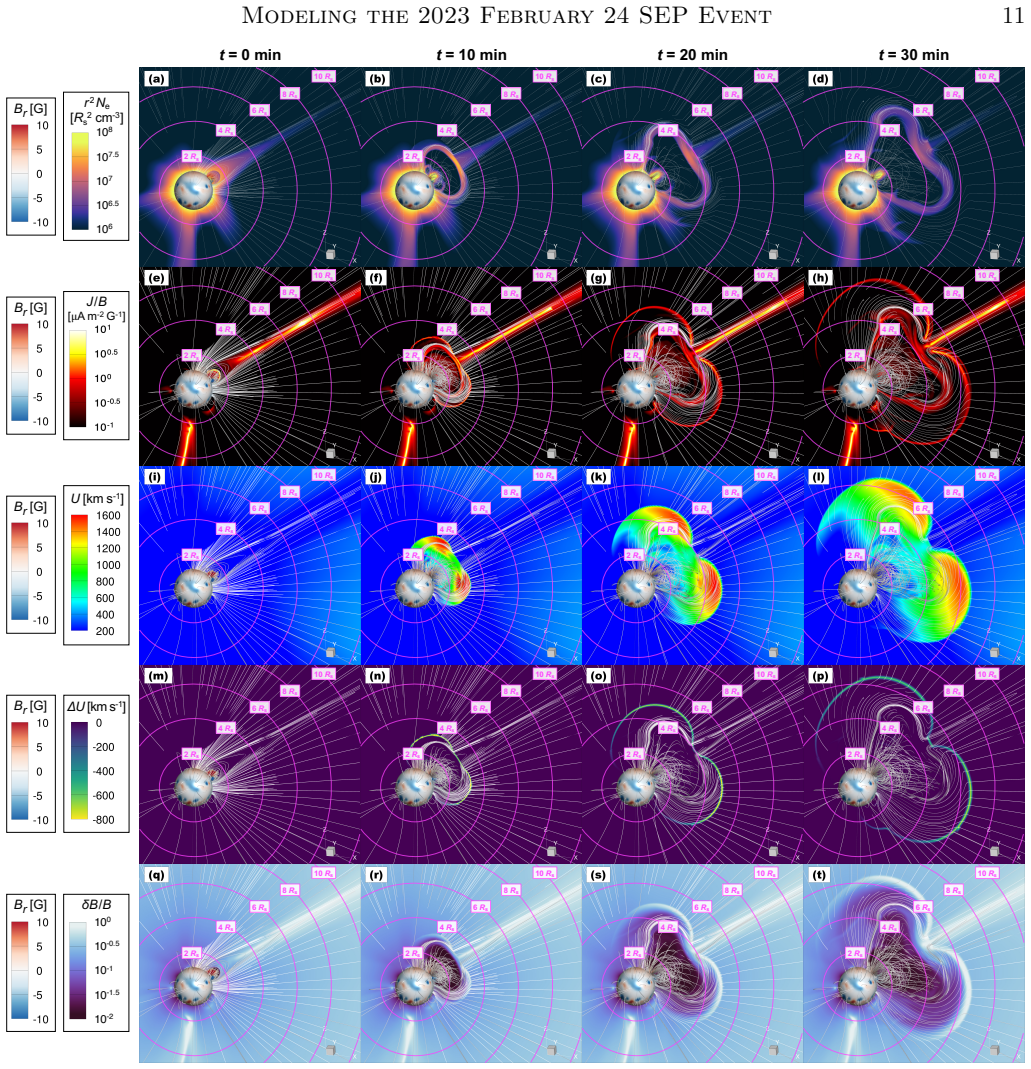
For solar energetic particles (SEPs), it is generally expected that observers magnetically closer to the eruption source region exhibit higher particle intensities than those poorly connected to the eruption site. However, the 2023 February 24 SEP event departs from this simple picture: Earth and STA, near 1 au, are nominally better connected to the source region, whereas Solar Orbiter (SolO), at 0.77 au but less favorably connected, observed SEP fluxes more than an order of magnitude higher. This difference cannot be simply explained by nominal magnetic connectivity or radial scaling of SEP fluxes alone. To investigate this behavior, we perform a global magnetohydrodynamic simulation of the associated coronal mass ejection (CME) using the Alfv\'{e}n Wave Solar-atmosphere Model-Realtime (AWSoM-R). The simulation reveals that the CME flux rope originates close to a coronal streamer and as it propagates and expands, the CME-driven shock is effectively distorted, developing into two distinct flanks with different strengths. Although the three spacecraft are separated by only $\lesssim$30$^{\circ}$ in heliolongitude, their magnetic footpoints differ by $\gtrsim$50$^{\circ}$ in longitude because of a nearby stream interaction region. Specifically, Earth and STA connect to a weaker shock region, while SolO connects to the shock nose with a higher compression ratio and more efficient particle acceleration. We further simulate SEPs using the Multiple-Field-Line Advection Model for Particle Acceleration (M-FLAMPA) coupled with AWSoM-R, obtaining results that reproduce the observed flux differences among the three spacecraft, demonstrating that this counterintuitive behavior results from their connections to different regions of the inhomogeneous CME-driven shock.
Editorial analysis
A structured set of objections, weighed in public.
Referee Report
Summary. The paper examines the 2023 February 24 SEP event in which SolO at 0.77 au observed fluxes more than an order of magnitude higher than Earth and STA despite nominally poorer magnetic connection to the source. AWSoM-R global MHD simulation of the CME shows that a nearby stream interaction region shifts the spacecraft footpoints by ≳50° in longitude, placing SolO on the nose of an inhomogeneous CME-driven shock (higher compression) while Earth and STA connect to weaker flanks; M-FLAMPA particle transport then reproduces the observed flux ordering.
Significance. If the modeled connectivity and shock properties hold, the result demonstrates that stream interaction regions can dominate SEP connectivity over nominal Parker-spiral estimates and that shock inhomogeneity can produce order-of-magnitude intensity differences across ≲30° longitudinal separations, with direct implications for SEP forecasting and interpretation of multi-spacecraft observations.
major comments (2)
- [AWSoM-R simulation results (near §3–4)] The central explanatory power rests on the AWSoM-R-derived footpoint mapping and the assignment of SolO to the shock nose versus Earth/STA to the flanks. No quantitative validation is supplied: the manuscript does not compare simulated solar-wind speed, density, or magnetic sector at the three spacecraft locations near event onset against the in-situ measurements that would independently confirm the >50° footpoint shift or the relative compression ratios.
- [M-FLAMPA transport results and abstract] The abstract and results state that M-FLAMPA reproduces the observed flux ordering, yet no error bars on connectivity angles, flux-ratio metrics, or sensitivity tests to initial coronal conditions or grid resolution are reported. Without these, it is unclear whether the ordering is robust or sensitive to modest (~20–30°) errors in the modeled stream-interface location.
minor comments (2)
- [Shock analysis] Clarify the precise definition of 'compression ratio' used for the shock nose versus flanks and how it is extracted from the MHD solution.
- [Figures] Figure captions should explicitly state the time of the connectivity mapping relative to the CME launch and the spacecraft radial distances used.
Simulated Author's Rebuttal
We thank the referee for their constructive comments, which help clarify the presentation of our simulation results. We respond to each major comment below.
read point-by-point responses
-
Referee: [AWSoM-R simulation results (near §3–4)] The central explanatory power rests on the AWSoM-R-derived footpoint mapping and the assignment of SolO to the shock nose versus Earth/STA to the flanks. No quantitative validation is supplied: the manuscript does not compare simulated solar-wind speed, density, or magnetic sector at the three spacecraft locations near event onset against the in-situ measurements that would independently confirm the >50° footpoint shift or the relative compression ratios.
Authors: We agree that quantitative validation against in-situ data would strengthen the claims. In the revised manuscript we will add direct comparisons of simulated solar-wind speed, density, and magnetic sector at the three spacecraft locations with the corresponding observations near event onset. These comparisons will be used to assess the modeled footpoint shift and relative compression ratios. revision: yes
-
Referee: [M-FLAMPA transport results and abstract] The abstract and results state that M-FLAMPA reproduces the observed flux ordering, yet no error bars on connectivity angles, flux-ratio metrics, or sensitivity tests to initial coronal conditions or grid resolution are reported. Without these, it is unclear whether the ordering is robust or sensitive to modest (~20–30°) errors in the modeled stream-interface location.
Authors: We acknowledge that uncertainty quantification and sensitivity tests were not included. In revision we will perform sensitivity experiments varying initial coronal conditions and grid resolution, report estimated uncertainties on connectivity angles and flux ratios, and demonstrate that the flux ordering remains robust under modest shifts in the stream-interface location. revision: yes
Circularity Check
No significant circularity; forward MHD+particle simulation matches independent multi-spacecraft observations
full rationale
The derivation proceeds by driving AWSoM-R with observed CME parameters to obtain magnetic footpoints and shock compression ratios, then running M-FLAMPA to compute SEP fluxes that are compared directly to the three spacecraft time series. No SEP flux data are used to tune model parameters, no self-citation supplies a uniqueness theorem that forces the connectivity result, and the ordering emerges from the inhomogeneous shock geometry rather than being imposed by construction. The central claim therefore remains externally falsifiable against the measured fluxes.
Axiom & Free-Parameter Ledger
axioms (1)
- domain assumption AWSoM-R simulation accurately captures CME propagation, shock distortion, and magnetic connectivity differences among the spacecraft.
Forward citations
Cited by 1 Pith paper
-
Radio Spectral Imaging and MHD Modeling of a CME-Driven Shock: Connecting Solar Type II Radio Bursts with Shock-Surface Magnetic Geometry
Type II radio burst sources align with quasi-perpendicular shock regions of enhanced Mach number in the simulation, with fundamental-harmonic offsets matching the projected shock-surface magnetic field direction.
Reference graph
Works this paper leans on
-
[1]
Baratashvili, T., Wang, H., Sorokina, D., Lani, A., & Poedts, S. 2026, title Modelling the total solar eclipse in 2024 with COCONUT, , 705, A145, 10.1051/0004-6361/202556300
-
[2]
Battarbee, M., Dalla, S., & Marsh, M. S. 2017, title Solar energetic particle transport near a heliospheric current sheet, , 836, 138, 10.3847/1538-4357/836/1/138
-
[3]
Borovikov, D., Sokolov, I., Huang, Z., Roussev, I., & Gombosi, T. 2019, title Toward quantitative model for simulation and forecast of solar energetic particle production during gradual events--II: kinetic description of SEP, arXiv preprint arXiv:1911.10165, 10.48550/arXiv.1911.10165
-
[4]
Borovikov, D., Sokolov, I., Roussev, I., Taktakishvili, A., & Gombosi, T. 2018, title Toward a quantitative model for simulation and forecast of solar energetic particle production during gradual events. I. Magnetohydrodynamic background coupled to the SEP Model , , 864, 88, 10.3847/1538-4357/aad68d
-
[5]
V., Manchester, W., Jin, M., & Gombosi, T
Borovikov, D., Sokolov, I. V., Manchester, W., Jin, M., & Gombosi, T. I. 2017, title Eruptive event generator based on the Gibson-Low magnetic configuration , Journal of Geophysical Research: Space Physics, 122, 7979, 10.1002/2017JA024304
-
[7]
Cane, H., Reames, D., & Von Rosenvinge, T. 1988, title The Role of Interplanetary Shocks in the Longitude Distribution of Solar Energetic Particles , Journal of Geophysical Research: Space Physics, 93, 9555, 10.1029/JA093iA09p09555
-
[8]
Cao, Y., Wang, Y., & Guo, J. 2025, title Radial dependence of solar energetic particle peak fluxes and fluences-Multispacecraft observations based on Parker Solar Probe, Solar Orbiter, and near-Earth particle detectors, , 695, A25, 10.1051/0004-6361/202452591
-
[9]
Chen, H., Sachdeva, N., Huang, Z., et al. 2025, title Decent Estimate of CME Arrival Time From a Data-Assimilated Ensemble in the Alfv \'e n Wave Solar Atmosphere Model (DECADE-AWSoM) , Space Weather, 23, e2024SW004165, 10.1029/2024SW004165
-
[10]
Chen, X., Giacalone, J., & Guo, F. 2022, title Solar Energetic Particle Acceleration at a Spherical Shock with the Shock Normal Angle Evolving in Space and Time, , 941, 23, 10.3847/1538-4357/ac9f43
-
[11]
Chen, X., Zhao, L., Giacalone, J., et al. 2025, title Evidence of Time-dependent Diffusive Shock Acceleration in the 2022 September 5 Solar Energetic Particle Event , , 994, 242, 10.3847/1538-4357/ae1227
-
[12]
1934, title Sur la sph \`e re vide
Delaunay, B. 1934, title Sur la sph \`e re vide. A la m \'e moire de Georges Vorono \" , Bull. Acad. Science USSR VII: Class. Sci. Mat. Nat., 793. https://www.mathnet.ru/links/95d7c8aa6111426eaf4114db10ced544/im4937.pdf
1934
-
[13]
Living Reviews in Solar Physics , keywords =
Desai, M., & Giacalone, J. 2016, title Large Gradual Solar Energetic Particle Events , Living Reviews in Solar Physics, 13, 3, 10.1007/s41116-016-0002-5
-
[14]
Ding, Z., Wimmer-Schweingruber, R. F., Kollhoff, A., et al. 2025, title Investigation of the inverse velocity dispersion in a solar energetic particle event observed by solar orbiter, , 696, A199, 10.1051/0004-6361/202553806
-
[15]
Domingo, V., Fleck, B., & Poland, A. I. 1995, title The SOHO mission: an overview, , 162, 1, 10.1007/BF00733425
-
[16]
Dresing, N., Jebaraj, I., Wijsen, N., et al. 2025, title The reason for the widespread energetic storm particle event of 13 March 2023, , 695, A127, 10.1051/0004-6361/202453596
-
[17]
Drury, L. O. 1983, title An introduction to the theory of diffusive shock acceleration of energetic particles in tenuous plasmas, Reports on Progress in Physics, 46, 973, 10.1088/0034-4885/46/8/002
-
[18]
1949, Physical Review, 75, 1169, doi: 10.1103/PhysRev.75.1169
Fermi, E. 1949, title On the origin of the cosmic radiation, Physical Review, 75, 1169, 10.1103/PhysRev.75.1169
-
[19]
Fisk, L., & Gloeckler, G. 2006, title The Common Spectrum for Accelerated Ions in the Quiet-time Solar Wind , , 640, L79, 10.1086/503293
-
[20]
Geyer, P., Dumbovi \'c , M., Temmer, M., et al. 2023, title Interaction of a coronal mass ejection and a stream interaction region: A case study, , 672, A168, 10.1051/0004-6361/202245433
-
[21]
Giacalone, J. 2005, title Particle acceleration at shocks moving through an irregular magnetic field, , 624, 765, 10.1086/429265
-
[22]
Gibson, S. E., & Low, B. 1998, title A Time-dependent Three-dimensional Magnetohydrodynamic Model of the Coronal Mass Ejection , , 493, 460, 10.1086/305107
-
[23]
Gloeckler, G. 2003, title Ubiquitous suprathermal tails on the solar wind and pickup ion distributions, AIP Conference Proceedings, 679, 583, 10.1063/1.1618663
-
[24]
Gombosi, T. I., De Zeeuw, D. L., Powell, K. G., et al. 2003, title Adaptive mesh refinement for global magnetohydrodynamic simulation, Space Plasma Simulation, 247, 10.1007/3-540-36530-3_12
-
[25]
I., van der Holst, B., Manchester, W., & Sokolov, I
Gombosi, T. I., van der Holst, B., Manchester, W., & Sokolov, I. V. 2018, title Extended MHD modeling of the steady solar corona and the solar wind, Living Reviews in Solar Physics, 15, 1, 10.1007/s41116-018-0014-4
-
[26]
Guo, F., & Giacalone, J. 2015, title The acceleration of electrons at collisionless shocks moving through a turbulent magnetic field, , 802, 97, 10.1088/0004-637X/802/2/97
-
[27]
, year = 1995, month = feb, volume =
Harten, R., & Clark, K. 1995, title The design features of the GGS wind and polar spacecraft, , 71, 23, 10.1007/BF00751324
-
[28]
Harvey, J., Hill, F., Hubbard, R., et al. 1996, title The global oscillation network group (GONG) project , Science, 272, 1284, 10.1126/science.272.5266.1284
-
[30]
Hill, F. 2018, title The Global Oscillation Network Group Facility—an Example of Research to Operations in Space Weather , Space Weather, 16, 1488, 10.1029/2018SW002001
-
[31]
A., Moses, J., Vourlidas, A., et al
Howard, R. A., Moses, J., Vourlidas, A., et al. 2008, title Sun Earth connection coronal and heliospheric investigation (SECCHI), , 136, 67, 10.1007/s11214-008-9341-4
-
[32]
Huang, Z., T \'o th, G., Sachdeva, N., & van der Holst, B. 2024, title Solar Wind Driven from GONG Magnetograms in the Last Solar Cycle , , 965, 1, 10.3847/1538-4357/ad32ca
-
[33]
Jian, L., Russell, C., Luhmann, J., & Galvin, A. 2018, title STEREO observations of interplanetary coronal mass ejections in 2007--2016, , 855, 114, 10.3847/1538-4357/aab189
-
[34]
Jin, M., Manchester, W., van der Holst, B., et al. 2017, title Data-constrained coronal mass ejections in a global magnetohydrodynamics model, , 834, 173, 10.3847/1538-4357/834/2/173
-
[35]
Jivani, A., Sachdeva, N., Huang, Z., et al. 2023, title Global Sensitivity Analysis and Uncertainty Quantification for Background Solar Wind Using the Alfvén Wave Solar Atmosphere Model , Space Weather, 21, e2022SW003262, 10.1029/2022SW003262
-
[37]
Kaiser, M. L., Kucera, T., Davila, J., et al. 2008, title The STEREO mission: An introduction, , 136, 5, 10.1007/s11214-007-9277-0
-
[38]
2024, title Magnetic connectivity from the Sun to the Earth with MHD models-I
Kennis, S., Perri, B., & Poedts, S. 2024, title Magnetic connectivity from the Sun to the Earth with MHD models-I. Impact of the magnetic modelling on connectivity validation , , 691, A257, 10.1051/0004-6361/202451005
-
[39]
Khoo, L., S \'a nchez-Cano, B., Lee, C., et al. 2024, title Multispacecraft observations of a widespread solar energetic particle event on 2022 february 15--16, , 963, 107, 10.3847/1538-4357/ad167f
-
[40]
Kiyani, K. H., Osman, K. T., & Chapman, S. C. 2015, title Dissipation and heating in solar wind turbulence: from the macro to the micro and back again, Philosophical Transactions of the Royal Society A: Mathematical, Physical and Engineering Sciences, 373, 10.1098/rsta.2014.0155
-
[41]
Klein, K.-L., & Dalla, S. 2017, title Acceleration and Propagation of Solar Energetic Particles , , 212, 1107, 10.1007/s11214-017-0382-4
-
[42]
Kolmogorov , A. 1941, title The Local Structure of Turbulence in Incompressible Viscous Fluid for Very Large Reynolds' Numbers , Akademiia Nauk SSSR Doklady, 30, 301, 10.1098/rspa.1991.0075
-
[43]
Kouloumvakos, A., Rouillard, A. P., Wu, Y., et al. 2019, title Connecting the properties of coronal shock waves with those of solar energetic particles, , 876, 80, 10.3847/1538-4357/ab15d7
-
[44]
Lario, D., Aran, A., G \'o mez-Herrero, R., et al. 2013, title Longitudinal and Radial Dependence of Solar Energetic Particle Peak Intensities: STEREO, ACE, SOHO, GOES, and MESSENGER Observations , , 767, 41, 10.1088/0004-637X/767/1/41
-
[45]
Lario, D., Kallenrode, M.-B., Decker, R., et al. 2006, title Radial and longitudinal dependence of solar 4-13 MeV and 27-37 MeV proton peak intensities and fluences: Helios and IMP 8 observations, , 653, 1531, 10.1086/508982
-
[46]
Lario, D., Kwon, R.-Y., Riley, P., & Raouafi, N. 2017, title On the Link between the Release of Solar Energetic Particles Measured at Widespread Heliolongitudes and the Properties of the Associated Coronal Shocks , , 847, 103, 10.3847/1538-4357/aa89e3
-
[47]
Lario, D., Sanahuja, B., & Heras, A. 1998, title Energetic particle events: Efficiency of interplanetary shocks as 50 keV< E< 100 MeV proton accelerators, , 509, 415, 10.1086/306461
-
[48]
Lario, D., Hu, J., Balmaceda, L., et al. 2026, title The Major Solar Energetic Particle Event on 2024 May 20: Multispacecraft Observations of a Long-lasting Energetic Particle Reservoir, , 998, 260, 10.3847/1538-4357/ae2ea4
-
[49]
E., Palmerio, E., Kay, C., Al-Haddad, N., & Riley, P
Ledvina, V. E., Palmerio, E., Kay, C., Al-Haddad, N., & Riley, P. 2023, title Modeling CME encounters at Parker Solar Probe with OSPREI: Dependence on photospheric and coronal conditions, , 673, A96, 10.1051/0004-6361/202245445
-
[50]
Li, G., Zank, G., & Rice, W. 2003, title Energetic particle acceleration and transport at coronal mass ejection--driven shocks, Journal of Geophysical Research: Space Physics, 108, 10.1029/2002JA009666
-
[51]
Liou, K., & Wu, C.-C. 2024, title Solar energetic particle and the heliospheric current sheet, , 966, 16, 10.3847/1538-4357/ad33c2
-
[52]
Liu, W., Sokolov, I. V., Zhao, L., et al. 2025, title Physics-based Simulation of the 2013 April 11 Solar Energetic Particle Event , , 985, 82, 10.3847/1538-4357/adc4e3
-
[53]
Liu, W., Zhao, L., Sokolov, I. V., et al. 2026, title Simulated operational testing of the prototype implementation of the SOFIE model: The 2025 space weather prediction testbed exercise, Space Weather, 24, e2025SW004811, 10.1029/2025SW004811
-
[54]
Liu, X., Liu, W., Manchester IV, W. B., et al. 2026, title Simulating the Solar Corona with Multiple Solar Photospheric Magnetic Maps during the 2024 April 8 Total Solar Eclipse, , 997, 243, 10.3847/1538-4357/ae290f
-
[55]
2010, title Utilizing real-time and near real-time data in the iNtegrated Space Weather Analysis System, in AGU Fall Meeting Abstracts, Vol
Maddox, M., Mullinix, R., Rastaetter, L., et al. 2010, title Utilizing real-time and near real-time data in the iNtegrated Space Weather Analysis System, in AGU Fall Meeting Abstracts, Vol. 2010, IN33C--08
2010
-
[56]
Manchester IV, W., Sachdeva, N., Kilpua, E., et al. 2025, title High-resolution Simulation of Coronal Mass Ejection--Corotating Interaction Region Interactions: Mesoscale Solar Wind Structure Formation Observable by the SWIFT Constellation, , 992, 51, 10.3847/1538-4357/adf855
-
[57]
Mays, M., MacNeice, P., Taktakishvili, A., et al. 2025, title NASA/NOAA MOU annex final report: Evaluating model advancements for predicting CME arrival time, arXiv preprint arXiv:2512.14462, 10.48550/arXiv.2512.14462
-
[58]
A., Cohen, C., Cook, W., et al
Mewaldt, R. A., Cohen, C., Cook, W., et al. 2008, title The Low-Energy Telescope (LET) and SEP central electronics for the STEREO mission, , 136, 285, 10.1007/s11214-007-9288-x
-
[59]
M \"o stl, C., Davies, E. E., Weiler, E., et al. 2026, title On the magnetic field evolution of interplanetary coronal mass ejections from 0.07 to 5.4 au, , 1001, 70, 10.3847/1538-4357/ae50fe
-
[60]
M \"u ller, D., Cyr, O. S., Zouganelis, I., et al. 2020, title The solar orbiter mission-science overview, , 642, A1, 10.1051/0004-6361/202038467
-
[61]
M \"u ller-Mellin, R., Kunow, H., Flei ner, V., et al. 1995, title COSTEP-comprehensive suprathermal and energetic particle analyser, , 162, 483, 10.1007/BF00733437
-
[62]
Nieves-Chinchilla, T., Linton, M., Hidalgo, M. A., et al. 2016, title A circular-cylindrical flux-rope analytical model for magnetic clouds, , 823, 27, 10.3847/0004-637X/823/1/27
-
[63]
Nieves-Chinchilla, T., Vourlidas, A., Raymond, J. C., et al. 2018, title Understanding the internal magnetic field configurations of ICMEs using more than 20 years of wind observations, , 293, 25, 10.1007/s11207-018-1247-z
-
[64]
Odstr c il, D., Dryer, M., & Smith, Z. 1996, title Propagation of an interplanetary shock along the heliospheric plasma sheet, Journal of Geophysical Research: Space Physics, 101, 19973, 10.1029/96JA00479
-
[65]
Odstr c il, D., & Pizzo, V. J. 1999, title Distortion of the interplanetary magnetic field by three-dimensional propagation of coronal mass ejections in a structured solar wind, Journal of Geophysical Research: Space Physics, 104, 28225, 10.1029/1999JA900319
-
[66]
Oughton, S., & Engelbrecht, N. E. 2021, title Solar wind turbulence: connections with energetic particles, New Astronomy, 83, 101507, 10.1016/j.newast.2020.101507
-
[67]
Papaioannou, A., Strauss, R. D. T., Lario, D., et al. 2025, title Predicting Solar Energetic Particles: Solar Storm Watch-Preparing for Space Odyssey , , 221, 1, 10.1007/s11214-025-01211-4
-
[68]
Parker, E. N. 1958, title Dynamics of the interplanetary gas and magnetic fields., , 128, 664, 10.1086/146579
-
[69]
Parker, E. N. 1965, title The Passage of Energetic Charged Particles through Interplanetary Space , Planetary and Space Science, 13, 9, 10.1016/0032-0633(65)90131-5
-
[70]
Perri, B., Finley, A., R \'e ville, V., et al. 2024, title Impact of far-side structures observed by Solar Orbiter on coronal and heliospheric wind simulations, , 687, A10, 10.1051/0004-6361/202349040
-
[71]
Prise, A., Harra, L., Matthews, S., Arridge, C. S., & Achilleos, N. 2015, title Analysis of a coronal mass ejection and corotating interaction region as they travel from the Sun passing Venus, Earth, Mars, and Saturn, Journal of Geophysical Research: Space Physics, 120, 1566, 10.1002/2014JA020256
-
[72]
Reames, D. V. 1999, title Particle Acceleration at the Sun and in the Heliosphere , , 90, 413, 10.1023/A:1005105831781
-
[73]
Richardson, I., Von Rosenvinge, T., Cane, H., et al. 2014, title > 25 MeV proton events observed by the high energy telescopes on the STEREO A and B spacecraft and/or at Earth during the first seven years of the STEREO mission , Coronal Magnetometry, 437, 10.1007/978-1-4939-2038-9_27
-
[74]
Riley, P., Mays, M. L., Andries, J., et al. 2018, title Forecasting the arrival time of coronal mass ejections: Analysis of the CCMC CME scoreboard, Space weather, 16, 1245, 10.1029/2018SW001962
-
[75]
Energetic particle instrument suite for the Solar Orbiter mission
Rodr \' guez-Pacheco, J., Wimmer-Schweingruber, R., Mason, G., et al. 2020, title The energetic particle detector-energetic particle instrument suite for the solar orbiter mission, , 642, A7, 10.1051/0004-6361/201935287
-
[76]
Romeo, O., Braga, C., Badman, S., et al. 2023, title Near-sun in situ and remote-sensing observations of a coronal mass ejection and its effect on the heliospheric current sheet, , 954, 168, 10.3847/1538-4357/ace62e
-
[77]
Rouillard, A., Sheeley Jr, N., Tylka, A., et al. 2012, title The longitudinal properties of a solar energetic particle event investigated using modern solar imaging, , 752, 44, 10.1088/0004-637X/752/1/44
-
[78]
Sachdeva, N., Huang, Z., T\'oth, G., et al. 2026, title Evolution of Coronal Mass Ejections in Different Data-driven Solar Wind Conditions, , 1001, 144, 10.3847/1538-4357/ae4348
-
[79]
Sachdeva, N., van Der Holst, B., Manchester, W., et al. 2019, title Validation of the Alfv \'e n wave solar atmosphere model (AWSoM) with observations from the low corona to 1 Au, , 887, 83, 10.3847/1538-4357/ab4f5e
-
[80]
Sachdeva, N., Manchester, W., Sokolov, I., et al. 2023, title Solar wind modeling with the Alfv \'e n Wave Solar atmosphere Model driven by HMI-based Near-Real-Time maps by the National Solar Observatory, , 952, 117, 10.3847/1538-4357/acda87
-
[81]
Shi, G., Shan, J., Feng, L., Chen, J., & Gan, W. 2025, title The Role of Farside Magnetic Structures in Modeling the 2024 Solar Eclipse, , 992, 89, 10.3847/1538-4357/ae0323
-
[82]
V., Roussev, I., Gombosi, T., et al
Sokolov, I. V., Roussev, I., Gombosi, T., et al. 2004, title A New Field Line Advection Model for Solar Particle Acceleration , , 616, L171, 10.1086/426812
-
[83]
Sokolov, I. V., Zhao, L., & Gombosi, T. I. 2022, title Stream-aligned Magnetohydrodynamics for Solar Wind Simulations , , 926, 102, 10.3847/1538-4357/ac400f
discussion (0)
Sign in with ORCID, Apple, or X to comment. Anyone can read and Pith papers without signing in.